Cause and effect in stories worksheet for Year 2: Because and so
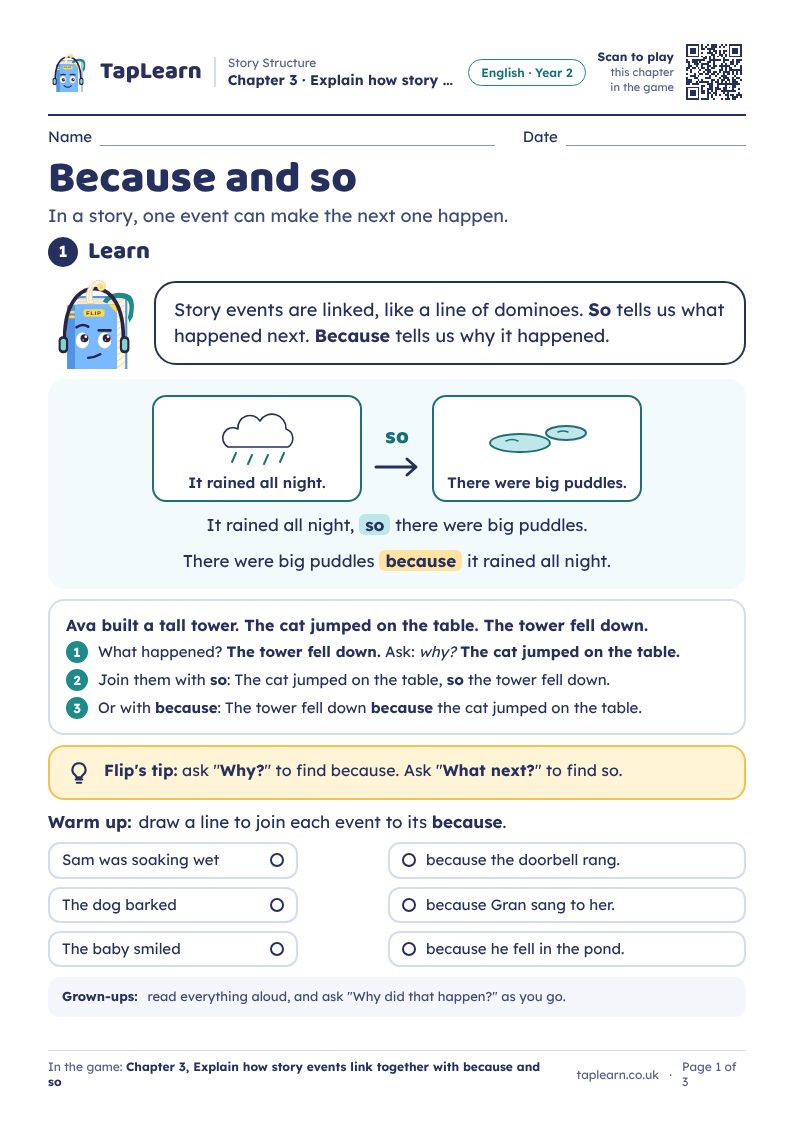
Because and So is a printable cause and effect in stories worksheet for Year 2 (ages 6 to 7) that teaches children that so tells what happened next and because tells why it happened. It covers the Year 2 English reading statement on discussing the sequence of events in books and how items of information are related.
This worksheet is for members
Membership opens every chapter of every game and every worksheet, for all your children.
See the plansAlready a member? Log in to print it.
Start with the free one: Beginning, middle, end (chapter 1).
Print it on A4, in colour or black and white. Do it after the chapter, or before it to see what your child already knows.
What's on the worksheet
Your child explains how one story event leads to the next using because and so. Includes a knock-on stories activity and an answers sheet.
- Page 1 · Learn
- Rain and puddles joined with so and because, a worked example linking a cat and a falling tower, Flip's tip to ask "Why?" and "What next?", and a join-the-because warm-up.
- Page 2 · Try it together
- Knock-on stories: stand books or blocks up like dominoes, knock them down, then build a story chain where each new idea follows on with so, and play again using because.
- Page 3 · Practise
- Match events to what they made happen, ring what happens next, fill gaps with because or so, finish sentences, and a challenge about why the cake burned.
- Answers sheet
- Every answer, mix-ups like picking an event that doesn't link, and so-what-happened and why-why-why ideas.
3 A4 pages and an answers sheet · about 20 minutes
Using it at home
- Read everything aloud and ask "Why did that happen?" as you go.
- In knock-on stories, if an idea doesn't follow on, ask "Did that happen because of the last part?"
- Play so what happened?: you say "It rained, so…" and your child finishes it, then swap and use because.
Watch out for
- Picking an event that doesn't link.
- Ask "Did that happen because of the ice cream?" The bus coming wasn't caused by it.
- Mixing up why and what next.
- Because points back to the reason; so points forward to the result. Say it both ways round to check.
Questions from the worksheet
- Draw a line from each event to what it made happen: The sun was very hot. The wind blew hard. Leo forgot his umbrella.
- Draw a ring round what happens next: Sam dropped his ice cream, so… he felt sad / the bus came / it was Tuesday.
- Write because or so in each gap: It was snowing, ___ we made a snowman.
- Mum forgot about the cake in the oven, so it burned. Leo says, "The cake burned because Mum took it out of the oven." Is he right? Write a better because sentence.
The answers are on the answers sheet, for grown-ups.
National curriculum in England
This worksheet practises this statement from the Year 2 english programme of study:
- Develop pleasure in reading, motivation to read, vocabulary and understanding by: discussing the sequence of events in books and how items of information are related
In the classroom
- Build a class domino chain story, adding one so sentence per child.
- While reading a class story, stop and ask why a character did something, answering with because.
Questions and answers
What is cause and effect in a story?
It's how one event makes the next one happen, like dominoes. The cat jumped on the table, so the tower fell down.
What is the difference between because and so?
Because tells why something happened. So tells what happened next as a result.
How can children find the link between story events?
Ask "Why?" to find the because, and "What next?" to find the so.
 TapLearn