Story openings and endings worksheet for Year 2: Story starts and ends
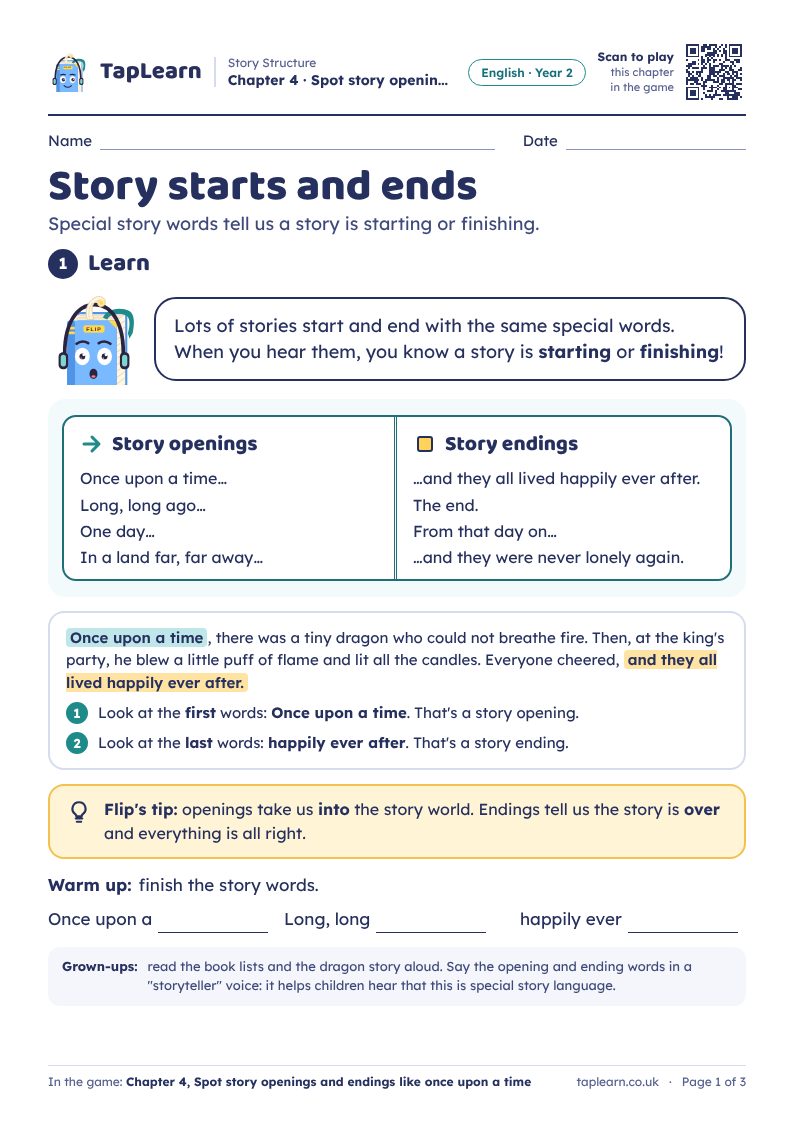
Story Starts and Ends is a printable story openings and endings worksheet for Year 2 (ages 6 to 7) that teaches children to spot the special words that tell us a story is starting or finishing. It covers the Year 2 English reading statement on recognising simple recurring literary language in stories and poetry.
This worksheet is for members
Membership opens every chapter of every game and every worksheet, for all your children.
See the plansAlready a member? Log in to print it.
Start with the free one: Beginning, middle, end (chapter 1).
Print it on A4, in colour or black and white. Do it after the chapter, or before it to see what your child already knows.
What's on the worksheet
Your child spots story openings like once upon a time and endings like happily ever after, then uses them in a story. Includes a story word hunt and an answers sheet.
- Page 1 · Learn
- Lists of story openings and endings, a tiny dragon story with its opening and ending marked, Flip's tip on what openings and endings do, and a finish-the-story-words warm-up.
- Page 2 · Try it together
- Story word hunt: before opening three storybooks, guess how each will start and end, check the first and last lines for story words, then tell a tiny story with an opening and an ending.
- Page 3 · Practise
- Write O or E for openings and endings, ring the sentence that sounds like a story, match openings to endings of the same story, write an opening and ending for a bear story, and a challenge.
- Answers sheet
- Every answer, mix-ups like choosing everyday sentences, and guess-the-start and story-starter ideas.
3 A4 pages and an answers sheet · about 20 minutes
Using it at home
- Say opening and ending words in a storyteller voice: it helps children hear that this is special story language.
- In the story word hunt, notice that not every book uses story words, and ask "Is that how a story usually starts?"
- Take turns saying a story opening while the other person says an ending to match.
Watch out for
- Mixing up openings and endings.
- Ask "Does this make you think the story is just starting, or nearly over?"
- Choosing everyday sentences.
- Instructions like "Turn left at the shop" don't sound like a story. Read them in a storyteller voice and talk about why they sound odd.
Questions from the worksheet
- Is it a story opening or a story ending? Write O or E: Long, long ago… The end. One dark and stormy night…
- Draw a ring round the one that sounds like a story opening: Wash your hands before lunch. Once upon a time, there lived a king. Take two eggs and some flour.
- Here is the middle of a story: …a bear found a shiny key in the woods. It opened a tiny door in a tree! Write an opening and an ending using story words.
- Ava's story ends like this: "Once upon a time, they all went home." What has she mixed up? How could she end it?
The answers are on the answers sheet, for grown-ups.
National curriculum in England
This worksheet practises this statement from the Year 2 english programme of study:
- Develop pleasure in reading, motivation to read, vocabulary and understanding by: recognising simple recurring literary language in stories and poetry
In the classroom
- Collect story openings and endings from class books on a display.
- Play story starter in pairs as a speaking warm-up before writing.
Questions and answers
What are common story openings?
Once upon a time, long, long ago, one day and in a land far, far away are common ways to start a story.
What are common story endings?
Happily ever after, the end, and from that day on are common ways to end a story.
Why do stories use special opening and ending words?
Openings take us into the story world, and endings tell us the story is over and everything is all right.
 TapLearn