Repeated words and refrains worksheet for Year 2: Spot the repeat
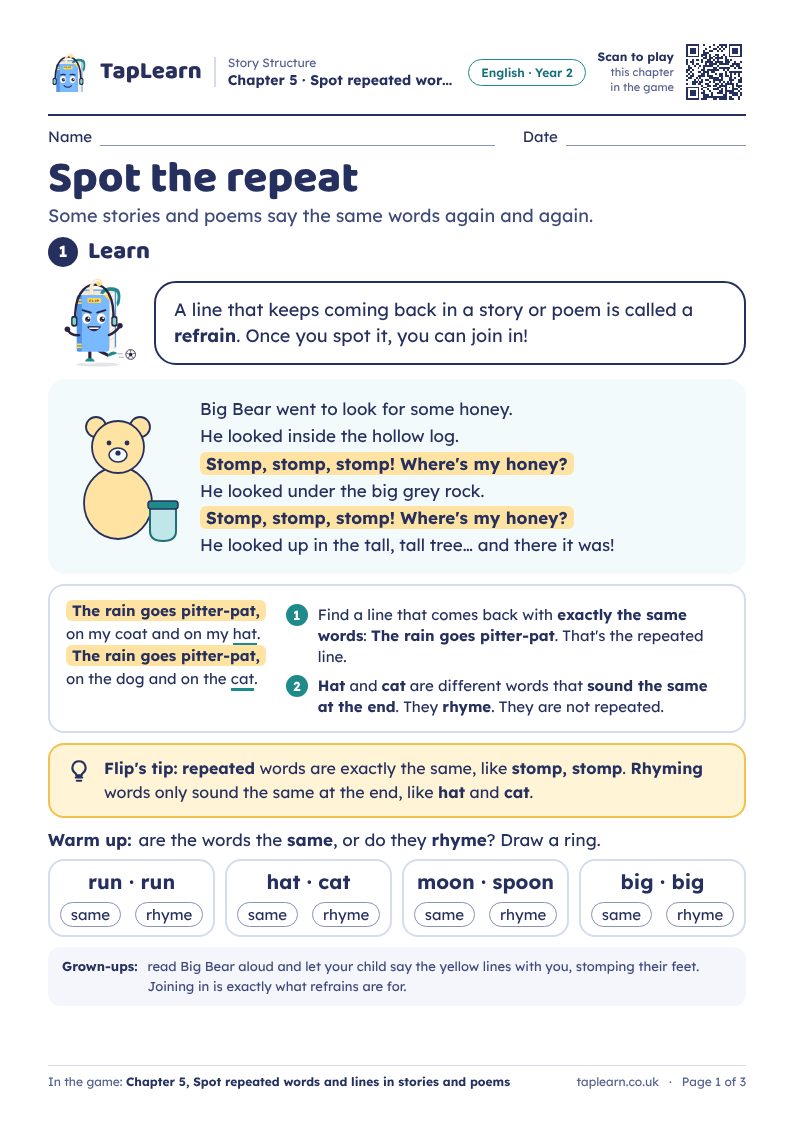
Spot the Repeat is a printable repeated words and refrains worksheet for Year 2 (ages 6 to 7) that teaches children that a refrain is a line that keeps coming back, and that repeated words are not the same as rhyming words. It covers the Year 2 English reading statement on recognising simple recurring literary language in stories and poetry.
This worksheet is for members
Membership opens every chapter of every game and every worksheet, for all your children.
See the plansAlready a member? Log in to print it.
Start with the free one: Beginning, middle, end (chapter 1).
Print it on A4, in colour or black and white. Do it after the chapter, or before it to see what your child already knows.
What's on the worksheet
Your child spots repeated words and lines (refrains) in stories and poems, joins in with them, and tells repeated words from rhyming words. Includes a clap-and-join-in activity and an answers sheet.
- Page 1 · Learn
- Big Bear's honey story with its refrain, a rain poem showing a repeated line and rhyming words, Flip's tip on repeats and rhymes, and a same-or-rhyme warm-up.
- Page 2 · Try it together
- Clap and join in: read or sing a rhyme with a repeating line, clap and join in every time it comes back, count how many times, then make up your own refrain for a story.
- Page 3 · Practise
- Ring the repeated line in a goat poem, decide if word pairs are the same or rhyme, write Little Owl's refrain, make up a refrain for a train story, and a challenge about cat and hat.
- Answers sheet
- Every answer, mix-ups like missing a line that comes back, and pause-and-join-in and rhyme-or-repeat ideas.
3 A4 pages and an answers sheet · about 20 minutes
Using it at home
- Read Big Bear aloud and let your child say the refrain with you, stomping their feet.
- In clap and join in, pause just before the repeated line and let your child say it.
- Say two words, like "frog, frog" or "frog, log", and your child says "repeat!" or "rhyme!"
Watch out for
- Mixing up rhyming and repeated words.
- Point to each word and ask "Is it the same word, or just the same sound at the end?"
- Missing a line that keeps coming back.
- Read aloud and clap when your child hears a line they've heard before. Hearing it is often easier than seeing it.
Questions from the worksheet
- Read the poem. Draw a ring round each line that is repeated. How many times is that line in the poem?
- Are the words the same, or do they rhyme? dog · dog, dog · log, sun · fun, tree · bee.
- Make up a refrain for a story about a little train. Like this: "Choo, choo, here I come!"
- Mia says, "Cat and hat are repeated words." Is she right? What is the difference between a repeated word and a rhyming word?
The answers are on the answers sheet, for grown-ups.
National curriculum in England
This worksheet practises this statement from the Year 2 english programme of study:
- Develop pleasure in reading, motivation to read, vocabulary and understanding by: recognising simple recurring literary language in stories and poetry
In the classroom
- Read a picture book with a refrain and have the class join in each time it comes back.
- Play rhyme or repeat as a quick phonics and reading warm-up.
Questions and answers
What is a refrain in a story or poem?
A refrain is a line that keeps coming back in a story or poem, like "Stomp, stomp, stomp! Where's my honey?"
What is the difference between repeated words and rhyming words?
Repeated words are exactly the same, like stomp, stomp. Rhyming words are different but sound the same at the end, like hat and cat.
Why do stories have refrains?
Refrains let listeners join in, which makes stories and poems easier to remember and share.
 TapLearn