3, 4 and 8 Times Tables: Ozzy's Times Table Island
Learn the 3, 4 and 8 times tables and their division facts by building trike wheels, doubling turtle flippers and solving puzzles with Ozzy.
Online game, chapter 1 free · Year 3 (KS2) · ages 7–8 · national curriculum in England · no adverts · plays on a phone, tablet or computer · no sign-up to start.
An online maths game for Year 3 (KS2). It covers the national curriculum in England, Year 3 maths: “Recall and use multiplication and division facts for the 3, 4 and 8 multiplication tables”.
5 short chapters, about 45 minutes in all. Children can stop after any chapter.
Start playing for free. Plays in the browser on phones, tablets and computers: no app, no adverts.
Free for teachers: every chapter on the whiteboard with a free teacher account.
Last updated · Checked against the national curriculum in England by the TapLearn team
What you'll learn
Recall the 3 times table facts up to 12 × 3
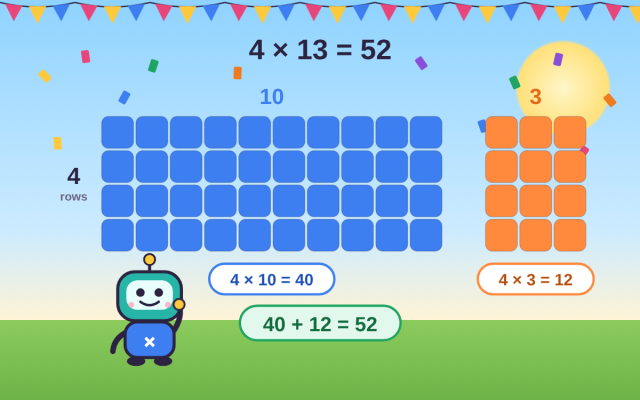
Use double and double again to work out 4 times table facts
Find 8 times table facts by doubling the 4 times table answer
Use multiplication facts to find division facts, such as 28 ÷ 4
Build a fact family of two multiplication and two division facts
Decide whether a word problem needs multiplying or dividing
What the chapters cover in the national curriculum in England:
Year 3 maths: Recall and use multiplication and division facts for the 3, 4 and 8 multiplication tables
How to play
Start on Ozzy's map of Times Table Island and pick a place, or do the warm-up first.
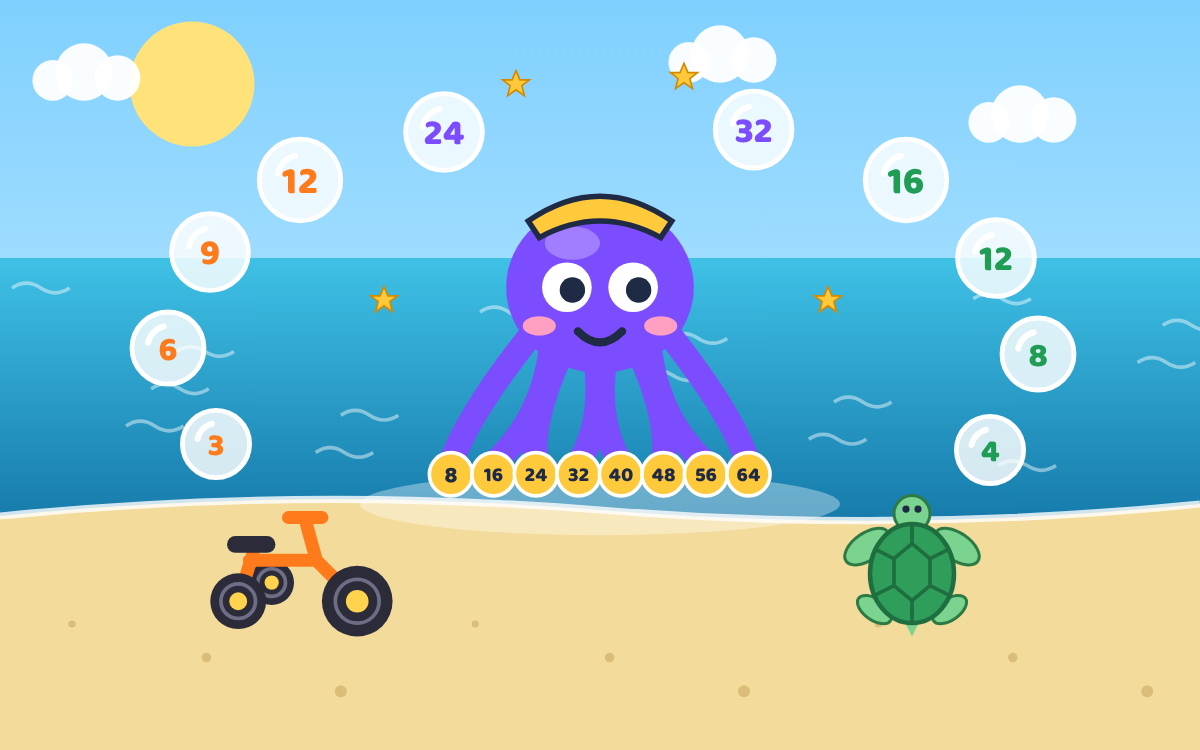
Build each table: add tricycles and watch the wheels go up in 3s, then tap every 3s number on the grid.
Learn the 4 times table as double, then double again, and the 8 times table as double the 4s.
Use each fact to find its division facts, then solve missing-number puzzles and short word problems.
Finish with the Treasure Challenge: mixed 3, 4 and 8 times table questions.
A worked example
What is 7 × 8?
Start with 7 × 2 = 14.
Double it: 14 × 2 = 28, so 7 × 4 = 28.
Double again: 28 × 2 = 56.
So 7 × 8 = 56, and the family facts are 8 × 7 = 56, 56 ÷ 8 = 7 and 56 ÷ 7 = 8.
Common mistakes and how to fix them
Gives the answer next door in the table, such as 7 × 3 = 24.Count on or back one step from a fact they know: 6 × 3 = 18, so 7 × 3 is 3 more, 21.
Adds instead of multiplying, such as 6 × 4 = 10.Say it as groups: 6 groups of 4. Draw or build the groups, then count in 4s.
Stops after one double, so 6 × 4 = 12.For the 4 times table it is double and double again: 6, 12, 24.
Forgets the last double, so 7 × 8 = 28.The 8 times table is double the 4 times table: 28 doubled is 56.
Writes division the wrong way round, such as 4 ÷ 28 = 7.Start a division with the biggest number, the whole: 28 ÷ 4 = 7.
Try it at home
Count in 3s on a walk or up the stairs, then ask a fact out of order, like 7 × 3.
Play 'double, double': say a number up to 12; your child doubles it twice and says the 4 times table fact.
Count spider or octopus legs in 8s, or the 8 rows of 8 squares on a chessboard.
Pick a fact like 4 × 8 = 32 and ask for its whole family: 8 × 4, 32 ÷ 4 and 32 ÷ 8.
In the classroom
Play a chapter on the whiteboard and let pupils answer the quick-fire questions on mini whiteboards before you tap.
Use the 3s grid to talk about the pattern of slanting stripes and the digit-sum rule for multiples of 3.
Ask pupils to write a times-or-divide story for a fact from the game, then swap and solve.
🖨️ Printable worksheets
5 printable 3, 4 and 8 Times Tables worksheets for Year 3, one for each of 5 chapters of this game, to print and do away from the screen, with answers for grown-ups.
3, 4 and 8 Times Tables is an interactive maths game that helps children aged 7–8 learn the 3, 4 and 8 times tables and the division facts that go with them, as set out in the Year 3 national curriculum.
Ozzy the octopus guides players around an island. They count trike wheels in 3s, double the 2 times table to make the 4s, then double the 4s to make the 8s. Along the way they spot patterns, such as the digits of every 3s answer adding up to 3, 6 or 9, and see that 3 × 4 gives the same answer as 4 × 3.
Later, children pack pearls into boxes to see division as the inverse of multiplication, build fact families such as 4 × 8 = 32 and 32 ÷ 8 = 4, and use their facts to solve missing number puzzles and word problems.
Questions and answers
What is the easiest way to learn the 4 times table?
The easiest way is to double a number and then double it again, because 4 is 2 × 2. For example, double 7 is 14 and double 14 is 28, so 7 × 4 = 28.
How can my child learn the 8 times table quickly?
Every 8 times table answer is double the matching 4 times table answer, so children can build the 8s from facts they already know. For example, 6 × 4 = 24, and double 24 is 48, so 6 × 8 = 48.
Is there a trick for the 3 times table?
Yes: add the digits of any 3 times table answer and you always get 3, 6 or 9. For example, 27 gives 2 + 7 = 9. This is a handy way for children to check an answer, alongside counting on in 3s.
What age do children learn the 3, 4 and 8 times tables?
Children in England learn the 3, 4 and 8 times tables in Year 3, when they are 7 to 8 years old. They are expected to know the division facts for these tables too, before moving on to all tables up to 12 × 12 in Year 4.
What does the 3, 4 and 8 times tables game include, and how long does it take?
The game has five chapters, an optional warm-up and a 12-question Treasure Challenge, and takes about 45 minutes to play in full. Each chapter can be played on its own, so children can return to any table they want to practise.
We count visits to make TapLearn better.We use one cookie, only on this site, to see how families find and use it. No adverts, and nothing is shared.One cookie, only on this site. No adverts.How we measure




 TapLearn