4 times table worksheet for Year 3: Double, double
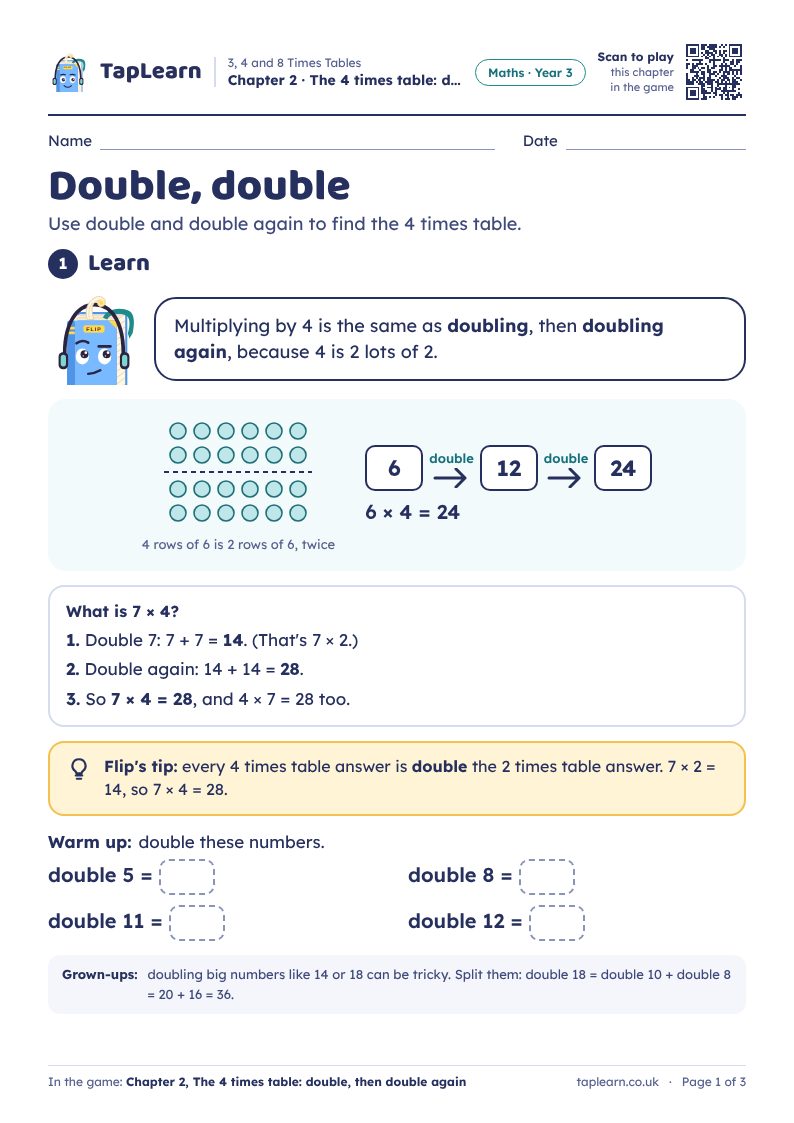
Double, Double is a printable 4 times table worksheet for Year 3 (ages 7 to 8) that teaches children to multiply by 4 by doubling and doubling again, so 7 × 4 is 14 doubled: 28. It covers the Year 3 maths statement on recalling and using multiplication and division facts for the 3, 4 and 8 multiplication tables.
This worksheet is for members
Membership opens every chapter of every game and every worksheet, for all your children.
See the plansAlready a member? Log in to print it.
Start with the free one: Threes (chapter 1).
Print it on A4, in colour or black and white. Do it after the chapter, or before it to see what your child already knows.
What's on the worksheet
Your child learns the 4 times table by doubling and doubling again, and sees that each 4s answer is double the 2s answer. Includes a pasta doubling activity and an answers sheet.
- Page 1 · Learn
- An array showing 4 rows of 6 as 2 rows of 6 twice, a worked example finding 7 × 4, Flip's tip that the 4s are double the 2s, and a doubling warm-up.
- Page 2 · Try it together
- Double, double: make a pile of pasta, double it by making another pile the same size, then double again, count, and write the 4 times table fact.
- Page 3 · Practise
- Double and double again for 4, 9 and 11, fill the gaps, finish the 4 times table, match facts to answers, and a challenge about stopping after one double.
- Answers sheet
- Every answer, mix-ups like adding instead of multiplying, and double-double and chair-legs ideas.
3 A4 pages and an answers sheet · about 25 minutes
In the classroom
- Play double, double as a quick-fire starter with numbers up to 12.
- Use the matching task as a pairs race, checking each match by doubling twice.
Questions from the worksheet
- Double, then double again: 4, 9, 11. Write each 4 times table fact.
- Fill the gaps: ___ × 4 = 36. 4 × ___ = 20. 12 × 4 = ___. ___ × 4 = 28.
- Draw lines to match each fact to its answer: 6 × 4, 8 × 4, 3 × 4, 10 × 4 and 32, 40, 24, 12.
- Mia says 6 × 4 = 12. She doubled 6. Is she right? What did she forget?
The answers are on the answers sheet, for grown-ups.
National curriculum in England
This worksheet practises this statement from the Year 3 maths programme of study:
- Recall and use multiplication and division facts for the 3, 4 and 8 multiplication tables
Source: National curriculum in England: mathematics programmes of study (DfE)
Using it at home
- Doubling big numbers like 14 or 18 can be tricky. Split them: double 18 = double 10 + double 8 = 20 + 16 = 36.
- Once your child is confident, play without the pasta: you say a number, they say double, double again, and the fact.
- Count the legs on chairs at home in 4s.
Watch out for
- Stopping after one double, like 6 × 4 = 12.
- Say "double, double" every time, and check the 4s answer is bigger than the 2s answer.
- Giving the fact next door, like 6 × 4 = 20.
- Double 6 twice to check: 12, then 24.
- Adding instead of multiplying, like 6 × 4 = 10.
- Say "6 lots of 4" and picture 6 groups.
Questions and answers
What is the trick for the 4 times table?
Double, then double again. Multiplying by 4 is the same as doubling twice, because 4 is 2 lots of 2.
How are the 2 and 4 times tables linked?
Every 4 times table answer is double the 2 times table answer. 7 × 2 = 14, so 7 × 4 = 28.
How do you double a bigger number?
Split it into tens and ones and double each part. Double 18 is double 10 plus double 8: 20 + 16 = 36.
 TapLearn