2, 5 and 10 Times Tables: A Beach Adventure with Pip
Learn the 2, 5 and 10 times tables, their division facts and odd and even numbers by calling seagulls, crabs and starfish onto the beach.
- Ages 6–8
- About 40 min
- Easy start
- Calculation
Learn the 2, 5 and 10 times tables, their division facts and odd and even numbers by calling seagulls, crabs and starfish onto the beach.
Year 2 maths · 1
Year 2 maths · 1
Year 2 maths · 1
Year 2 maths · 1
Year 2 maths · 1
What the chapters cover in the national curriculum in England:
2, 5 and 10 Times Tables is an interactive maths game that teaches children aged 6–8 the 2, 5 and 10 times tables, the division facts that go with them, and how to recognise odd and even numbers. It follows the Year 2 national curriculum in England.
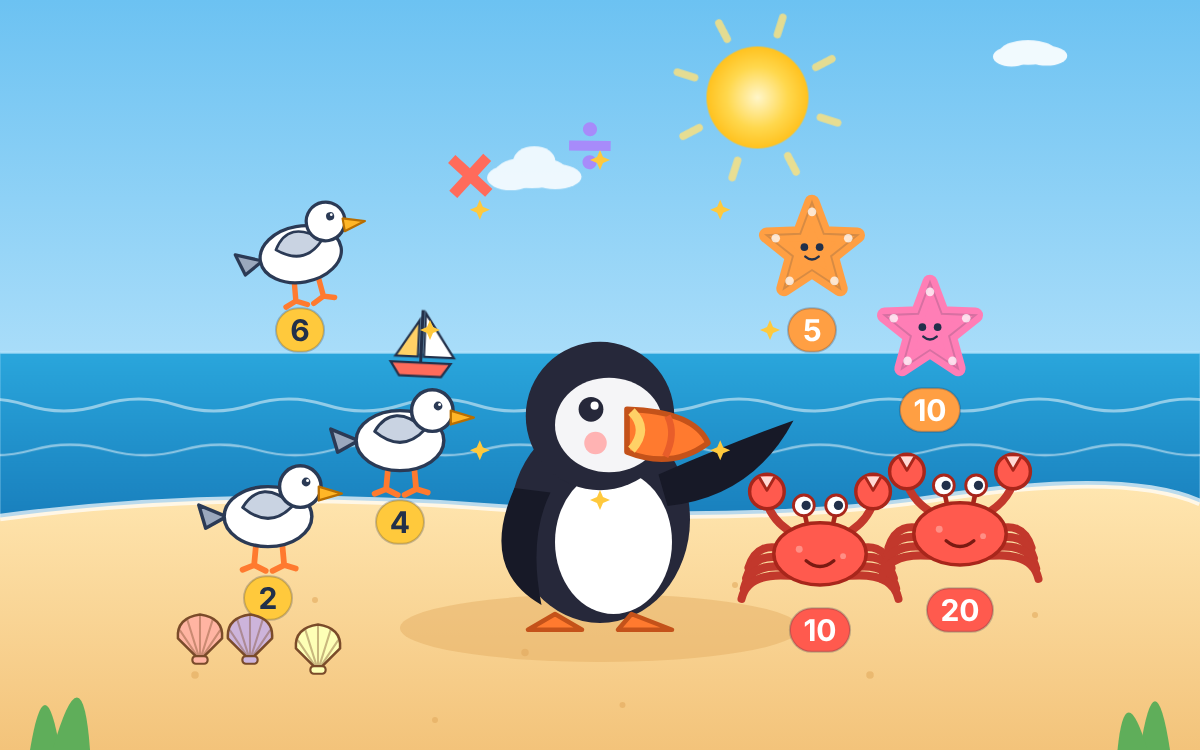
On a sunny beach with Pip the puffin, children build each table themselves: every seagull adds 2 feet, every starfish 5 arms and every crab 10 legs, while the facts fill a board. They spot patterns, such as 5 times table answers ending in 5 or 0, and pair up shells to see that even numbers make pairs and odd numbers leave one over.
Division is shown as sharing equally and as grouping, then as a times table fact turned round. Practice mixes tap-to-choose and typed answers, with counting pictures as hints and a final 10-question challenge.
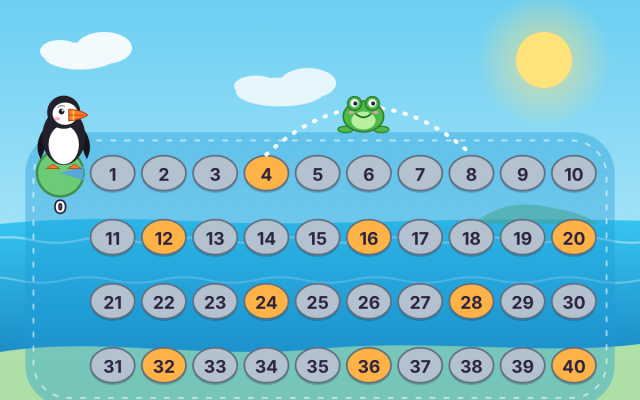
Start by counting in equal steps, then link each step to a fact, such as 3 groups of 2 make 6. Patterns help too: 2 times table answers end in 0, 2, 4, 6 or 8, the 5s end in 5 or 0, and the 10s always end in 0.
Look at the last digit: a number ending in 0, 2, 4, 6 or 8 is even, and one ending in 1, 3, 5, 7 or 9 is odd. Even numbers can be split into pairs with nothing left over, while odd numbers always have one left.
Every division fact is a times table fact turned round. Because 4 × 5 = 20, you know that 20 put into groups of 5 makes 4 groups, so 20 ÷ 5 = 4. In Year 2, children learn division both as sharing equally and as grouping.
It is designed for children aged 6 to 7 in Year 2, matching the national curriculum in England for multiplication and division. Children up to about 8 who are still unsure of the 2, 5 and 10 times tables can use it for extra practice.
The game has an optional counting warm-up, five chapters and a 10-question challenge, and takes about 40 minutes to play in full. Each chapter starts with a short animated intro, and every instruction is read aloud, with hints when an answer is wrong.
 TapLearn
Getting it ready…
Great work on chapter 1! To open the next chapters, ask a grown-up to take a look.
To play this game, ask a grown-up to take a look. There are lots of free games you can play right now too!
Create a free family account and your child can play every chapter of every game for 7 days, with no card needed. Their progress is kept. After that, the free plan is free for ever, and membership is £6.99 a month if you'd like to keep every chapter.
That's all the learning time for today. Great work! Flip will be ready to play again tomorrow.