Division facts worksheet for Year 3: Fact families
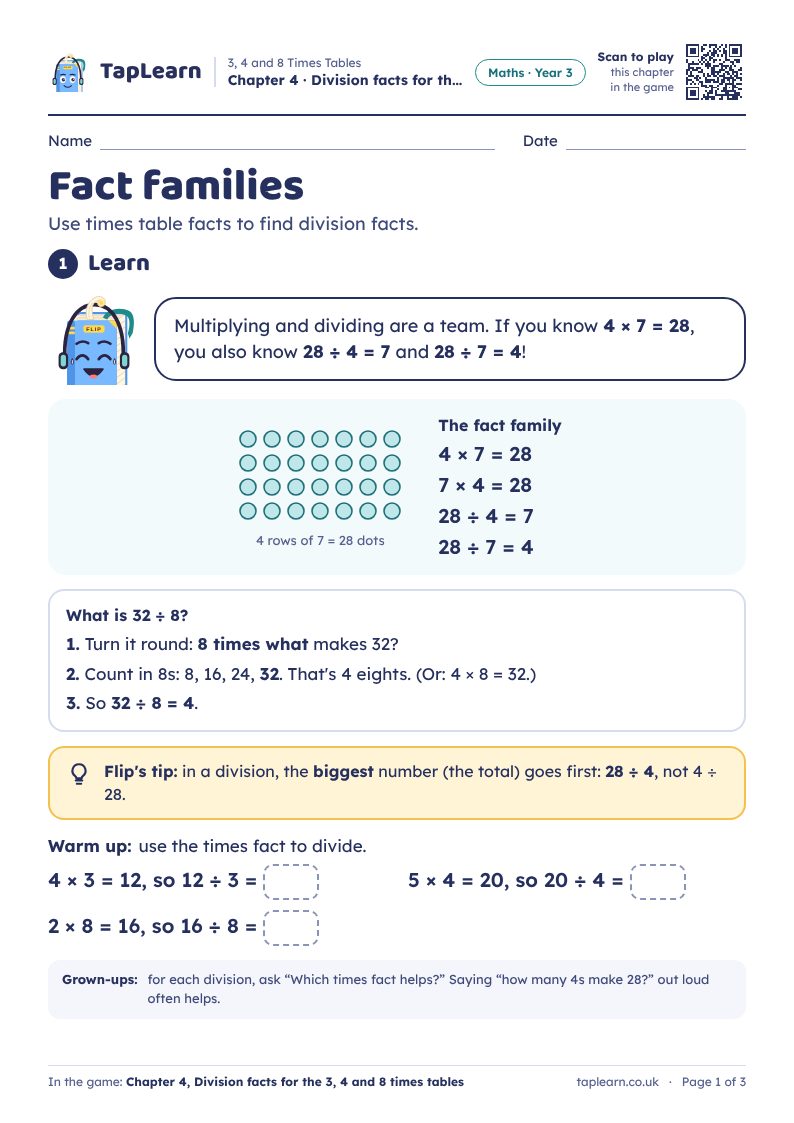
Fact Families is a printable division facts worksheet for Year 3 (ages 7 to 8) that teaches children to turn a division round into a times fact, so 32 ÷ 8 asks how many 8s make 32. It covers the Year 3 maths statement on recalling and using multiplication and division facts for the 3, 4 and 8 multiplication tables.
This worksheet is for members
Membership opens every chapter of every game and every worksheet, for all your children.
See the plansAlready a member? Log in to print it.
Start with the free one: Threes (chapter 1).
Print it on A4, in colour or black and white. Do it after the chapter, or before it to see what your child already knows.
What's on the worksheet
Your child uses the 3, 4 and 8 times tables to work out division facts and writes fact families of two multiplication and two division facts. Includes a share-it-out activity and an answers sheet.
- Page 1 · Learn
- A fact family for 4 × 7 = 28 with a dot array, a worked example finding 32 ÷ 8, Flip's tip to write the total first, and a use-the-times-fact warm-up.
- Page 2 · Try it together
- Share it out: share 24 pasta pieces equally onto 3 plates, then 4 and 8 plates, write each division fact, and say a whole fact family for one row.
- Page 3 · Practise
- Write fact families for triangles, divide using times facts, ring the right answer, cross out a division written the wrong way round, and a challenge about 24 ÷ 4.
- Answers sheet
- Every answer, mix-ups like being one group out, and family-names and fair-shares ideas.
3 A4 pages and an answers sheet · about 25 minutes
In the classroom
- Play family names as a starter: show a times fact and pupils write the other three facts on mini whiteboards.
- Run share it out in small groups with counters and paper plates.
Questions from the worksheet
- Divide. Think of the times fact: 15 ÷ 3, 27 ÷ 3, 32 ÷ 4, 44 ÷ 4, 48 ÷ 8, 72 ÷ 8.
- Ring the right answer: 28 ÷ 4 = 6, 7 or 8? 56 ÷ 8 = 6, 7 or 8? 33 ÷ 3 = 10, 11 or 12?
- One of these is written the wrong way round. Cross it out: 4 ÷ 28 = 7, 28 ÷ 4 = 7.
- Ava says 24 ÷ 4 = 8, because 3 × 8 = 24. Is she right? Which fact should she use?
The answers are on the answers sheet, for grown-ups.
National curriculum in England
This worksheet practises this statement from the Year 3 maths programme of study:
- Recall and use multiplication and division facts for the 3, 4 and 8 multiplication tables
Source: National curriculum in England: mathematics programmes of study (DfE)
Using it at home
- For each division, ask "Which times fact helps?" Saying "how many 4s make 28?" out loud often helps.
- In share it out, ask your child to check each share with a times fact: 3 plates of 8 is 3 × 8 = 24.
- Say a times fact and ask your child for the other three in its family.
Watch out for
- Being one group out, like 28 ÷ 4 = 6.
- Check by multiplying back: 6 × 4 = 24, not 28.
- Writing the numbers the wrong way round, like 4 ÷ 28.
- The total is always first in a division here.
- Using the wrong table, like 24 ÷ 4 = 8.
- Ask "How many 4s make 24?" and count in 4s.
Questions and answers
What is a fact family?
A fact family is two multiplication facts and two division facts made from the same three numbers, like 4 × 7 = 28, 7 × 4 = 28, 28 ÷ 4 = 7 and 28 ÷ 7 = 4.
How do times tables help with division?
Turn the division round into a times question. For 32 ÷ 8, ask "8 times what makes 32?" 4 × 8 = 32, so 32 ÷ 8 = 4.
Which number goes first in a division?
The total, the biggest number, goes first: 28 ÷ 4, not 4 ÷ 28.
 TapLearn