Times tables word problems worksheet for Year 3: Times or divide?
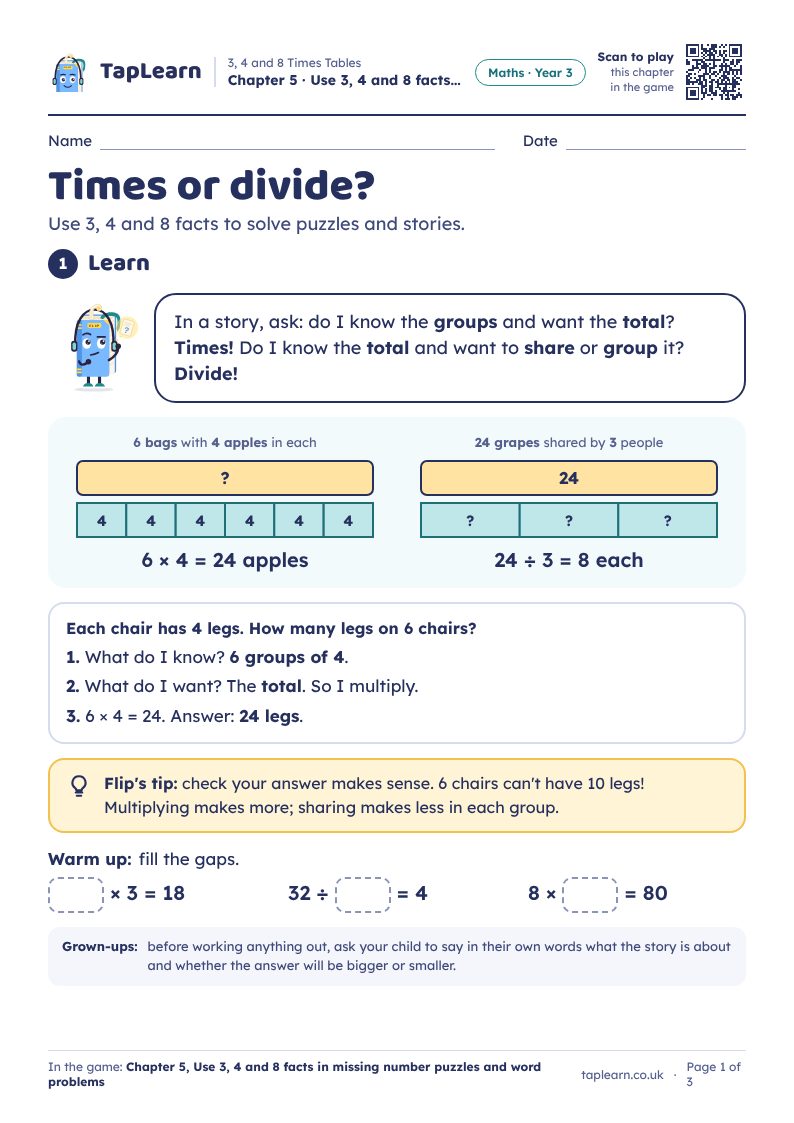
Times or Divide? is a printable times tables word problems worksheet for Year 3 (ages 7 to 8) that teaches children to ask whether they know the groups and want the total (times) or know the total and want to share it (divide). It covers the Year 3 maths statement on recalling and using multiplication and division facts for the 3, 4 and 8 multiplication tables.
This worksheet is for members
Membership opens every chapter of every game and every worksheet, for all your children.
See the plansAlready a member? Log in to print it.
Start with the free one: Threes (chapter 1).
Print it on A4, in colour or black and white. Do it after the chapter, or before it to see what your child already knows.
What's on the worksheet
Your child solves missing number puzzles and word problems with 3, 4 and 8 times table facts, deciding whether each story needs multiplying or dividing. Includes a kitchen stories activity and an answers sheet.
- Page 1 · Learn
- Bags of apples and shared grapes showing times and divide, a worked example about chair legs, Flip's tip to check the answer makes sense, and a fill-the-gaps warm-up.
- Page 2 · Try it together
- Kitchen stories: the grown-up makes up a story with real cups, spoons or fruit, the child says times or divide, writes the number sentence and checks by counting. Then swap.
- Page 3 · Practise
- Missing number puzzles, a two-step crayons problem, four times-or-divide stories, write your own story for 6 × 4 = 24, and a challenge about teams of 4.
- Answers sheet
- Every answer, mix-ups like adding the numbers in the story, and story-swap and bigger-or-smaller ideas.
3 A4 pages and an answers sheet · about 25 minutes
Using it at home
- Before working anything out, ask your child to say what the story is about and whether the answer will be bigger or smaller.
- In kitchen stories, try one sharing story (12 grapes shared by 3) and one grouping story (12 socks in fours). Both are division.
- Take turns making up times or divide stories at mealtimes.
Watch out for
- Choosing the wrong operation.
- Ask "Do we know the total already?" If yes, it's usually divide.
- Adding the numbers in the story, like 4 + 8 = 12 legs.
- Picture the groups: 4 spiders each with 8 legs.
- Being one step out in the table, like 28 ÷ 4 = 6.
- Multiply back to check: 6 × 4 = 24, not 28.
Questions from the worksheet
- Missing number puzzles: 7 × ___ = 21. ___ × 8 = 48. 36 ÷ ___ = 9. ___ ÷ 4 = 5.
- Mia has 5 boxes of 8 crayons. She gives 10 crayons to Leo. How many crayons does Mia have left?
- Times or divide? 27 stickers are shared equally between 3 friends. How many stickers does each friend get?
- Pencils come in packs of 4. Sam needs 28 pencils. How many packs does he need?
- Leo reads: "32 children get into teams of 4. How many teams?" He writes 32 × 4. Is he right? What should he write?
The answers are on the answers sheet, for grown-ups.
National curriculum in England
This worksheet practises this statement from the Year 3 maths programme of study:
- Recall and use multiplication and division facts for the 3, 4 and 8 multiplication tables
Source: National curriculum in England: mathematics programmes of study (DfE)
In the classroom
- Read each Practise C story aloud and have pupils show × or ÷ cards before solving.
- Ask pairs to write their own stories for 6 × 4 = 24 and swap them.
Questions and answers
How do you know whether to multiply or divide in a word problem?
If you know the groups and want the total, multiply. If you know the total and want to share or group it, divide.
How can children check a word problem answer?
Ask whether it makes sense: 6 chairs can't have 10 legs. Multiply back to check a division.
What is a missing number puzzle?
A number sentence with a gap, like 7 × ___ = 21. Children use times table facts to find the missing number.
 TapLearn