Multiplication Word Problems: Build a Summer Festival
Learn to solve multiplication word problems by splitting numbers into tens and ones, scaling and counting combinations as you build a summer festival.
Online game, chapter 1 free · Year 4 (KS2) · ages 8–10 · national curriculum in England · no adverts · plays on a phone, tablet or computer · no sign-up to start.
An online maths game for Year 4 (KS2). It covers the national curriculum in England, Year 4 maths: “Solve problems involving multiplying and adding, including using the distributive law to multiply two-digit numbers by 1 digit, integer scaling problems and harder correspondence problems such as n objects are connected to m objects”.
5 short chapters, about 45 minutes in all. Children can stop after any chapter.
Start playing for free. Plays in the browser on phones, tablets and computers: no app, no adverts.
Free for teachers: every chapter on the whiteboard with a free teacher account.
Last updated · Checked against the national curriculum in England by the TapLearn team
What you'll learn
Multiply a 2-digit number by splitting it into tens and ones
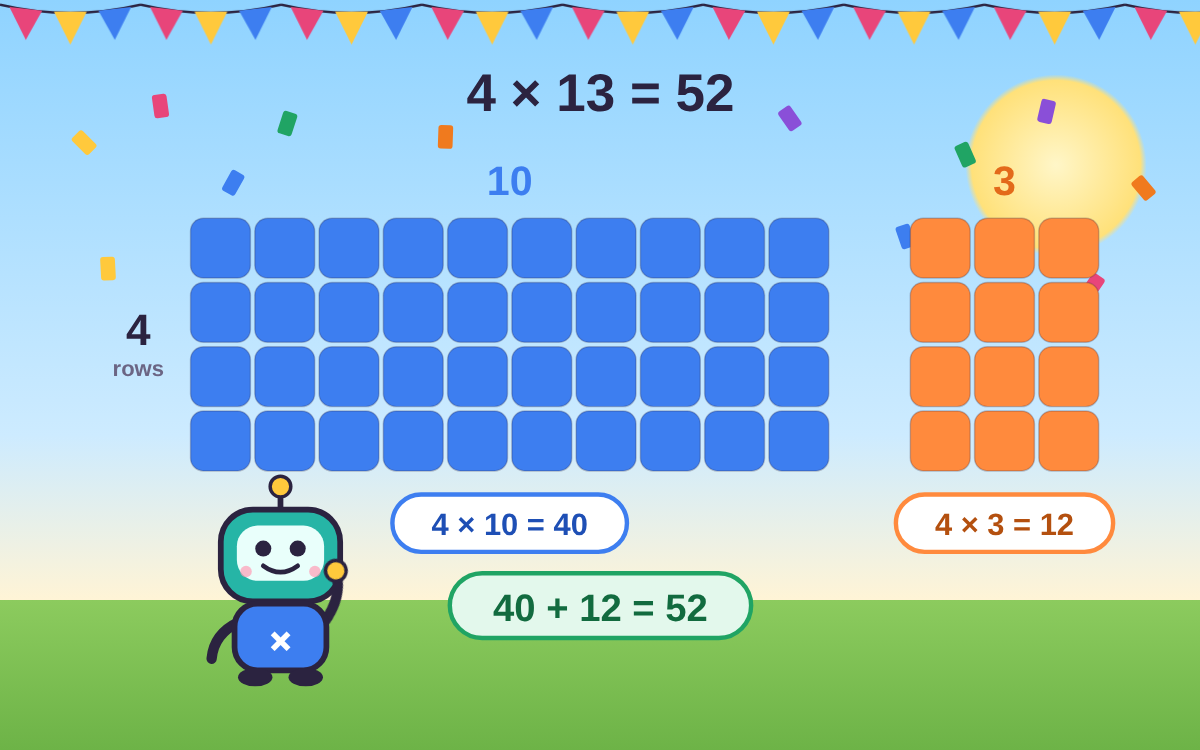
Use the distributive law to split a multiplication into easier parts
Join same-size groups first to make multiplying quicker
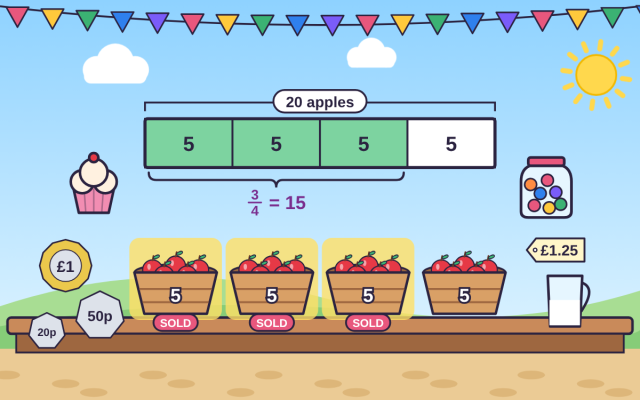
Solve 'times as tall' scaling problems with bar models
Count combinations from two or three sets by multiplying
Choose whether a word problem needs splitting, scaling or matching
Chapter by chapter
Multiply 2-digit by 1-digit numbers by splitting into tens and onesStart playing for free
Year 4 maths · 1
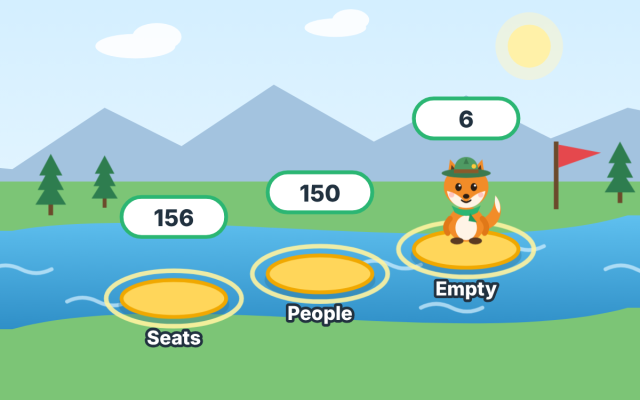
Solve multiply-and-add word problems by joining or splitting equal groups
Year 4 maths · 1
Solve 'times as tall' and 'times as many' scaling problems
Year 4 maths · 1
Count all the ways to combine two or three sets
Year 4 maths · 1
Choose split, scale or match to solve multiplication word problems
Year 4 maths · 1
Grand Opening Challenge: 10 mixed multiplication word problems (10 questions)
What the chapters cover in the national curriculum in England:
Year 4 maths: Solve problems involving multiplying and adding, including using the distributive law to multiply two-digit numbers by 1 digit, integer scaling problems and harder correspondence problems such as n objects are connected to m objects
About this adventure
Festival Builders is an interactive maths game that teaches children aged 8–10 how to solve Year 4 multiplication word problems, including 2-digit × 1-digit calculations, scaling problems and combination problems.
Guided by Tally the robot, players tile a stage, fill cake boxes, grow giant puppets and plan a food court. They cut a grid with scissors to see that 39 × 7 is the same as 30 × 7 plus 9 × 7 (the distributive law), copy and cut bar models to solve 'times as tall' questions, and draw lines to find every meal that can be made from a menu.
Spoken hints respond to common mistakes, such as adding instead of multiplying or forgetting to multiply the ones. A final job-sorting round asks children to choose the right method before solving.
Questions and answers
What is the distributive law in multiplication, in simple words?
The distributive law means you can split a number into parts, multiply each part, then add the answers. For example, 39 × 7 is the same as 30 × 7 plus 9 × 7, which is 210 + 63 = 273.
How do you solve a 'times as tall' problem?
Multiply to find the bigger amount and divide to find the smaller one. If a puppet is 14 cm tall and a giant puppet is 4 times as tall, the giant is 14 × 4 = 56 cm, not 14 + 4.
How do you work out how many combinations there are?
Multiply the number of choices in each group. With 3 wraps and 4 drinks there are 3 × 4 = 12 meals, and adding 2 kinds of pudding makes 12 × 2 = 24, because every choice goes with every other choice.
What age is this multiplication word problems game for?
It is written for children aged 8 to 10 and follows the Year 4 national curriculum in England. Older children can use it to revise, and a skippable warm-up recaps tens, ones and times tables first.
What does the game include and how long does it take?
There are five chapters, an optional warm-up and a 10-question final challenge, taking about 45 minutes in total. Every chapter can be played on its own, and all instructions are read aloud.
We count visits to make TapLearn better.We use one cookie, only on this site, to see how families find and use it. No adverts, and nothing is shared.One cookie, only on this site. No adverts.How we measure


 TapLearn