Year 3 Adding and Subtracting: Column Method Starport
Learn Year 3 adding and subtracting in columns with up to three digits, including exchanging, then estimate, check with the inverse and find missing numbers.
Online game, chapter 1 free · Year 3 (KS2) · ages 7–9 · national curriculum in England · no adverts · plays on a phone, tablet or computer · no sign-up to start.
An online maths game for Year 3 (KS2). It covers the national curriculum in England, Year 3 maths: “Add and subtract numbers with up to 3 digits, using formal written methods of columnar addition and subtraction”, and 2 more statements listed under the chapters.
6 short chapters, about 45 minutes in all. Children can stop after any chapter.
Start playing for free. Plays in the browser on phones, tablets and computers: no app, no adverts.
Free for teachers: every chapter on the whiteboard with a free teacher account.
Last updated · Checked against the national curriculum in England by the TapLearn team
What you'll learn
Line up hundreds, tens and ones correctly for column calculations
Exchange 10 ones for a ten and 10 tens for a hundred
Subtract in columns, exchanging when the top digit is too small
Exchange across a zero, as in 302 − 157
Estimate answers using the nearest ten or hundred
Check answers with the inverse and find missing numbers
Chapter by chapter
Column addition: lining up hundreds, tens and ones and adding each columnStart playing for free
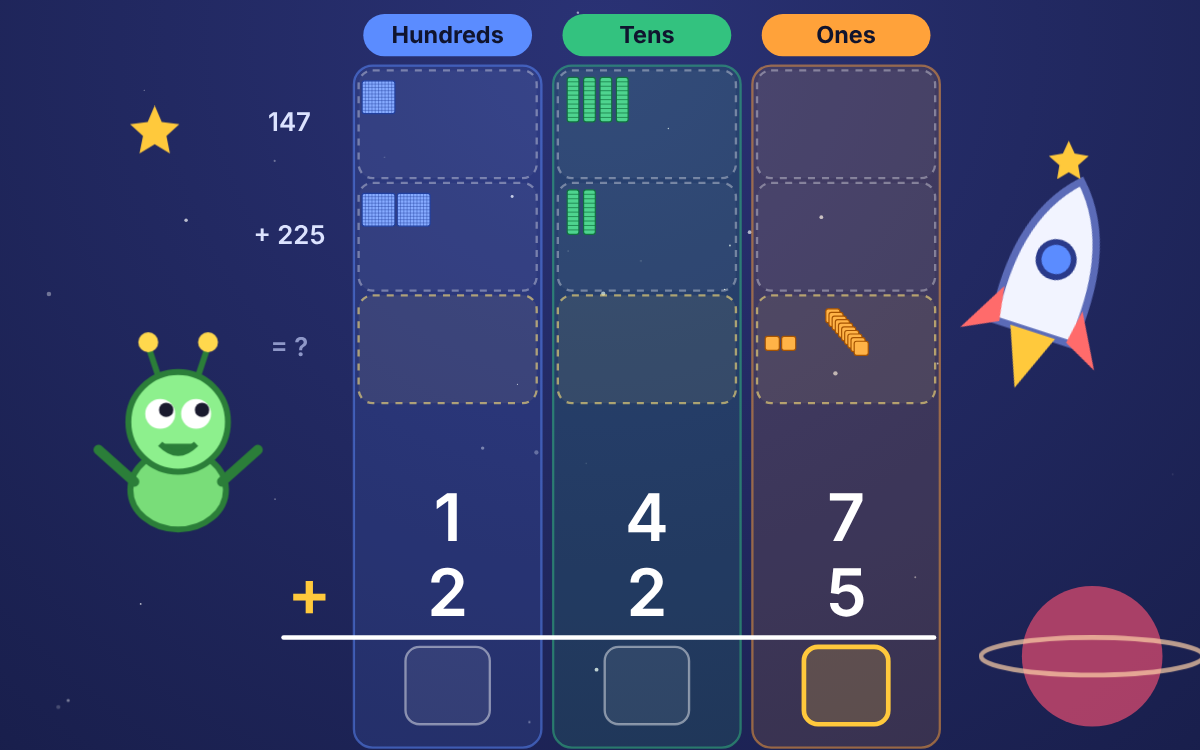
Learn to set out numbers with up to three digits in the right columns and add the ones, tens and hundreds in turn, by loading place value blocks into trays.
Year 3 maths · 1
Column addition with exchanging: 10 ones make a ten, 10 tens make a hundred
Learn what to do when a column adds up to 10 or more: exchange it into the next column and add the exchanged digit there too (sometimes called carrying).
Year 3 maths · 1
Column subtraction: taking the bottom number from the top number, column by column
Learn that the starting number goes on top and to take the bottom digit from the top digit in each column, practising subtractions with up to three digits that need no exchange.
Year 3 maths · 1
Column subtraction with exchanging, including exchanging across a zero
Learn to exchange a ten for 10 ones or a hundred for 10 tens when the top digit is too small, crossing out and writing the new digits, even when the tens digit is zero.
Year 3 maths · 1
Estimating answers and checking them with the inverse
Learn to estimate a calculation by using the nearest hundred, spot answers that cannot be right, and check additions by subtracting and subtractions by adding with the Undo Machine.
Year 3 maths · 2
Solving missing number problems with bar models and the inverse
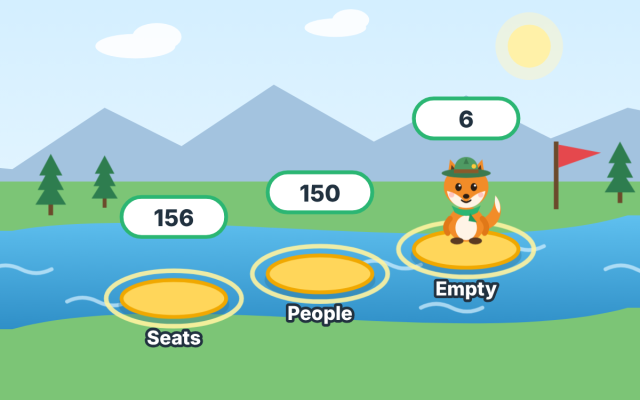
Learn to find a missing part or whole in an addition or subtraction using a bar model and the inverse, and work out missing digits by reasoning about place value and exchanges.
Year 3 maths · 3
Launch challenge: 10 mixed adding and subtracting questions (10 questions)
What the chapters cover in the national curriculum in England:
Year 3 maths: Add and subtract numbers with up to 3 digits, using formal written methods of columnar addition and subtraction
Year 3 maths: Estimate the answer to a calculation and use inverse operations to check answers
Year 3 maths: Solve problems, including missing number problems, using number facts, place value, and more complex addition and subtraction
About this adventure
Starport Columns is an interactive maths game that teaches Year 3 adding and subtracting to children aged 7 to 9: column addition and subtraction with up to three digits, as set out in the national curriculum in England. Players line up hundreds, tens and ones, then add or subtract one column at a time, starting with the ones.
At a busy space starport, children move place value blocks between trays, watch 10 ones snap into a ten, and unpack a hundred into 10 tens when the top digit is too small, including tricky exchanges across a zero. They spot the classic mistakes made by Glitch the alien, such as taking the smaller digit from the larger one.
Later missions teach estimating with the nearest ten or hundred, checking answers with the inverse operation and solving missing number problems with a bar model. A final launch challenge mixes everything together.
Questions and answers
How do you do column addition, step by step?
Write the numbers under each other with ones under ones, tens under tens and hundreds under hundreds. Add the ones first, then the tens, then the hundreds. If a column makes 10 or more, write the last digit and exchange the ten into the next column.
What does exchanging mean in column subtraction?
Exchanging means swapping 1 ten for 10 ones, or 1 hundred for 10 tens, when the top digit is too small to take away from. You cross out the digit you exchange from, write one less, and put a small 1 in front of the next digit.
How do you subtract across a zero, like 302 − 157?
When there are no tens to exchange, first exchange 1 hundred for 10 tens. Then exchange 1 of those tens for 10 ones. For 302 − 157 this gives 12 − 7 = 5, 9 − 5 = 4 and 2 − 1 = 1, so the answer is 145.
What age is column addition and subtraction taught in England?
Children in England learn formal column addition and subtraction in Year 3, at ages 7 to 8, with numbers up to three digits. This game fits Year 3 and also works as revision for children in Year 4.
What is in the Starport Columns game and how long does it take?
The game has six chapters, a short place value warm-up and a 10-question final challenge, taking about 45 minutes in total. Chapters can be played separately, and every chapter has guided examples followed by practice with hints.
We count visits to make TapLearn better.We use one cookie, only on this site, to see how families find and use it. No adverts, and nothing is shared.One cookie, only on this site. No adverts.How we measure



 TapLearn