3 times table worksheet for Year 3: Threes
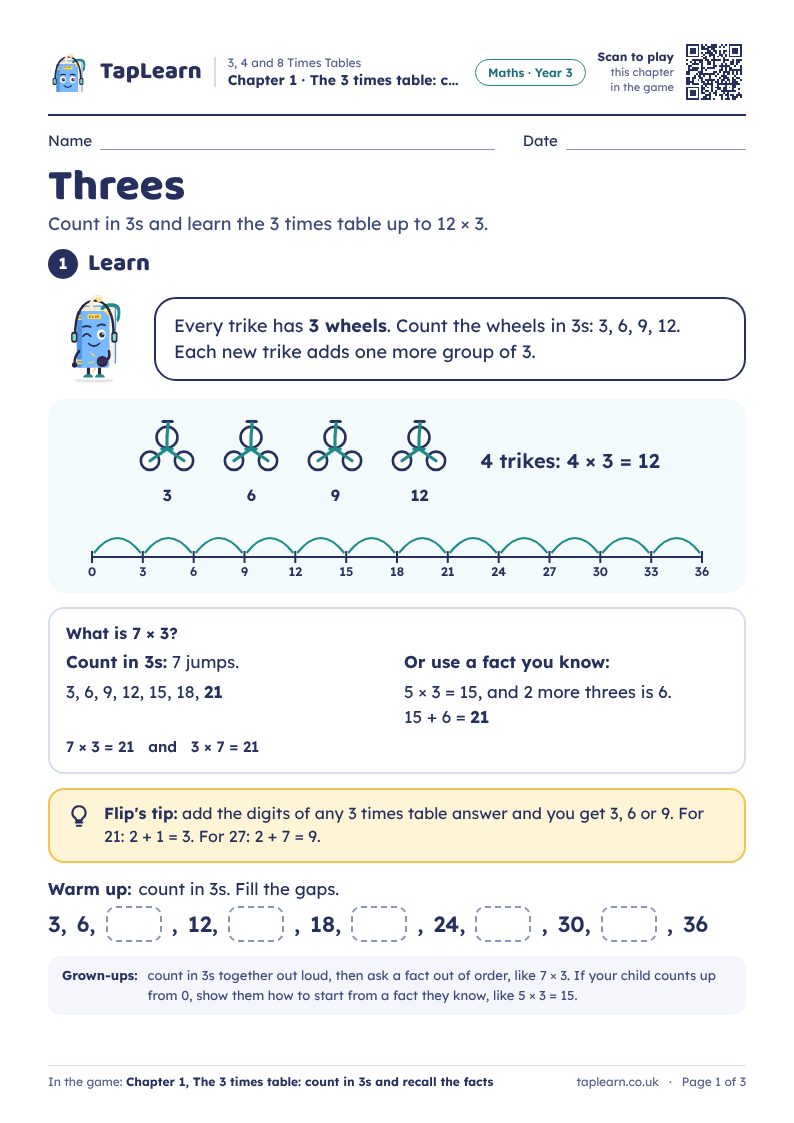
Threes is a printable 3 times table worksheet for Year 3 (ages 7 to 8) that teaches children to count in 3s to 36 and work out facts like 7 × 3 from one they know, such as 5 × 3 = 15. It covers the Year 3 maths statement on recalling and using multiplication and division facts for the 3, 4 and 8 multiplication tables.
Free to print, no account needed.
Print it on A4, in colour or black and white. Do it after the chapter, or before it to see what your child already knows.
What's on the worksheet
Your child counts in 3s and recalls the 3 times table facts up to 12 × 3, using facts they know to find new ones. Includes a pasta trikes activity and an answers sheet.
- Page 1 · Learn
- Trikes counted in 3s on a number line to 36, a worked example finding 7 × 3 two ways, Flip's digit-sum tip, and a count-in-3s warm-up.
- Page 2 · Try it together
- Pasta trikes: make groups of 3 pasta pieces as trike wheels, count the wheels in 3s for each row of the table, write the fact, then answer facts out of order.
- Page 3 · Practise
- Finish the 3 times table, ring numbers in the 3 times table, write facts for arrays, fill the gaps, use 10 × 3 to find 9 × 3 and 11 × 3, and a challenge.
- Answers sheet
- Every answer, mix-ups like the fact next door, and stair-threes and quick-fire ideas.
3 A4 pages and an answers sheet · about 25 minutes
In the classroom
- Count in 3s round the class as a starter, then fire facts out of order.
- Use Practise B as a quick mini-whiteboard check: is it in the 3 times table?
Questions from the worksheet
- Ring the numbers that are in the 3 times table: 12, 14, 21, 25, 27, 30, 32, 33, 16, 9.
- Fill the gaps: ___ × 3 = 27. 3 × ___ = 24. 12 × 3 = ___.
- Use a fact you know. 10 × 3 = 30, so 9 × 3 = ___ and 11 × 3 = ___.
- Leo says 7 × 3 = 24. Is he right? How do you know?
The answers are on the answers sheet, for grown-ups.
National curriculum in England
This worksheet practises this statement from the Year 3 maths programme of study:
- Recall and use multiplication and division facts for the 3, 4 and 8 multiplication tables
Source: National curriculum in England: mathematics programmes of study (DfE)
Using it at home
- Count in 3s together out loud, then ask a fact out of order. If your child counts up from 0, show them how to start from a fact they know, like 5 × 3 = 15.
- For 11 trikes, see if your child can use 10 × 3 = 30 and add one more 3, instead of counting all the way.
- Count in 3s on each step going up the stairs.
Watch out for
- Giving the fact next door, like 7 × 3 = 24.
- Count on or back from a fact you're sure of, like 5 × 3 or 10 × 3.
- Adding instead of multiplying, like 7 × 3 = 10.
- Say it as "7 lots of 3" or "7 groups of 3".
- Using a fact from another table, like 7 × 3 = 28.
- Ask "Is 28 in the 3s? Count in 3s and see."
Questions and answers
How can children learn the 3 times table?
Count in 3s to 36, then use facts they know to find new ones. 5 × 3 = 15, so 7 × 3 is 15 plus two more threes: 21.
Is there a trick for the 3 times table?
Add the digits of any 3 times table answer and you get 3, 6 or 9. For 27, 2 + 7 = 9.
When do children learn the 3 times table?
Children in England learn the 3, 4 and 8 times tables in Year 3.
 TapLearn