Learn Year 2 adding and subtracting: make ten, add tens, add 2-digit numbers and check with the inverse, on a railway trip with Ruby.
Online game, chapter 1 free · Year 2 (KS1) · ages 6–8 · national curriculum in England · no adverts · plays on a phone, tablet or computer · no sign-up to start.
An online maths game for Year 2 (KS1). It covers the national curriculum in England, Year 2 maths: “Recall and use addition and subtraction facts to 20 fluently, and derive and use related facts up to 100”, and 4 more statements listed under the chapters.
6 short chapters, about 45 minutes in all. Children can stop after any chapter.
Start playing for free. Plays in the browser on phones, tablets and computers: no app, no adverts.
Free for teachers: every chapter on the whiteboard with a free teacher account.
Last updated · Checked against the national curriculum in England by the TapLearn team
What you'll learn
Add and subtract within 20 by making ten first
Use 3 + 4 = 7 to work out 30 + 40 = 70
Add and subtract ones or tens to a 2-digit number
Add two 2-digit numbers, swapping 10 ones for a ten
Why adding works in any order but subtracting does not
Use the inverse to check answers and find missing numbers
Chapter by chapter
Number facts to 20: making 10 to add and subtractStart playing for free
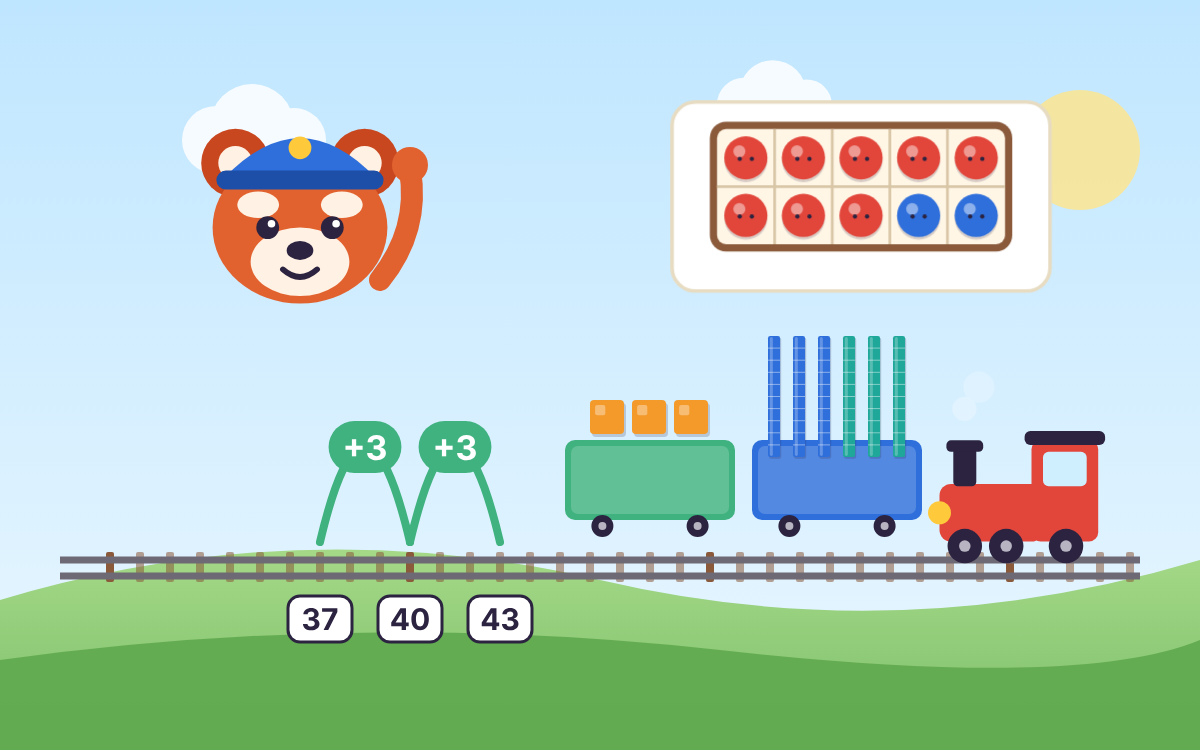
Learn addition and subtraction facts to 20 by filling ten frames to 10 first, then adding or taking away the rest, as in 8 + 5 and 13 − 5 (number bonds and bridging ten).
Year 2 maths · 1Year 2 maths · 2
Related facts to 100: using 3 + 4 = 7 to add and subtract tens
Use known facts to derive related facts up to 100, turning ones into tens through a tunnel so 3 + 4 = 7 becomes 30 + 40 = 70, and fill a train to find pairs of tens that make 100.
Year 2 maths · 1
Adding and subtracting ones or tens to a 2-digit number
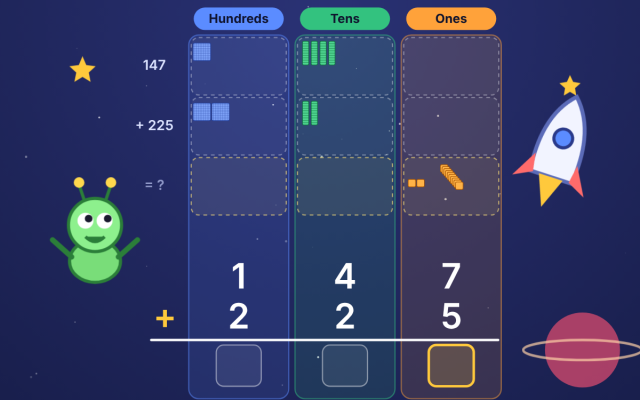
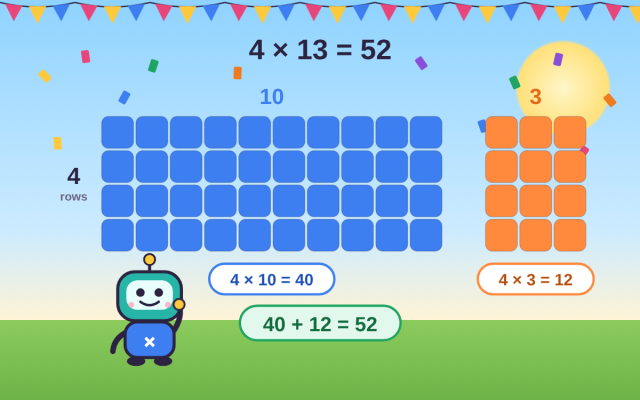
Add and subtract a 2-digit number and ones, or a 2-digit number and tens, with base ten blocks and a number line, swapping 10 ones for a ten or breaking a ten when crossing a ten.
Year 2 maths · 3Year 2 maths · 2
Adding and subtracting two 2-digit numbers, including lengths in cm
Add and subtract two 2-digit numbers by joining tens and ones, hopping along a number line and spotting a common mistake, then solve length problems in centimetres (partitioning).
Year 2 maths · 3Year 2 maths · 2
Adding three 1-digit numbers, and why adding works in any order but taking away doesn't
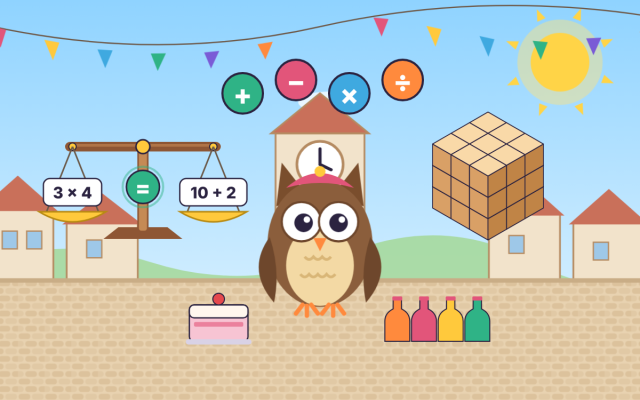
Swap carriages to show that addition is commutative but subtraction is not, then add three 1-digit numbers by spotting a pair that makes 10 or a double.
Year 2 maths · 3Year 2 maths · 4
Using the inverse to check answers and find missing numbers
Use the inverse relationship between addition and subtraction to undo a calculation, build four facts from one bar model, check answers and solve missing number problems, including masses in kilograms (fact families and the bar model).
Year 2 maths · 5Year 2 maths · 2
Grand Terminus Challenge: 10 mixed adding and subtracting questions (10 questions)
What the chapters cover in the national curriculum in England:
Year 2 maths: Recall and use addition and subtraction facts to 20 fluently, and derive and use related facts up to 100
Year 2 maths: Solve problems with addition and subtraction: using concrete objects and pictorial representations, including those involving numbers, quantities and measures; applying their increasing knowledge of mental and written methods
Year 2 maths: Add and subtract numbers using concrete objects, pictorial representations, and mentally, including: a two-digit number and 1s; a two-digit number and 10s; 2 two-digit numbers; adding 3 one-digit numbers
Year 2 maths: Show that addition of 2 numbers can be done in any order (commutative) and subtraction of 1 number from another cannot
Year 2 maths: Recognise and use the inverse relationship between addition and subtraction and use this to check calculations and solve missing number problems
About this adventure
Year 2 Adding and Subtracting is an interactive maths game that teaches children aged 6 to 8 how to add and subtract within 100, following the national curriculum for England.
Ruby the red panda drives a train round six stations. Children fill ten-seat carriages to cross ten, send ones through a tunnel to turn them into tens, load base ten blocks onto wagons and swap 10 ones for a ten, and hop a train along a number line track. They add two 2-digit numbers by partitioning into tens and ones, spot pairs that make 10 when adding three numbers, and see why 9 − 2 is not the same as 2 − 9.
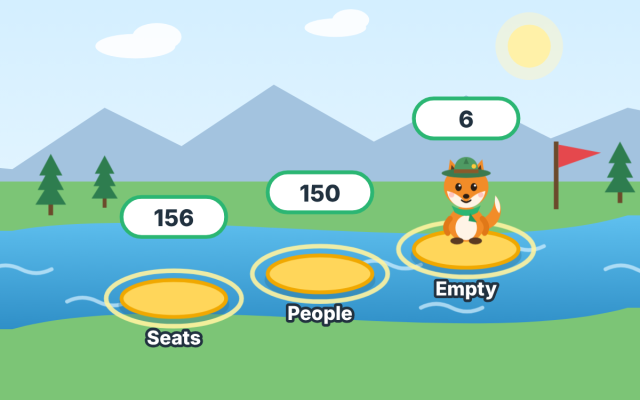
At the Signal Box they use the inverse to check answers and find missing numbers with a bar model, before a 10-question final challenge. Hints and worked answers appear after a wrong try.
Questions and answers
How do Year 2 children add two 2-digit numbers?
Year 2 children usually partition both numbers into tens and ones, add the tens, add the ones, then put them together. For 36 + 27 that is 30 + 20 = 50 and 6 + 7 = 13, so 50 + 13 = 63.
What does making ten mean when adding?
Making ten means filling up to the next ten first, then adding what is left. For 8 + 5, you split the 5 into 2 and 3: 8 + 2 = 10, then 10 + 3 = 13. It uses number bonds to 10 and works for subtracting too.
Why can you add numbers in any order but not subtract them?
Adding is commutative, so 2 + 9 and 9 + 2 both make 11. Subtracting is not: 9 − 2 = 7, but with only 2 things you cannot take 9 away. Children learn this in Year 2.
What age is this adding and subtracting game for?
The game is pitched at Year 2, ages 6 to 7, and follows the Year 2 national curriculum for addition and subtraction. Older children who need a refresher on 2-digit adding and subtracting will also find it useful.
What is in the game and how long does it take?
There are six chapters, an optional tens and ones warm-up, and a 10-question final challenge. Playing everything takes about 45 minutes, and each chapter can be played on its own in around 6 to 8 minutes.
We count visits to make TapLearn better.We use one cookie, only on this site, to see how families find and use it. No adverts, and nothing is shared.One cookie, only on this site. No adverts.How we measure


 TapLearn