Learn Year 2 money skills: use £ and p, count coins, make amounts in different ways and give change while helping at Hazel's woodland market.
Online game, chapter 1 free · Year 2 (KS1) · ages 6–7 · national curriculum in England · no adverts · plays on a phone, tablet or computer · no sign-up to start.
An online money and life skills game for Year 2 (KS1). It covers the national curriculum in England, Year 2 maths: “Recognise and use symbols for pounds (£) and pence (p); combine amounts to make a particular value”, and 2 more statements listed under the chapters.
5 short chapters, about 40 minutes in all. Children can stop after any chapter.
Start playing for free. Plays in the browser on phones, tablets and computers: no app, no adverts.
Free for teachers: every chapter on the whiteboard with a free teacher account.
Last updated · Checked against the national curriculum in England by the TapLearn team
What you'll learn
Write prices with p after pence and £ before pounds
Why 100p is worth the same as one £1 coin
Count coins and notes by starting with the biggest
Choose coins to pay an exact amount, tens first
Find different ways, and the fewest coins, to make an amount
Give change by counting on from the price
Chapter by chapter
Use £ and p to write amountsStart playing for free
Learn to use the £ and p symbols, with p after pence and £ before pounds, and that 100p is worth £1, by sorting money into pots and painting signs on price tags.
Year 2 maths · 1
Count coins and notes to find the total
Learn to combine coins and notes to find a total, counting on from the coin worth the most, and see that what coins are worth matters more than how many there are.
Year 2 maths · 1
Choose coins to make an amount
Learn to choose coins and notes that make an exact amount, splitting the price into tens and ones, by paying for honey cakes and buns at the bakery.
Year 2 maths · 1
Find different ways to make the same amount
Find different combinations of coins that equal the same amount with a swap machine, make 20p in three ways, and work out the fewest coins for amounts like 80p and £8.
Year 2 maths · 2
Add prices and give change
Solve practical shop problems with money in the same unit: add two prices, then give change by counting on from the price to the money paid, using till coins and a number line.
What the chapters cover in the national curriculum in England:
Year 2 maths: Recognise and use symbols for pounds (£) and pence (p); combine amounts to make a particular value
Year 2 maths: Find different combinations of coins that equal the same amounts of money
Year 2 maths: Solve simple problems in a practical context involving addition and subtraction of money of the same unit, including giving change
About this adventure
Year 2 Money is an interactive maths game that teaches children aged 6–7 to use the £ and p symbols, count coins and notes, make amounts in different ways and give change.
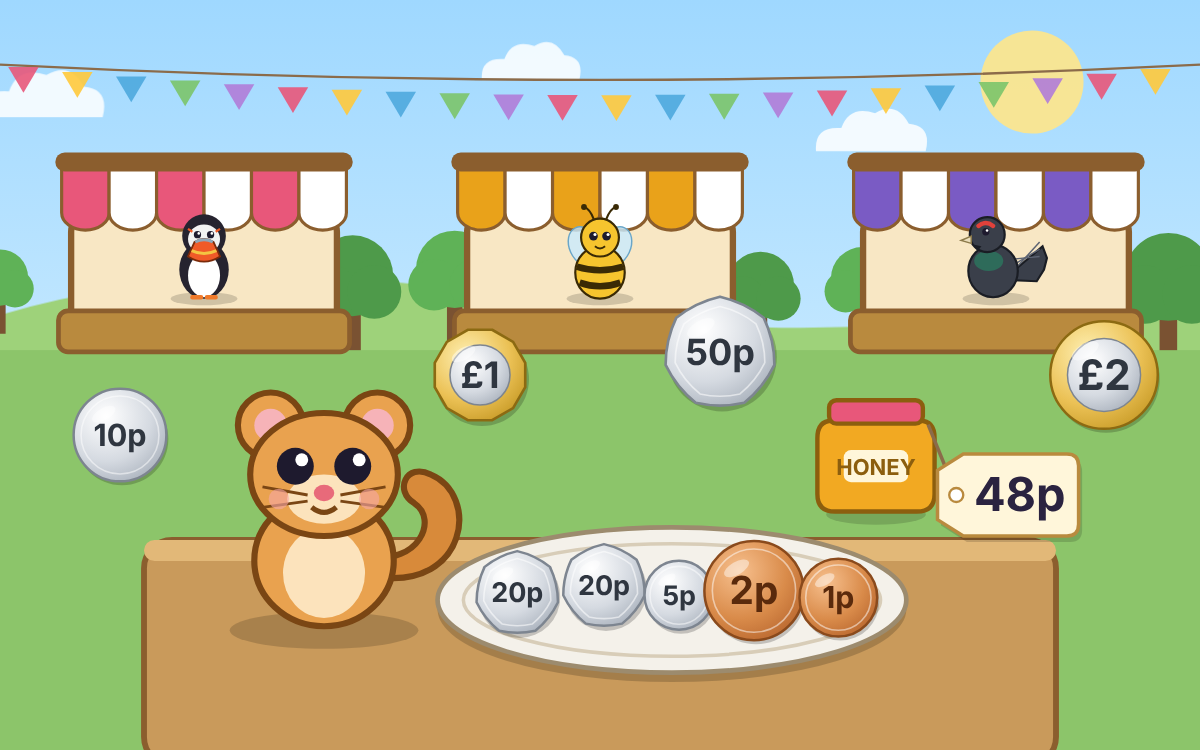
Players join Hazel the dormouse at Acorn Market, where each stall teaches one skill. They paint price tags with p after pence and £ before pounds, count coins starting with the one worth the most, put exact coins on a dish, swap coins for smaller ones worth the same, find the fewest coins for an amount, and count on from the price to give change.
Every task is hands-on and read aloud, with hints aimed at common mix-ups, such as thinking a bigger coin is worth more or counting the coins instead of their value. A 10-question Market Day Challenge checks everything at the end.
Questions and answers
How do you count coins quickly?
Start with the coin worth the most, then count on with the next biggest, and so on. For 20p, 10p, 5p and 2p you say 20, 30, 35, 37, so the total is 37p. Putting coins of the same value together first helps too.
How do you write pounds and pence in Year 2?
In Year 2, children write the £ sign before a number of pounds, like £5, and a small p after a number of pence, like 35p. They never use both signs in one amount, and they write pounds and pence separately, such as £2 and 30p.
How do you work out change by counting on?
Start at the price and count up to the money paid; the amount you counted is the change. For a 34p item paid for with 50p, count from 34p to 35p, then to 40p, then to 50p: 1p, 5p and 10p make 16p change.
What age is this money game for?
This game is for children aged 6 to 7 in Year 2 and follows the national curriculum in England for money. Children who know their coins from Year 1 can start straight away, and a quick Coin check warm-up helps anyone who needs a reminder.
What does the money game include and how long does it take?
The game has five chapters, a Coin check warm-up and a 10-question Market Day Challenge. Playing everything takes about 40 minutes, and each chapter takes five to eight minutes, so it works well in short sessions.
We count visits to make TapLearn better.We use one cookie, only on this site, to see how families find and use it. No adverts, and nothing is shared.One cookie, only on this site. No adverts.How we measure
 TapLearn