Fraction Word Problems: Shop and Share at the Fraction Fair
Learn to solve fraction word problems with amounts, money and measures by sharing cupcakes, selling apples and paying for toys at a market fair.
Online game, chapter 1 free · Year 4 (KS2) · ages 8–10 · national curriculum in England · no adverts · plays on a phone, tablet or computer · no sign-up to start.
An online maths game for Year 4 (KS2). It covers the national curriculum in England, Year 4 maths: “Solve problems involving increasingly harder fractions to calculate quantities, and fractions to divide quantities, including non-unit fractions where the answer is a whole number”, and 1 more statement listed under the chapters.
5 short chapters, about 40 minutes in all. Children can stop after any chapter.
Start playing for free. Plays in the browser on phones, tablets and computers: no app, no adverts.
Free for teachers: every chapter on the whiteboard with a free teacher account.
Last updated · Checked against the national curriculum in England by the TapLearn team
What you'll learn
Find a unit fraction of an amount by dividing by the denominator
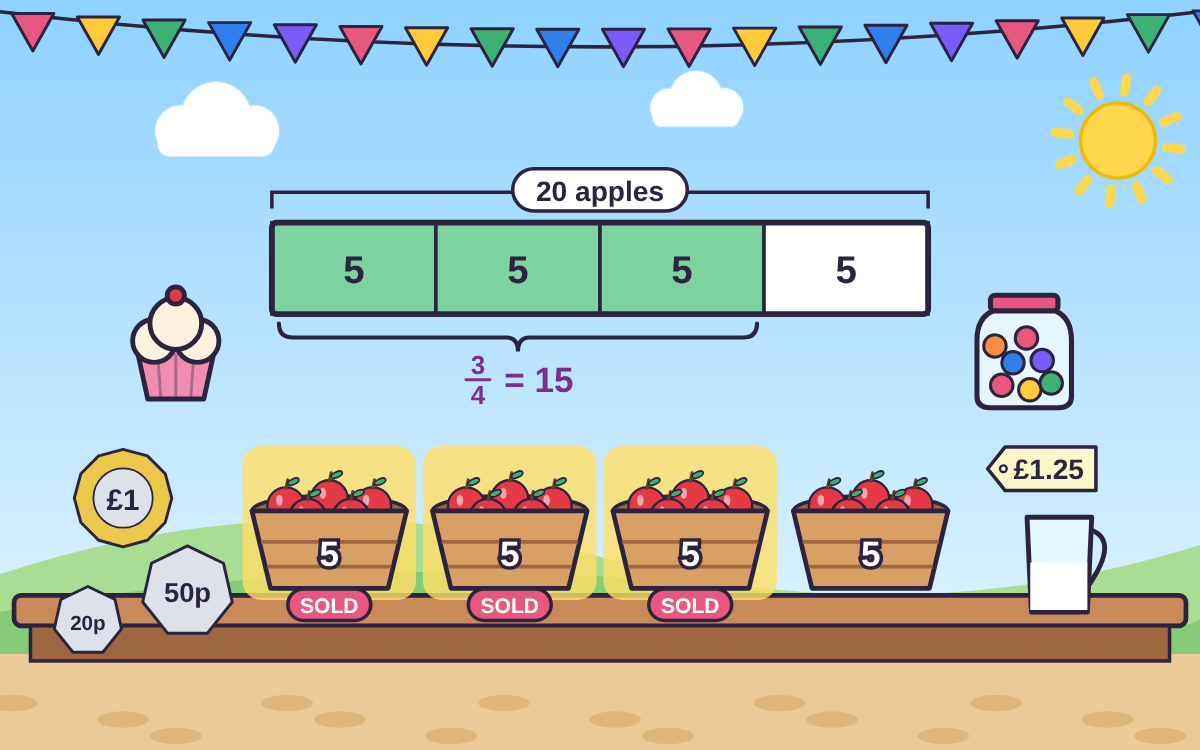
Find non-unit fractions of an amount, such as ¾ of 20
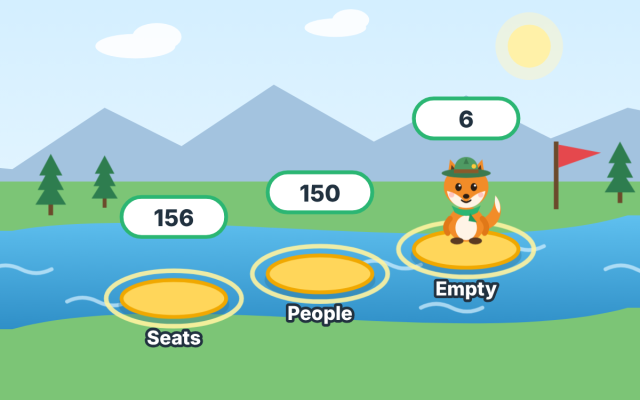
Work backwards from a known fraction to find the whole amount
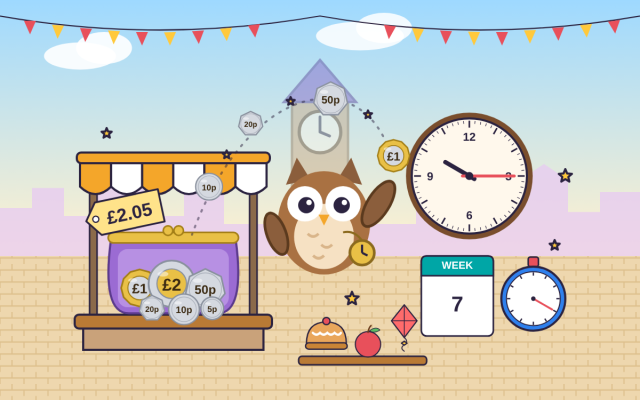
Write money correctly with two digits for pence, like £3.05
Change pounds to pence and count on to work out change
Know that ¼ kg is 0.25 kg or 250 g
Chapter by chapter
Find a unit fraction of an amountStart playing for free
Year 4 maths · 1
Find non-unit fractions of an amount
Year 4 maths · 1
Find the whole amount from a fraction
Year 4 maths · 1
Solve money problems with fractions and decimals
Year 4 maths · 2Year 4 maths · 1
Solve measure problems with fractions and decimals
What the chapters cover in the national curriculum in England:
Year 4 maths: Solve problems involving increasingly harder fractions to calculate quantities, and fractions to divide quantities, including non-unit fractions where the answer is a whole number
Year 4 maths: Solve simple measure and money problems involving fractions and decimals to 2 decimal places
About this adventure
Fraction Word Problems is an interactive maths game that teaches children aged 8–10 how to find fractions of amounts and solve money and measure problems with fractions and decimals, following the Year 4 curriculum in England.
At five market stalls, players deal cupcakes into boxes, split apples into baskets and shade bar models to see why a fraction of an amount means dividing by the denominator (the bottom number) and then multiplying by the numerator (the top number). They work backwards from a known part to find the whole, change pounds into pence, pay with coins and count on to find change.
In the kitchen they pour ¾ of a litre and weigh 0.25 kg of flour, linking ½, ¼ and ¾ to 0.5, 0.25 and 0.75. Answers are typed on a number pad, and every mistake gets a hint matched to it.
Questions and answers
How do you find a fraction of an amount?
Divide the amount by the denominator to find one part, then multiply by the numerator. For example, to find ¾ of 20, work out 20 ÷ 4 = 5, then 5 × 3 = 15.
How do you find the whole when you know a fraction of it?
Divide the known amount by the numerator to find one part, then multiply by the denominator. If ⅗ of a jar is 15 sweets, one fifth is 15 ÷ 3 = 5, so the whole jar holds 5 × 5 = 25 sweets.
Why is £3.05 different from £3.50?
Pence always take two digits after the decimal point, so £3.05 is three pounds and five pence, while £3.50 is three pounds and fifty pence. The zero holds the tens place for the pence, which changes the value by 45p.
What age is this fraction word problems game for?
It is made for children aged 8 to 10, matching Year 4 maths in England. Older children who find fractions of amounts tricky can use it to catch up, as each stall starts from a simple, visual example.
What is in the Fraction Fair game and how long does it take?
The game has five stalls, each with an animated introduction, guided activities and three practice problems, followed by a 10-question challenge. Playing everything takes about 40 minutes, and each stall can be played on its own.
We count visits to make TapLearn better.We use one cookie, only on this site, to see how families find and use it. No adverts, and nothing is shared.One cookie, only on this site. No adverts.How we measure

 TapLearn