What you'll learn
- Name all eight UK coins, from 1p to £2
- Say what each coin is worth in pence or pounds
- Recognise the £5, £10, £20 and £50 notes by number and colour
- Tell pence coins from pound coins, such as 2p and £2
- Know that a bigger coin is not always worth more
- Spot the seven-sided 20p and 50p and the twelve-sided £1
Chapter by chapter
- Pence coins: 1p, 2p, 5p and 10p Free to try
Year 1 maths · 1
- Seven-sided coins: 20p and 50p
Year 1 maths · 1
- Pound coins: £1 and £2
Year 1 maths · 1
- Notes: £5, £10, £20 and £50
Year 1 maths · 1
- Which is worth more? Coin and note values
Year 1 maths · 1
- Money Master quiz (10 questions)
What the chapters cover in the national curriculum in England:
- Year 1 maths: Recognise and know the value of different denominations of coins and notes
About this adventure
UK Coins and Notes is an interactive maths game that teaches children aged 5–7 to recognise every UK coin and note and know what each one is worth. It follows the Year 1 money objective in the national curriculum for England.
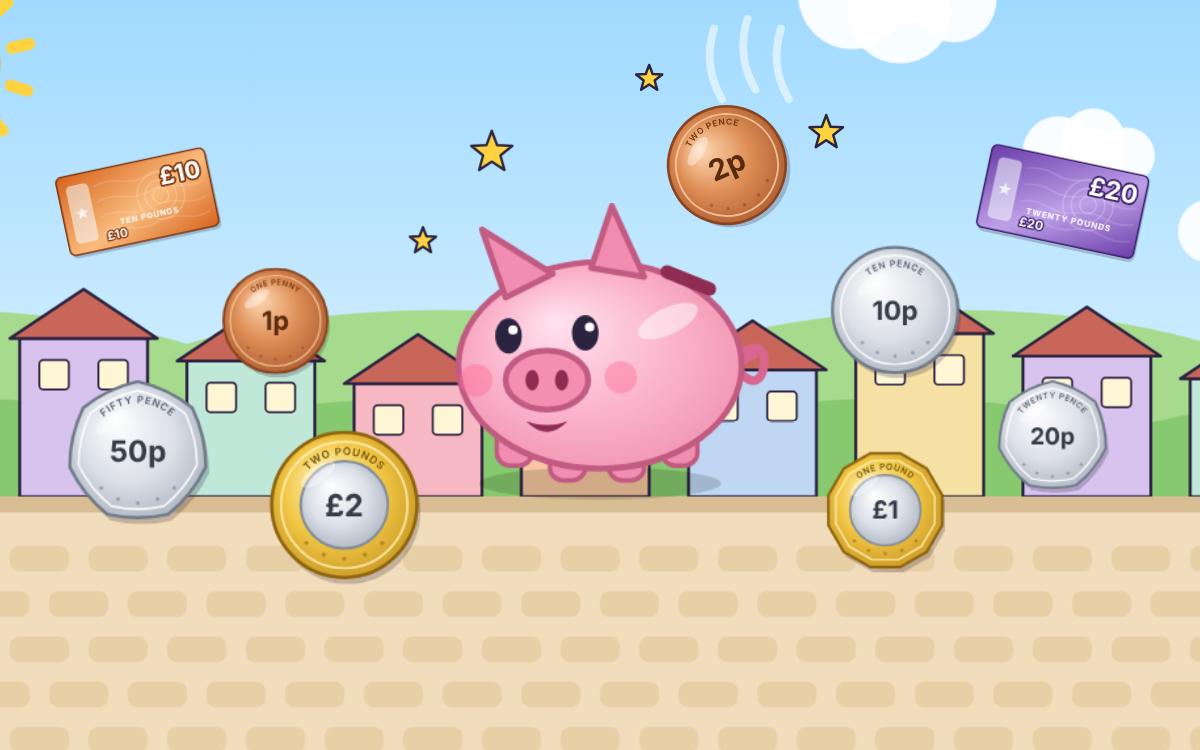
Penny the piggy bank guides players along Money Street, where they meet the 1p, 2p, 5p, 10p, 20p, 50p, £1 and £2 coins and the £5, £10, £20 and £50 notes. Children learn the clues that help them tell money apart: copper or silver colour, the seven curved sides of the 20p and 50p, and the twelve sides of the £1. They also learn the difference between pence and pounds.
One chapter tackles a common mix-up: a bigger coin is not always worth more. Every line is read aloud with captions, and a 10-question quiz checks what children remember.
Questions and answers
What coins and notes are used in the UK?
The UK uses eight coins and four Bank of England notes. The coins are 1p, 2p, 5p, 10p, 20p, 50p, £1 and £2, and the notes are £5, £10, £20 and £50.
How can children tell UK coins apart?
Children can tell UK coins apart by colour, shape and size, then check the number on the coin. The 1p and 2p are copper, the 20p and 50p have seven curved sides, the £1 has twelve sides, and the £2 is round with a gold rim.
Why is a 5p worth more than a 2p when it is smaller?
A coin's value comes from the number on it, not from its size. The 2p is bigger than the 5p, 10p and 20p but is worth less than all of them, so children learn to look at the number to find the value.
What age is the coins and notes game for?
It is made for children aged 5 to 7 and matches the Year 1 maths objective to recognise and know the value of coins and notes. Older children who are unsure about money can also use it as a refresher.
What does the coins and notes game include and how long does it take?
The game has five chapters and a 10-question Money Master quiz, and takes about 35 minutes to play through. Each chapter opens with an animated introduction, every line is read aloud with captions, and chapters can be played in any order.
More to explore
See all
How Money Works: The Story from Barter to Bank Cards
Learn where money came from and how it works today: swap goods, mint coins, open a bank and tap to pay, one s…
Converting Units of Measure: Explore Measure Town with Milli
Learn converting units of measure, from km to m and hours to minutes, then estimate, compare and work out cha…
Year 4 Decimals: Chop, Count and Shop with Dot the Robot
Learn Year 4 decimals: tenths, hundredths, rounding and comparing. Chop a chocolate slab, roll cars down Roun…
Saving Money: A Piggy Bank Adventure with Penny
Learn how saving money works: earn pocket money, choose a goal, make a weekly plan and watch your savings gro…
Animal Life Cycles: Grow a Frog, Butterfly, Robin and Rabbit
Learn how animal life cycles work by helping a frog, butterfly, robin and rabbit grow, from egg or birth to a…
Skeletons and Muscles: Build a Body with Skelly
Learn how skeletons and muscles work together: build a skeleton, test how bones protect you, and make an arm…
The Heart and Circulatory System: Ride with Rosie
Learn how the heart and circulatory system work, then guide Rosie the red blood cell round the body, build yo…
 TapLearn