Money and Time Word Problems: A Clocktower Market Day
Learn to solve money and time word problems: write pounds and pence, work out change and convert hours, weeks and years at a busy market.
Online game, chapter 1 free · Year 4 (KS2) · ages 8–9 · national curriculum in England · no adverts · plays on a phone, tablet or computer · no sign-up to start.
An online maths game for Year 4 (KS2). It covers the national curriculum in England, Year 4 maths: “Estimate, compare and calculate different measures, including money in pounds and pence”, and 1 more statement listed under the chapters.
6 short chapters, about 45 minutes in all. Children can stop after any chapter.
Start playing for free. Plays in the browser on phones, tablets and computers: no app, no adverts.
Free for teachers: every chapter on the whiteboard with a free teacher account.
Last updated · Checked against the national curriculum in England by the TapLearn team
What you'll learn
Write amounts with a decimal point, such as £3.05 and 305p
Compare prices by checking pounds first, then pence
Round prices to the nearest pound to estimate a total
Add money and find change by counting up
Convert hours to minutes and minutes to seconds using 60
Convert weeks to days and years to months, and back again
Chapter by chapter
Write money in pounds and penceStart playing for free
Year 4 maths · 1
Compare and estimate amounts of money
Year 4 maths · 1
Add money and work out change
Year 4 maths · 1
Estimate, compare and calculate measures
Year 4 maths · 1
Convert hours to minutes and minutes to seconds
Year 4 maths · 2
Convert years to months and weeks to days
Year 4 maths · 2
Market Day challenge: money, measures and time (12 questions)
What the chapters cover in the national curriculum in England:
Year 4 maths: Estimate, compare and calculate different measures, including money in pounds and pence
Year 4 maths: Solve problems involving converting from hours to minutes, minutes to seconds, years to months, weeks to days
About this adventure
Money and Time Word Problems is an interactive maths game that teaches children aged 8–9 (Year 4) to estimate, compare and calculate money and measures, and to convert between units of time.
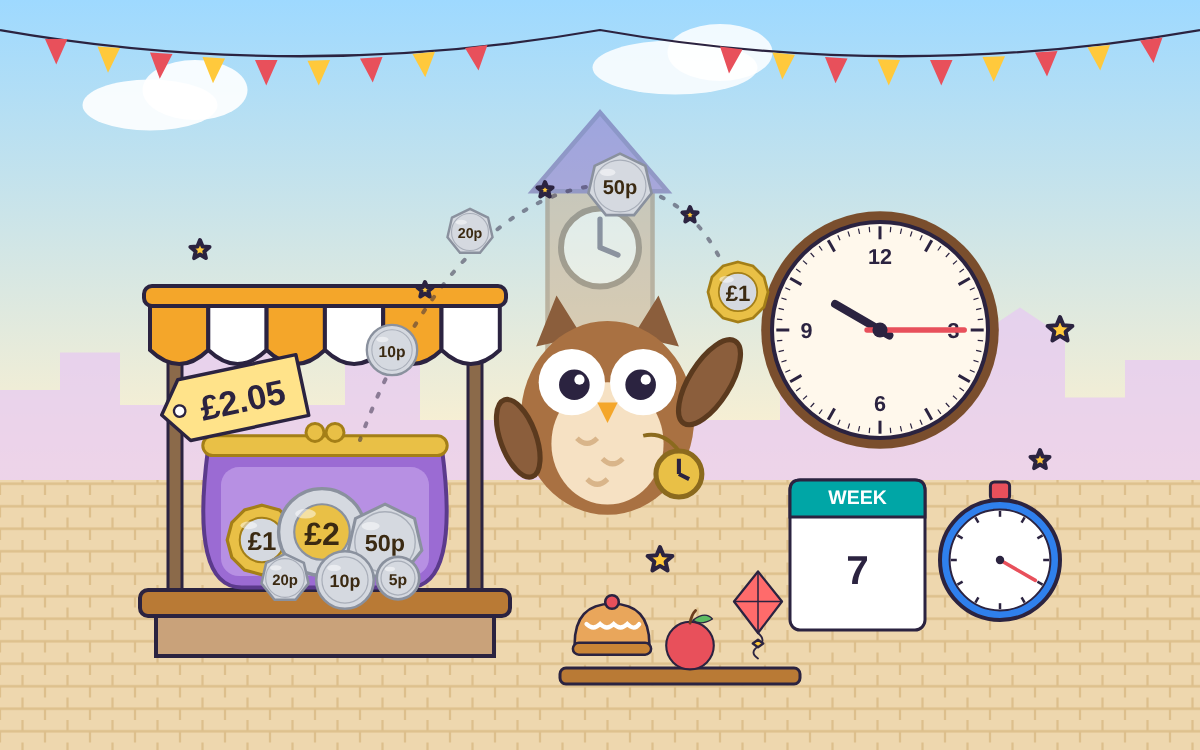
Guided by Ollie the time-keeper owl, players visit six market stalls. They drop coins into a purse to make exact amounts, slide a marker along a number line to round prices to the nearest pound, hop along a number line to count up change, weigh melons on a balance and spin a clock's minute hand to see that every hour adds 60 minutes.
Each stall begins with a short animated introduction and, where needed, a quick refresher. Spoken hints spot common slips, such as writing £2.5 instead of £2.05 or using 100 instead of 60 for an hour. A 12-question Market Day challenge at the clock tower brings everything together.
Questions and answers
How do you convert hours to minutes?
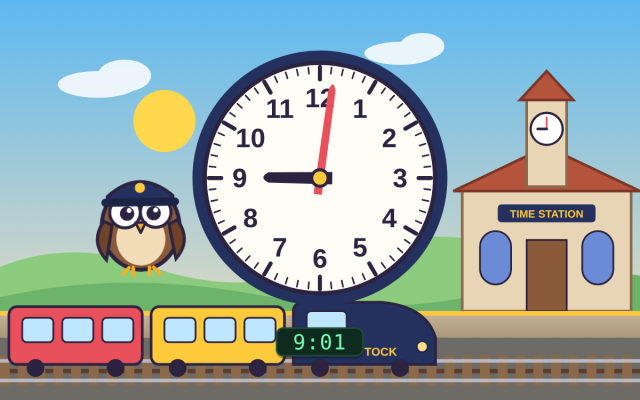
Multiply the number of hours by 60, because there are 60 minutes in every hour. So 2 hours is 120 minutes, and 1 hour 20 minutes is 60 + 20 = 80 minutes. To go back from minutes to hours, divide by 60.
How do you work out change from a note, the easy way?
Count up from the price to the money you paid. For £3.65 paid with £5, hop 5p to £3.70, 30p to £4, then £1 to £5. Adding the hops gives £1.35 change.
How do you write 5p in pounds?
Five pence is written £0.05, with a zero after the decimal point. Prices always have two digits after the point, so two pounds and five pence is £2.05, not £2.5, which would mean £2.50.
What age is this money and time game for?
It is pitched at children aged 8 to 9, in Year 4 of the national curriculum in England. Older children who need a refresher on money, change and time conversions will also find it useful.
What does the game include and how long does it take?
It has six chapters on money, measures and time, each with an animated introduction, hands-on tasks and typed answers, plus a 12-question final challenge. Playing everything takes about 45 minutes, and chapters can be played in any order.
We count visits to make TapLearn better.We use one cookie, only on this site, to see how families find and use it. No adverts, and nothing is shared.One cookie, only on this site. No adverts.How we measure


 TapLearn