What you'll learn
- Add amounts of money, swapping 100p for £1
- Give change by counting on from the price to the money paid
- Add and subtract lengths in metres, centimetres and millimetres
- Add and subtract masses in kilograms and grams
- Add and subtract capacities in litres and millilitres
- Use a bar model to choose between adding and subtracting
Chapter by chapter
- Add amounts of money in pounds and pence Free to try
Year 3 maths · 1
- Give change by counting on from the price
Year 3 maths · 1
- Add and subtract lengths in m, cm and mm
Year 3 maths · 2
- Add and subtract masses (kg, g) and capacities (l, ml)
Year 3 maths · 2
- Solve money and measure word problems: add or subtract?
Year 3 maths · 2 Year 3 maths · 1
- Market Day Challenge: money and measures quiz (10 questions)
See every Maths chapter in the chapter library
What the chapters cover in the national curriculum in England:
- Year 3 maths: Add and subtract amounts of money to give change, using both £ and p in practical contexts
- Year 3 maths: Measure, compare, add and subtract: lengths (m/cm/mm); mass (kg/g); volume/capacity (l/ml)
About this adventure
Market Square is an interactive maths game of money and measures word problems for children aged 7–9, teaching them to add money, give change in pounds and pence, and add and subtract lengths, masses and capacities.
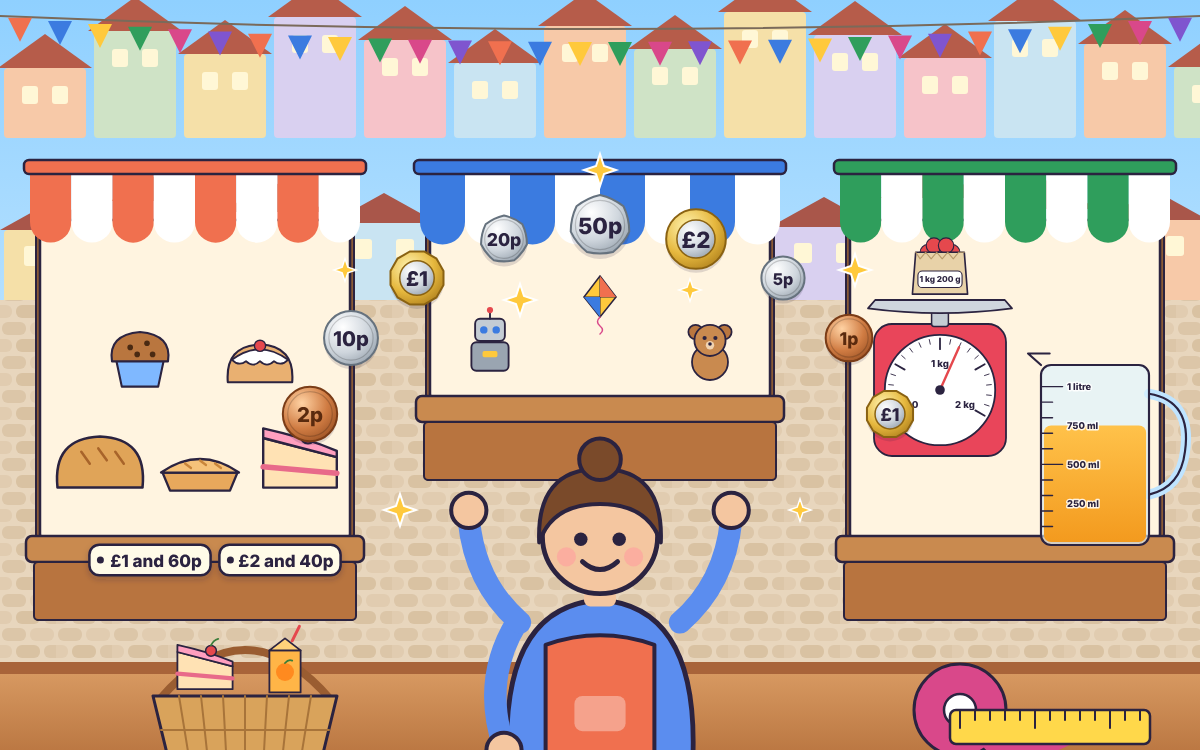
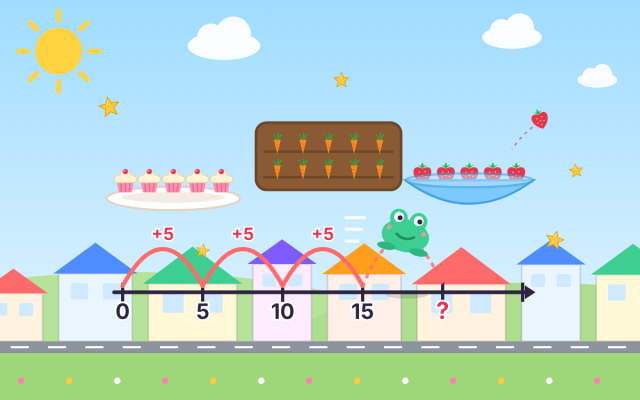
Players help Marnie the stallholder serve customers. They add prices pounds to pounds and pence to pence, swapping 100p for £1, and give change using the shopkeeper's counting-on method on a number line. They join and cut ribbons, weigh fruit on scales and pour juice into a measuring jug, working with mixed units such as 1 m 20 cm and the facts 1000 g = 1 kg and 1000 ml = 1 litre.
A bar model then helps them decide whether a problem needs adding or subtracting. The game follows the Year 3 maths curriculum in England.
Questions and answers
How do you work out change in pounds and pence?
Count on from the price to the money paid: hop to the next 10p, then to the next pound, then up to the amount paid. For a £3 and 40p toy paid for with £5, hop 60p to £4 and £1 to £5, so the change is £1 and 60p.
How do you add metres and centimetres?
Add metres to metres and centimetres to centimetres, then swap every 100 cm for 1 m. For example, 2 m 70 cm + 50 cm gives 2 m 120 cm, which is the same as 3 m 20 cm.
How many grams are in a kilogram, and millilitres in a litre?
There are 1000 grams in 1 kilogram and 1000 millilitres in 1 litre. So 600 g + 700 g = 1300 g, which is 1 kg 300 g, and a jug holding 750 ml needs 250 ml more to reach 1 litre.
What age is this money and measures game for?
It is designed for children aged 7 to 9 and matches the Year 3 maths curriculum in England for money and measurement. Older children who need more practice with change or mixed units can use it too.
What does the Market Square game include and how long does it take?
It has five stall chapters, a short warm-up of key facts and a 10-question Market Day Challenge, and takes about 45 minutes to play in full. Every chapter can be played on its own, with spoken instructions, hints and a second try.
 TapLearn