Telling the Time for Year 4: 24-Hour Clock Adventure at Tock's Station
Learn to tell the time to the minute, swap between 12-hour and 24-hour clocks, and convert hours, minutes, weeks and years at a busy train station.
Online game, chapter 1 free · Year 4 (KS2) · ages 8–10 · national curriculum in England · no adverts · plays on a phone, tablet or computer · no sign-up to start.
An online maths game for Year 4 (KS2). It covers the national curriculum in England, Year 4 maths: “Read, write and convert time between analogue and digital 12- and 24-hour clocks”, and 1 more statement listed under the chapters.
5 short chapters, about 35 minutes in all. Children can stop after any chapter.
Start playing for free. Plays in the browser on phones, tablets and computers: no app, no adverts.
Free for teachers: every chapter on the whiteboard with a free teacher account.
Last updated · Checked against the national curriculum in England by the TapLearn team
What you'll learn
Read an analogue clock to the nearest minute and write it digitally
Turn 'past' and 'to' times into digital times, such as 3:40
Change a.m. And p.m. Times to the 24-hour clock by adding 12
Change 24-hour times back to a.m. And p.m. And set a clock face
Convert hours to minutes and minutes to seconds using 60
Convert years to months and weeks to days using 12 and 7
Chapter by chapter
Read clocks to the minute and write digital timesStart playing for free
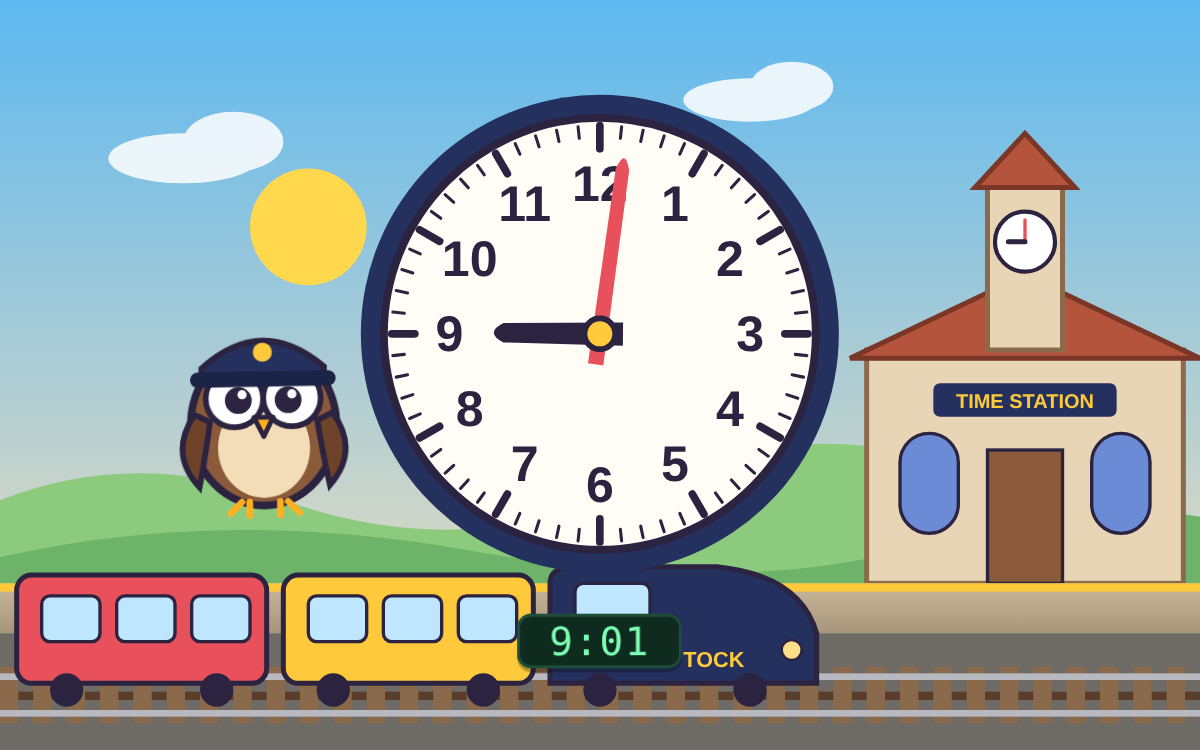
Learn to read an analogue clock to the nearest minute, turn 'past' and 'to' times into digital times, and write them in 12-hour digital form by dragging a geared station clock.
Year 4 maths · 1
Change a.m. and p.m. times to the 24-hour clock
Discover how a.m. and p.m. times become 24-hour times by sliding through a whole day, then add 12 after midday, write four digits and fix a train departure board.
Year 4 maths · 1
Change 24-hour times to a.m., p.m. and clock faces
Convert 24-hour times back to 12-hour a.m. and p.m. times by taking away 12, sort times into morning and afternoon, and show 24-hour times on an analogue clock face.
Year 4 maths · 1
Convert hours to minutes and minutes to seconds
Find out that 60 seconds make a minute and 60 minutes make an hour, then multiply by 60 to convert and share into sixties to convert back, including mixed times like 1 hour 20 minutes.
Year 4 maths · 2
Convert years to months and weeks to days
Build up months year by year and days week by week to see that 1 year is 12 months and 1 week is 7 days, then solve conversions both ways.
Year 4 maths · 2
Station Master Challenge: mixed time quiz (10 questions)
What the chapters cover in the national curriculum in England:
Year 4 maths: Read, write and convert time between analogue and digital 12- and 24-hour clocks
Year 4 maths: Solve problems involving converting from hours to minutes, minutes to seconds, years to months, weeks to days
About this adventure
Telling the Time is an interactive maths game that teaches children aged 8–10 to read analogue clocks to the minute, convert between 12-hour and 24-hour times, and change units of time, following the Year 4 curriculum in England.
Guided by Tock, an owl station master, players drag the hands of a geared station clock, slide the sun across a whole day to watch a.m., p.m. And 24-hour times change together, and fix a train departure board. They learn to add 12 to afternoon hours, write 24-hour times with four digits, and remember that midnight is 00:00.
Later platforms use a speedy stopwatch, growing hour bars and a busy calendar to show why time counts in sixties, and how to convert hours to minutes, minutes to seconds, years to months and weeks to days. Hints spot common mistakes, such as thinking an hour has 100 minutes.
Questions and answers
How do you change a 12-hour time to the 24-hour clock?
For a.m. Times, keep the hours the same and add a zero if needed, so 8:05 a.m. Is 08:05. For p.m. Times after 1 p.m., add 12 to the hours, so 4:20 p.m. Becomes 16:20. The minutes never change.
What is midnight on the 24-hour clock?
Midnight is 00:00 on the 24-hour clock, because the day starts again from zero. Midday is 12:00, so a time like 12:30 p.m. Stays 12:30, while 12:30 a.m. Is written 00:30.
Why are there 60 minutes in an hour and not 100?
Time is counted in sixties because ancient Babylonians used a number system based on 60 thousands of years ago, and we still use it. So 1 hour is 60 minutes and 1 minute is 60 seconds, which means converting time uses the 60 times table.
What age is this telling the time game for?
It is designed for children aged 8 to 10 and matches the Year 4 time objectives in the national curriculum for England. A short, skippable clock-hands refresher at the start helps children who need a reminder from Year 3.
What does the game include and how long does it take?
The game has five chapters on reading clocks, 24-hour times and converting units of time, plus a 10-question Station Master Challenge. Playing everything takes about 35 minutes, and each chapter can be played on its own.
We count visits to make TapLearn better.We use one cookie, only on this site, to see how families find and use it. No adverts, and nothing is shared.One cookie, only on this site. No adverts.How we measure

 TapLearn