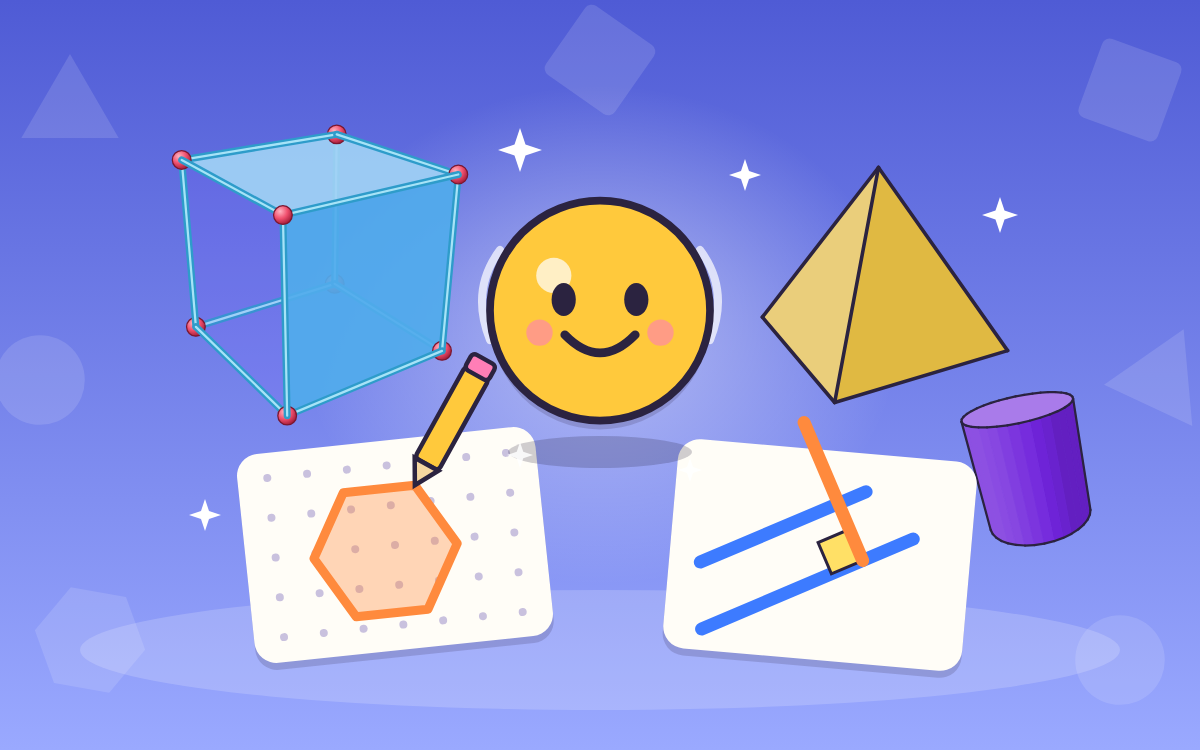
Properties of Shapes: Draw, Build and Spot Lines
Learn the properties of shapes by drawing 2-D shapes on dotty paper, building 3-D models from straws and clay, and spotting parallel lines.
- Ages 7–9
- About 40 min
- Easy start
- Shapes & Measures
Learn the properties of shapes by drawing 2-D shapes on dotty paper, building 3-D models from straws and clay, and spotting parallel lines.
Year 3 maths · 1
Year 3 maths · 1
Year 3 maths · 1
Year 3 maths · 2
Year 3 maths · 2
What the chapters cover in the national curriculum in England:
Shape Lab is an interactive properties of shapes game that teaches children aged 7–9 to draw 2-D shapes, make and describe 3-D shapes, and identify horizontal, vertical, parallel and perpendicular lines, matching Year 3 maths in England.
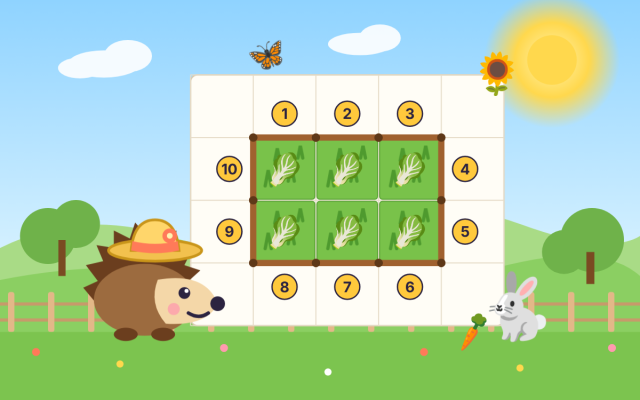
Players join dots to draw polygons such as pentagons and hexagons, then press clay balls onto the vertices of a model, add straws for its edges and cover its faces with card. They turn a cone, prism or pyramid upside down or onto its side and find that its name stays the same.
Later, a spirit level and a plumb line help them make a plank horizontal or vertical. Children also turn a line until it is parallel (always the same distance apart) or perpendicular (meeting at a right angle). A friendly narrator reads every instruction aloud, and common mix-ups, like counting only the faces you can see, are explained as they happen.
Parallel lines always stay the same distance apart and never meet, like the two rails of a train track. Perpendicular lines meet or cross at a right angle, which is a square corner, like the corner of a book.
A cube has 6 faces, 12 edges and 8 vertices. The faces are flat squares, the edges are where two faces meet, and the vertices are the corners where edges join together.
No, turning a 3-D shape does not change what it is. A cone lying on its side is still a cone, with the same faces, edges and vertices, even though it looks different from where you are standing.
The game is made for children aged 7 to 9 and follows the Year 3 maths curriculum in England. Younger children can play with help, and older children can use it to revise shapes and lines.
It has five chapters and a 10-question Shape Master Challenge, taking about 40 minutes to play in full. Children can start from any chapter and return to the chapter map whenever they like.

 TapLearn
Getting it ready…
Great work on chapter 1! To open the next chapters, ask a grown-up to take a look.
To play this game, ask a grown-up to take a look. There are lots of free games you can play right now too!
Create a free family account and your child can play every chapter of every game for 7 days, with no card needed. Their progress is kept. After that, the free plan is free for ever, and membership is £6.99 a month if you'd like to keep every chapter.
That's all the learning time for today. Great work! Flip will be ready to play again tomorrow.