Missing Angles Year 6: Fix the Rose Window with Glint
Learn to find missing angles on a line, around a point, vertically opposite and in triangles, quadrilaterals and regular polygons by mending a rose window.
Online game, chapter 1 free · Year 6 (KS2) · ages 10–11 · national curriculum in England · no adverts · plays on a phone, tablet or computer · no sign-up to start.
An online maths game for Year 6 (KS2). It covers the national curriculum in England, Year 6 maths: “Recognise angles where they meet at a point, are on a straight line, or are vertically opposite, and find missing angles”, and 1 more statement listed under the chapters.
6 short chapters, about 45 minutes in all. Children can stop after any chapter.
Start playing for free. Plays in the browser on phones, tablets and computers: no app, no adverts.
Free for teachers: every chapter on the whiteboard with a free teacher account.
Last updated · Checked against the national curriculum in England by the TapLearn team
What you'll learn
Angles on a straight line add up to 180°
Angles around a point add up to 360°
Vertically opposite angles are equal when two straight lines cross
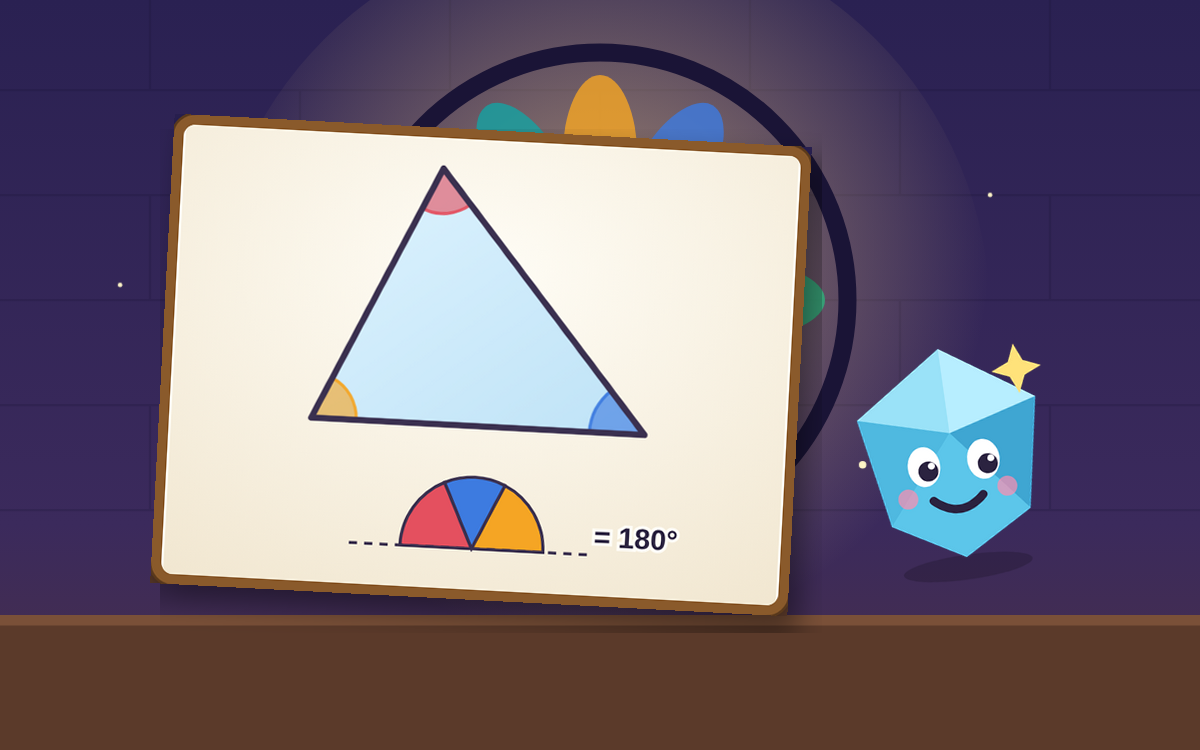
The angles in any triangle add up to 180°, including isosceles triangles
The angles in a quadrilateral add up to 360°
Find each interior angle of a regular polygon by splitting it into triangles
Chapter by chapter
Missing angles on a straight line and around a pointStart playing for free
Recognise that angles meeting at one point on a straight line add up to 180° and angles around a point add up to 360°, by turning strips of lead, then calculate missing angles.
Year 6 maths · 1
Vertically opposite angles are equal
Discover that vertically opposite angles are equal by turning two crossing strips, see why using angles on a straight line, and use this to find missing angles where lines cross.
Year 6 maths · 1
Missing angles in triangles (180°)
Snip the corners off any triangle to show its angles add up to 180°, then find unknown angles in scalene, right-angled, isosceles and equilateral triangles.
Year 6 maths · 2
Missing angles in quadrilaterals (360°)
Cut a quadrilateral along a diagonal into two triangles to see why its angles add up to 360°, then find unknown angles in quadrilaterals, a parallelogram and a trapezium.
Year 6 maths · 2
Angles in regular polygons
Split regular polygons into triangles from one vertex to find the sum of their interior angles, divide to find each angle, and see why hexagons tile a honeycomb but pentagons don't.
Year 6 maths · 2
Multi-step angle puzzles: combining angle facts
Solve angle problems with more than one step by choosing the right fact each time: straight lines, vertically opposite angles, triangles, isosceles triangles and angles around a point.
Year 6 maths · 2Year 6 maths · 1
Rose Window Challenge (10 questions) (10 questions)
What the chapters cover in the national curriculum in England:
Year 6 maths: Recognise angles where they meet at a point, are on a straight line, or are vertically opposite, and find missing angles
Year 6 maths: Compare and classify geometric shapes based on their properties and sizes and find unknown angles in any triangles, quadrilaterals, and regular polygons
About this adventure
Missing Angles Year 6 is an interactive maths game that teaches children aged 10–11 how to calculate unknown angles using angle facts, matching the Year 6 national curriculum in England.
Players help Glint repair a cracked stained-glass rose window, where every new piece of glass must be cut to the right angle. They drag strips of lead to see that angles on a straight line add up to 180° and angles around a point make 360°, turn crossing strips to discover that vertically opposite angles are equal, and snip the corners off a triangle to show its angles make 180°.
They then cut quadrilaterals into two triangles (360°), split regular polygons into triangles to find each interior angle, and solve multi-step puzzles by choosing the right fact for each step. Every answer is typed in and checked, with hints that spot common mistakes.
Questions and answers
How do you find a missing angle in a triangle?
Add the angles you know and take the total away from 180°, because the three angles in any triangle add up to 180°. For example, if two angles are 70° and 45°, the missing angle is 180° − 115° = 65°.
What are vertically opposite angles?
Vertically opposite angles are the angles opposite each other where two straight lines cross, and they are always equal. The word vertically comes from vertex, the point where the lines meet, not from up and down.
How do you work out the angles in a regular polygon?
Split the polygon into triangles from one corner: there are always two fewer triangles than sides. Multiply the number of triangles by 180° to get the total, then divide by the number of angles. A regular hexagon has 720° ÷ 6 = 120° in each angle.
What age is this missing angles game for?
It is designed for children aged 10 to 11 and follows the Year 6 maths curriculum in England for finding unknown angles. It also suits Year 7 pupils who want to revise angle facts from primary school.
What does the game include and how long does it take?
There are six chapters, each with an animated introduction, hands-on activities and typed-in questions, plus a ten-question final challenge. An optional refresher covers degrees and turns first. Playing everything takes about 45 minutes, and each chapter can be played on its own.
We count visits to make TapLearn better.We use one cookie, only on this site, to see how families find and use it. No adverts, and nothing is shared.One cookie, only on this site. No adverts.How we measure


 TapLearn