Area and Perimeter Year 6: Build Grid City with Ada
Learn to find the area of parallelograms and triangles, and why shapes with the same area can have different perimeters, by planning Grid City.
Online game, chapter 1 free · Year 6 (KS2) · ages 10–11 · national curriculum in England · no adverts · plays on a phone, tablet or computer · no sign-up to start.
An online maths game for Year 6 (KS2). It covers the national curriculum in England, Year 6 maths: “Recognise that shapes with the same areas can have different perimeters and vice versa”, and 2 more statements listed under the chapters.
4 short chapters, about 45 minutes in all. Children can stop after any chapter.
Start playing for free. Plays in the browser on phones, tablets and computers: no app, no adverts.
Free for teachers: every chapter on the whiteboard with a free teacher account.
Last updated · Checked against the national curriculum in England by the TapLearn team
What you'll learn
Shapes with the same area can have different perimeters
Shapes with the same perimeter can have different areas
Area of a parallelogram = base × perpendicular height
Area of a triangle = base × perpendicular height ÷ 2
Why the perpendicular height is used, not the slanted side
When an area formula works, and when to split or estimate
Chapter by chapter
Same area, different perimeters (and the other way round)Start playing for free
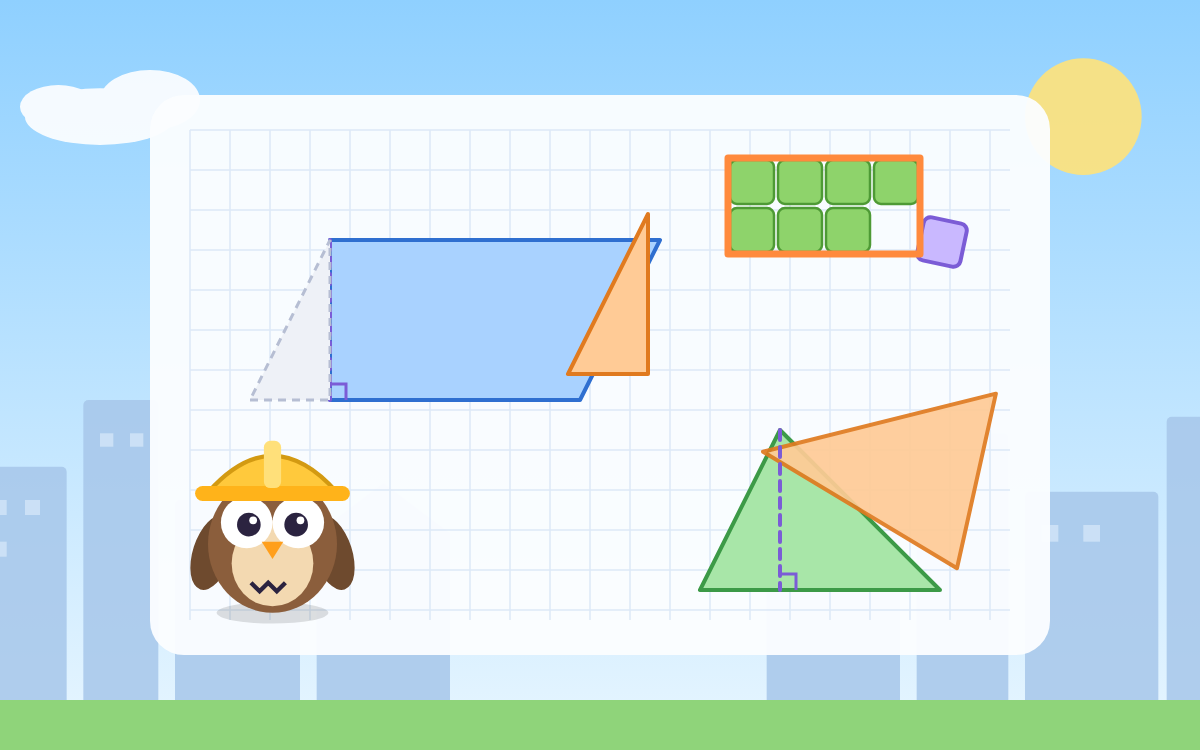
Discover that shapes with the same area can have different perimeters, and the other way round, by building every rectangle from 12 slabs, reshaping a patio and stretching a 16 m fence.
Year 6 maths · 1
Area of a parallelogram: base × perpendicular height
Learn to calculate the area of a parallelogram with base × perpendicular height by cutting off a triangle, sliding it into a rectangle, and leaning the shape to see that the slanted side doesn't matter.
Year 6 maths · 2
Area of a triangle: base × perpendicular height ÷ 2
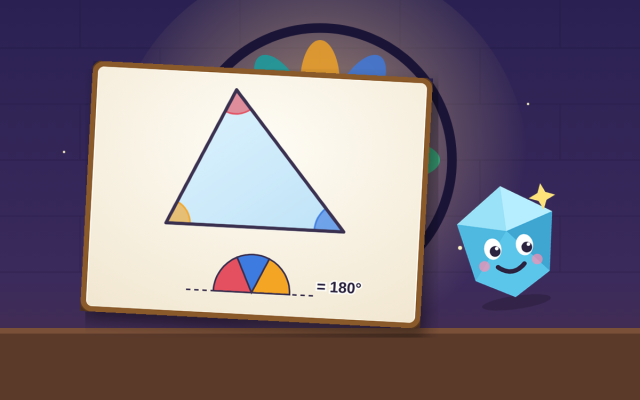
Learn to calculate the area of any triangle with base × perpendicular height ÷ 2 by joining two identical triangles into a parallelogram, including triangles whose height falls outside the shape.
Year 6 maths · 2
When can you use an area formula? Splitting shapes into pieces
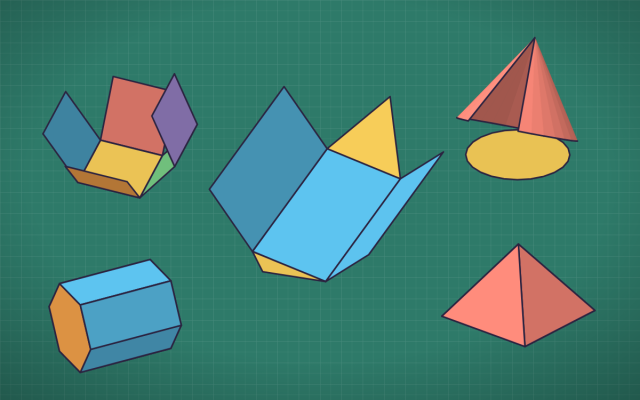
Recognise when an area formula can be used by sorting straight-edged and curvy shapes, checking which measurements are needed, and splitting a town hall into a rectangle and a triangle (compound shapes).
Year 6 maths · 3
Grid City Challenge: area and perimeter (10 questions)
What the chapters cover in the national curriculum in England:
Year 6 maths: Recognise that shapes with the same areas can have different perimeters and vice versa
Year 6 maths: Calculate the area of parallelograms and triangles
Year 6 maths: Recognise when it is possible to use formulae for area and volume of shapes
About this adventure
Area and Perimeter Year 6 is an interactive maths game that teaches children aged 10–11 to calculate the area of parallelograms and triangles, and to see that shapes with the same area can have different perimeters.
Players help Ada the architect owl plan Grid City. They move paving slabs to change a garden's perimeter while its area stays the same, cut a triangle off a parallelogram and slide it across to make a rectangle, and spin a copy of a triangle to show it is half of a parallelogram. They learn to use the perpendicular height, the height at a right angle to the base, and never the slanted side.
Later they sort shapes into ones with a formula and curvy ones to estimate, then split a town hall into a rectangle and a triangle. Narration, hints that name the exact mistake and a 10-question challenge check understanding.
Questions and answers
How do you find the area of a triangle?
Multiply the base by the perpendicular height, then divide by 2. A triangle is exactly half of a parallelogram with the same base and height, so a triangle with a base of 10 cm and a perpendicular height of 6 cm has an area of 30 cm².
How do you work out the area of a parallelogram?
Multiply the base by the perpendicular height, which is the distance straight up from the base at a right angle. Don't use the slanted side: a parallelogram can be cut and rearranged into a rectangle with the same base and height, so it has the same area.
Can two shapes have the same area but different perimeters?
Yes. A 12 m by 1 m garden and a 4 m by 3 m garden both cover 12 m², but their perimeters are 26 m and 14 m. Shapes with the same perimeter can also have different areas.
What age is this area and perimeter game for?
It is made for children aged 10 to 11, matching Year 6 maths in England. An optional warm-up recaps the Year 5 area and perimeter of rectangles for anyone who would like a refresher first.
What does the game include and how long does it take?
It has four chapters, an optional warm-up and a 10-question final challenge, taking about 45 minutes in total. Each chapter opens with a short animated introduction, can be played on its own, and works on phones, tablets and computers.
We count visits to make TapLearn better.We use one cookie, only on this site, to see how families find and use it. No adverts, and nothing is shared.One cookie, only on this site. No adverts.How we measure

 TapLearn