Measuring for Year 2: Weigh and Measure the Rescue Animals
Learn Year 2 measuring: length, mass, capacity and temperature. Read rulers, scales, jugs and thermometers to care for the rescue animals.
Online game, chapter 1 free · Year 2 (KS1) · ages 6–8 · national curriculum in England · no adverts · plays on a phone, tablet or computer · no sign-up to start.
An online maths game for Year 2 (KS1). It covers the national curriculum in England, Year 2 maths: “Choose and use appropriate standard units to estimate and measure length/height in any direction (m/cm); mass (kg/g); temperature (°C); capacity (litres/ml) to the nearest appropriate unit, using rulers, scales, thermometers and measuring vessels”, and 1 more statement listed under the chapters.
6 short chapters, about 40 minutes in all. Children can stop after any chapter.
Start playing for free. Plays in the browser on phones, tablets and computers: no app, no adverts.
Free for teachers: every chapter on the whiteboard with a free teacher account.
Last updated · Checked against the national curriculum in England by the TapLearn team
What you'll learn
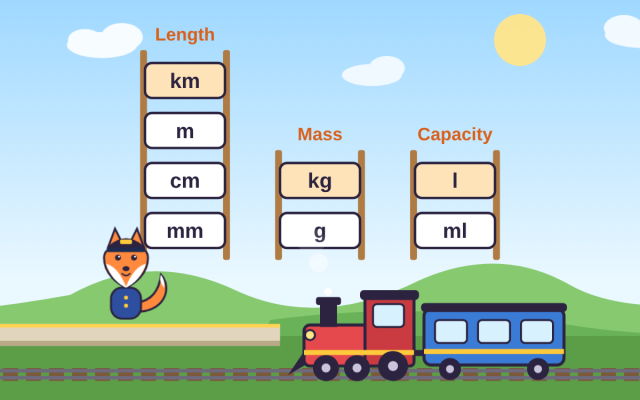
Choose cm or m, g or kg, ml or litres, and °C
Measure with a ruler starting from zero, not the edge
Read scales that count in 2s, 5s and 10s
Measure mass on balances and dial scales in grams and kilograms
Read capacity and volume in millilitres and litres on measuring jugs
Compare and order measurements using <, > and =
Chapter by chapter
Choosing units and tools: cm, m, g, kg, ml, litres and °CStart playing for free
Learn why standard units give everyone the same answer, match each job to a ruler, scales, jug or thermometer, choose between small and big units, and make sensible estimates.
Year 2 maths · 1
Measuring length and height in cm and m with a ruler
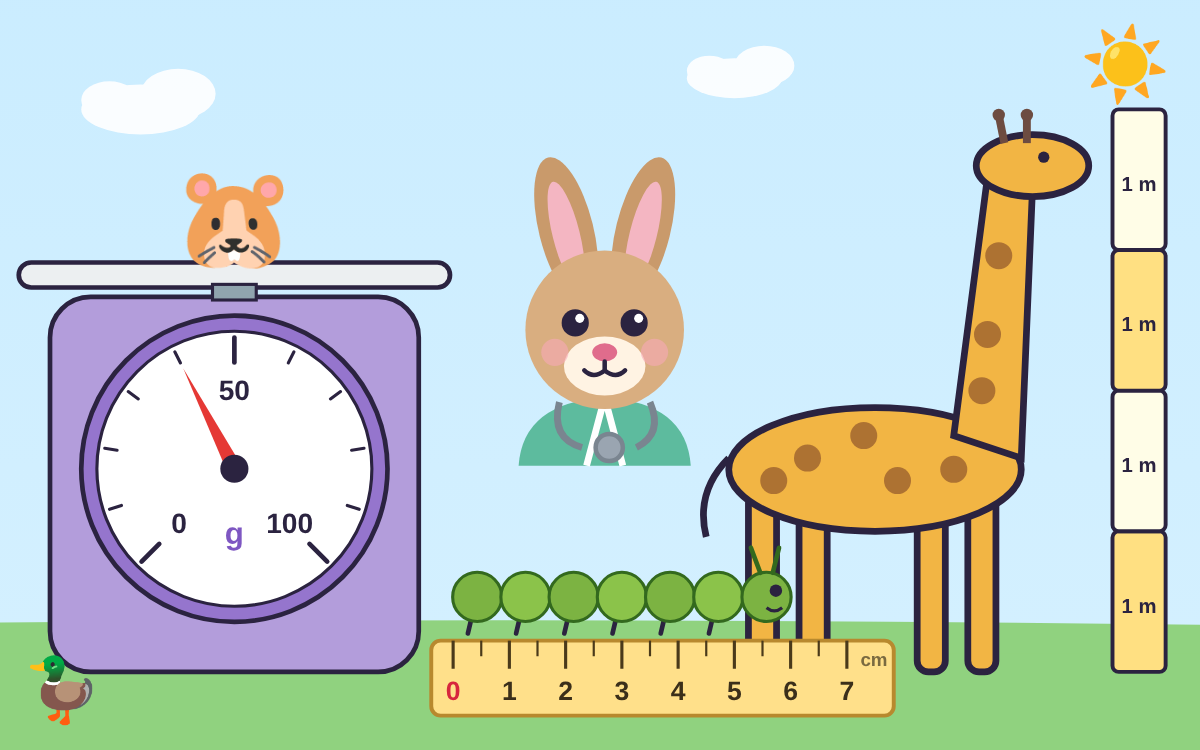
Line up a ruler at zero to measure a caterpillar and a worm in centimetres, measure height upwards, stack metre sticks against a giraffe and read a height chart counting in tens.
Year 2 maths · 1
Measuring mass in grams and kilograms with scales
Discover that bigger is not always heavier on a balance, balance a hamster with 10 gram weights, and read dial scales in grams and kilograms that count in 5s and 2s.
Year 2 maths · 1Year 2 maths · 2
Measuring capacity and volume in ml and litres with jugs
Learn the difference between volume and capacity, pour exactly 30 millilitres, read jugs and buckets in millilitres and litres, and test whether a tall vase really holds more than a wide bowl.
Year 2 maths · 1Year 2 maths · 2
Reading temperature in °C with a thermometer
See the red line rise and fall, learn that water freezes at 0 °C and boils at 100 °C, read and set thermometers that count in 2s and 5s, and decide which is colder.
Year 2 maths · 1
Comparing and ordering measurements with <, > and =
Use the greater than, less than and equals signs to compare lengths, volumes and masses, check the units before comparing, and order dogs by mass and places by temperature.
What the chapters cover in the national curriculum in England:
Year 2 maths: Choose and use appropriate standard units to estimate and measure length/height in any direction (m/cm); mass (kg/g); temperature (°C); capacity (litres/ml) to the nearest appropriate unit, using rulers, scales, thermometers and measuring vessels
Year 2 maths: Compare and order lengths, mass, volume/capacity and record the results using >, < and =
About this adventure
Measuring for Year 2 is an interactive maths game that teaches children aged 6–8 to choose standard units and measure length, height, mass, capacity and temperature, then compare the results using <, > and =. It follows the Year 2 national curriculum for England.
Players help Hattie the vet at Willow Wood Rescue. They slide a ruler so its zero lines up with a caterpillar, stack metre sticks against a giraffe, balance a hamster with 10 gram weights, pour water to an exact line in a measuring jug and drag a thermometer to the right temperature in degrees Celsius.
The key skill throughout is reading a scale: working out what each unlabelled mark is worth by counting in 2s, 5s and 10s. The game also tackles common mix-ups, such as starting a ruler at 1, thinking bigger things are always heavier, or thinking a taller container always holds more.
Questions and answers
What do children learn about measuring in Year 2?
In Year 2, children learn to choose and use standard units: centimetres and metres, grams and kilograms, millilitres and litres, and degrees Celsius. They estimate and measure with rulers, scales, jugs and thermometers, then compare and order results using <, > and =.
How do you read a scale when not every mark has a number?
Find two numbered marks, count the gaps between them, and work out what each gap is worth. For example, if 10 and 20 have four marks between them, each mark is worth 2, so you count 12, 14, 16, 18.
Why must you start measuring at zero on a ruler?
Zero is where the measurement starts, so the end of the object must line up with the 0 mark. Starting at 1 or at the edge of the ruler gives the wrong length, usually one centimetre too much or too little.
What age is this measuring game for?
It is designed for children aged 6 to 8, matching Year 2 in England (Key Stage 1). Year 3 children can also use it to revise measuring before adding and subtracting measures.
What does the game include and how long does it take?
There is an optional counting warm-up, six chapters with hands-on activities and a quick check in each, and a 10-question Rescue Challenge. Playing everything takes about 40 minutes, and each chapter can be played on its own.
We count visits to make TapLearn better.We use one cookie, only on this site, to see how families find and use it. No adverts, and nothing is shared.One cookie, only on this site. No adverts.How we measure
 TapLearn