What you'll learn
- How to line up the ends before comparing lengths and heights
- Measuring length with cubes end to end, with no gaps or overlaps
- Reading a centimetre ruler by starting at 0
- Why the heavier side of a balance scale goes down
- Using full, half full and empty, and measuring capacity with cups
- Comparing quicker and slower, and what takes seconds, minutes or hours
Chapter by chapter
- Lengths and heights: comparing longer, shorter and taller Free to try
Year 1 maths · 1
- Measuring length with cubes and a centimetre ruler
Year 1 maths · 2
- Mass and weight: heavier, lighter and measuring on a balance
Year 1 maths · 1 Year 1 maths · 2
- Capacity and volume: full, half full, empty and measuring with cups
Year 1 maths · 1 Year 1 maths · 2
- Time: quicker and slower, seconds, minutes and hours
Year 1 maths · 1 Year 1 maths · 2
- Measure Meadow Challenge (10 questions) (10 questions)
What the chapters cover in the national curriculum in England:
- Year 1 maths: Compare, describe and solve practical problems for: lengths and heights; mass/weight; capacity and volume; time
- Year 1 maths: Measure and begin to record the following: lengths and heights; mass/weight; capacity and volume; time (hours, minutes, seconds)
About this adventure
Measure Meadow is an interactive game about measuring for kids aged 5–6 that teaches how to compare and measure length, height, mass, capacity and time, matching Year 1 maths in England.
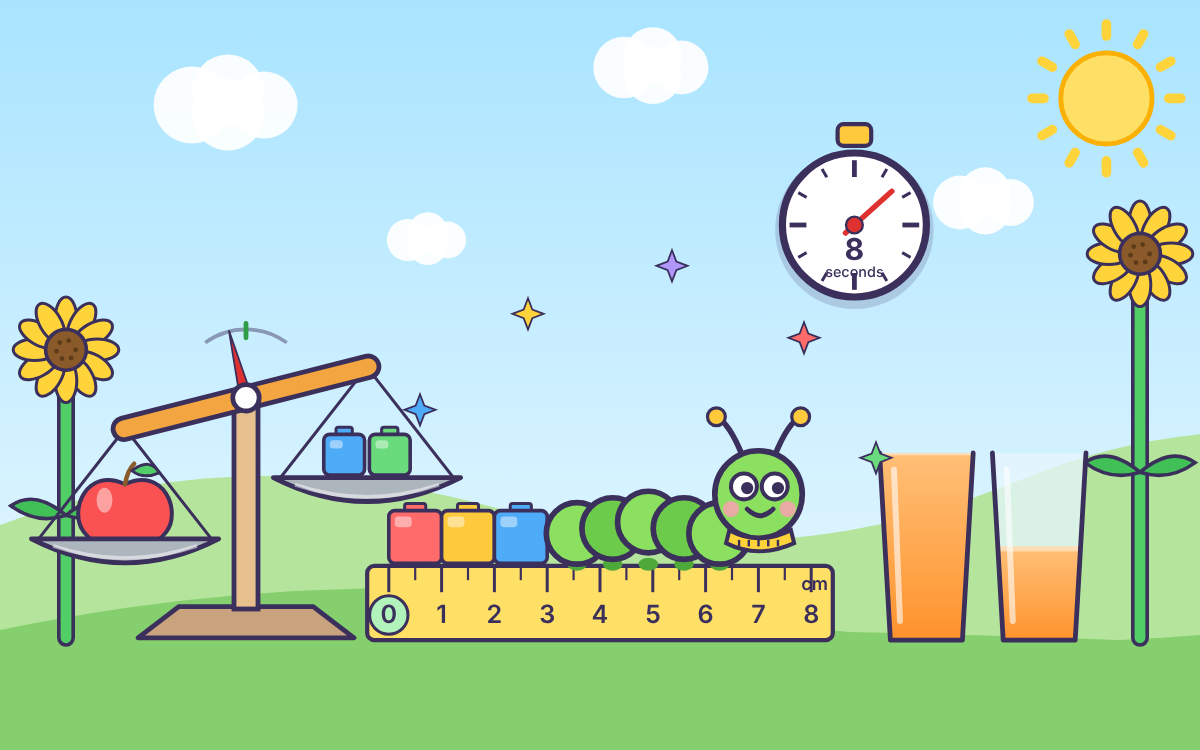
Inchy the inchworm reads every step aloud with captions. Children line up snakes at a start line before deciding which is longer, lay cubes end to end with no gaps or overlaps, and slide a crayon to 0 on a centimetre ruler. On a balance scale they see that the heavier side goes down, then add cubes until both sides are level to measure a pear.
They hold a tap to fill a glass, describe volume as full, half full or empty, and count cups to find capacity, which is how much a container can hold. Finally they race a rabbit against a snail and time a ladybird in seconds on a stopwatch.
Questions and answers
How do you teach measuring to a 5 year old?
Start by comparing two things directly with their ends lined up, then measure with equal-sized objects such as cubes laid end to end with no gaps. Once that makes sense, children can move on to a ruler, starting at 0.
How does a balance scale show which is heavier?
On a balance scale, the heavier side goes down and the lighter side goes up. When both sides are level they have the same mass, so you can measure an object by adding cubes until the balance is level.
Does a taller container always hold more?
No, a taller container does not always hold more. A short, wide bowl can hold more water than a tall, thin vase, which is why children count cups of water to compare capacity instead of judging by height.
What age is this measuring game for?
The game is for children aged 5 to 6 and follows Year 1 measurement in the national curriculum for England. Every line is read aloud and shown as a caption, so children who are still learning to read can play.
What does the measuring game include and how long does it take?
It has five chapters on comparing lengths, measuring with cubes and a ruler, mass, capacity and time, plus a counting warm-up and a 10-question challenge. Playing everything takes about 45 minutes, and children can start any chapter from the meadow map.


 TapLearn