What's new this year
Reception is the final year of the Early Years Foundation Stage (EYFS), which runs from birth to five. Most learning happens through play, songs, stories and conversation, with short whole-class sessions for phonics and maths that grow a little longer as the year goes on.
Teachers plan around seven areas of learning. Three are "prime" areas: communication and language; personal, social and emotional development; and physical development. Four are "specific" areas: literacy, mathematics, understanding the world, and expressive arts and design.
- Reception baseline assessment: a short, one-to-one set of practical tasks in the first six weeks. No score is given to you or used to label your child.
- Early learning goals: 17 goals describing what most children can do by the end of Reception.
- EYFS profile: in the summer term (April to June 2027) the teacher records whether your child is at the expected level for each goal or still "emerging". You'll hear about it in the end-of-year report.
Being ready to learn matters more than early academics. Putting on a coat, going to the toilet alone, listening to a story and asking for help are the skills that make the rest possible. Children arrive at very different points, and a summer-born child may be almost a year younger than some classmates.
Maths in Reception
- Counting objects, actions and sounds, and knowing the last number counted tells you how many.
- Spotting small amounts up to 5 without counting (called subitising).
- Number bonds to 5 and some to 10, including doubles such as 3 and 3.
- Comparing amounts (more, fewer, the same) and counting past 20 out loud.
- Noticing patterns: odd and even, sharing fairly, and exploring shapes, size and position through play.
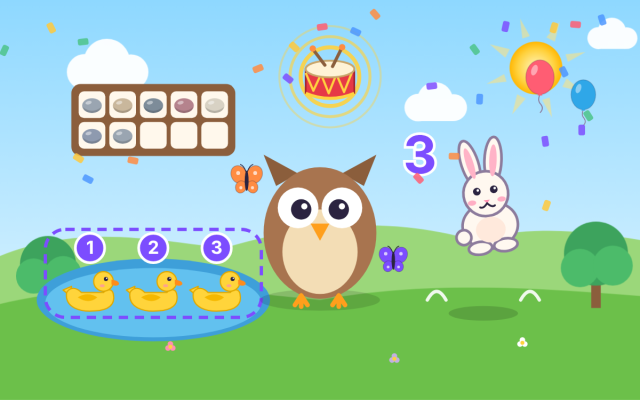
Counting Objects, Actions and Sounds: Count with Ollie
Learn counting objects, actions and sounds: say one number for each thing and find out how many. Count ducks,…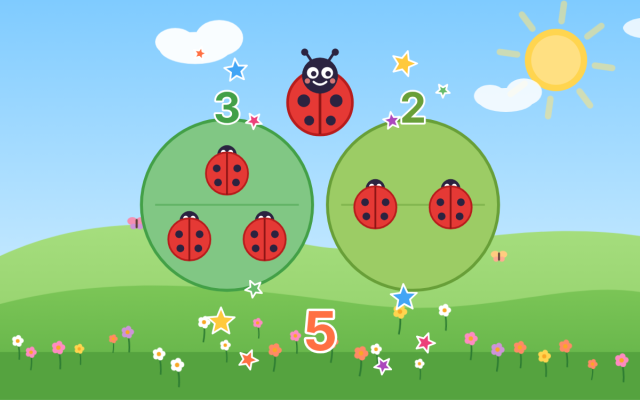
Subitising to 5: Spot It Quick with Dotty the Ladybird
Learn subitising to 5: seeing how many there are without counting. Spot dot patterns, dice, fingers and tens…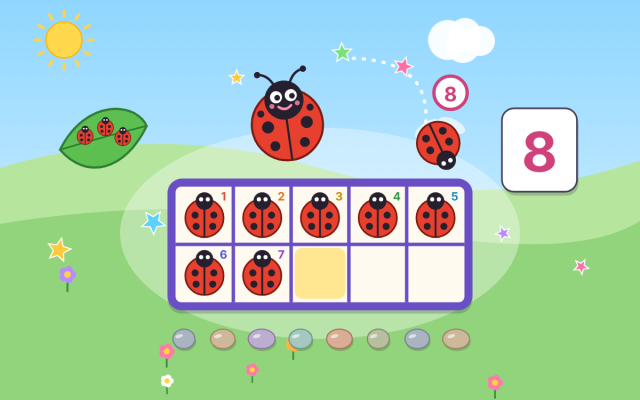
Counting to 10: Tens Frames and Pebbles with Dotty
Learn counting to 10 and match numerals 0 to 10 to amounts by counting pebbles, filling tens frames and loadi…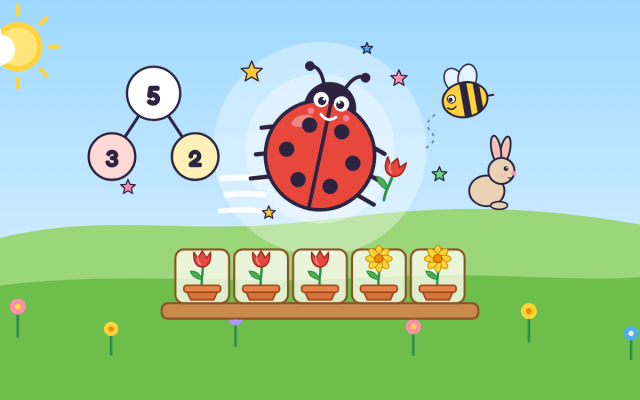
Number Bonds to 5 and 10: Dot the Ladybird's Garden
Learn number bonds to 5 and 10, take-away facts and doubles by growing flowers, sending bunnies home and fill…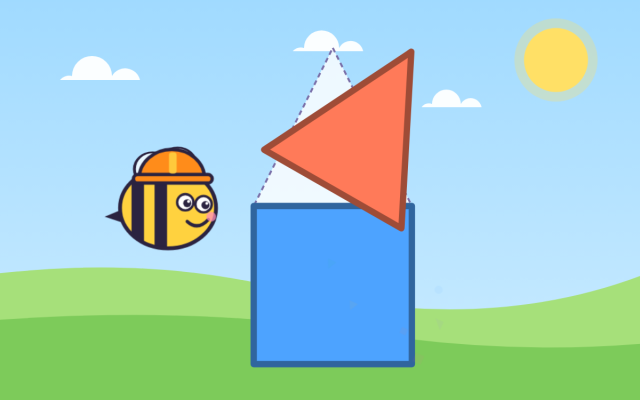
Shape Puzzles: Turn, Fit and Build with Bea the Bee
Learn to turn, fit and join shapes with these shape puzzles for Reception: build pictures, cut shapes apart a…Reading, writing and talk in Reception
- Phonics: a short daily lesson, learning the sound each letter or letter group makes and blending sounds to read simple words.
- Tricky words: a few common words, such as "the" and "was", that can't be fully sounded out yet.
- Talk and stories: listening, retelling stories, learning new words, rhymes and songs.
- Writing: forming recognisable letters, spelling simple words by their sounds, and by the summer writing short phrases or sentences.
- Hand strength: play dough, threading and drawing build the control needed for a pencil.
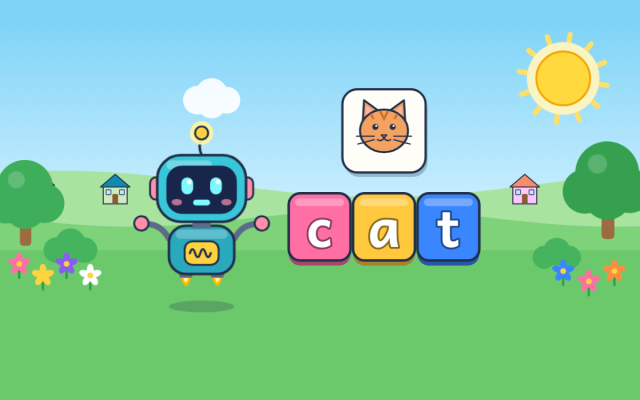
Letter Sounds and Blending: Read Words with Bip the Robot
Learn letter sounds and blending: match letters to sounds, hear first sounds and push sounds together to read…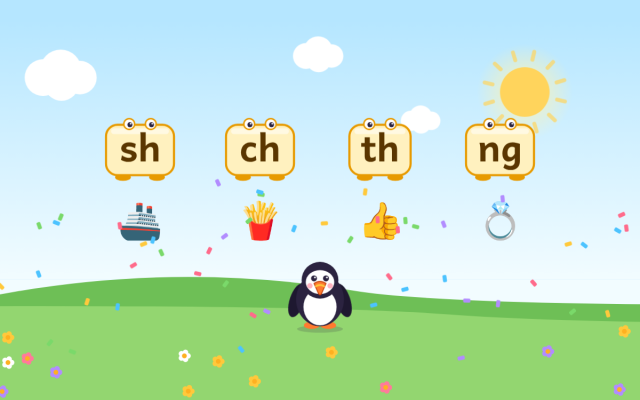
Phonics Digraphs: Two Letters, One Sound with Pip
Learn phonics digraphs such as sh, ch, ai and igh. Drag letters into teams, tap sound buttons and blend words…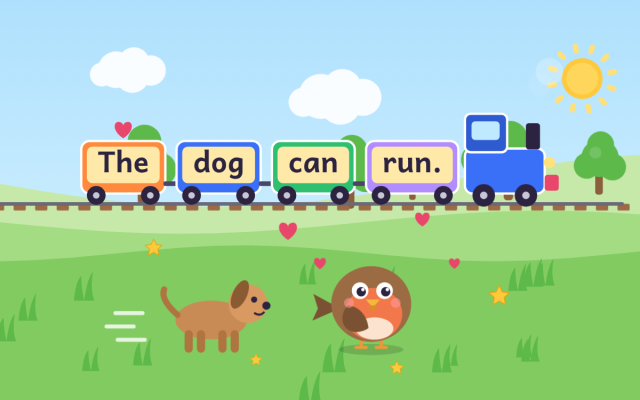
Tricky Words for Reception: Read with Pip the Robin
Learn to read the tricky words the, I, to, no and go, spot the tricky part of each, then read sentences and a…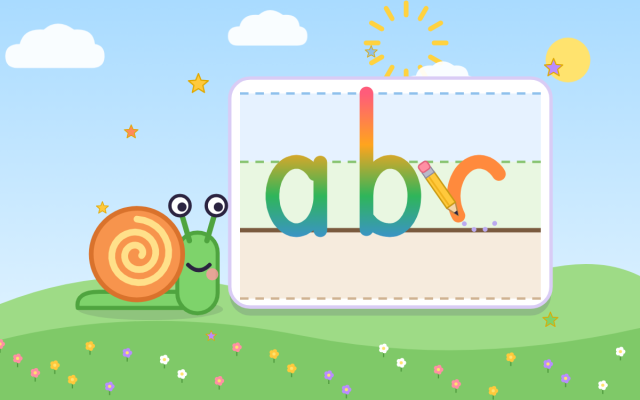
Letter Formation: Trace and Write with Squiggle the Snail
Learn letter formation: where each letter starts and which way to go. Trace, then write lower-case and capita…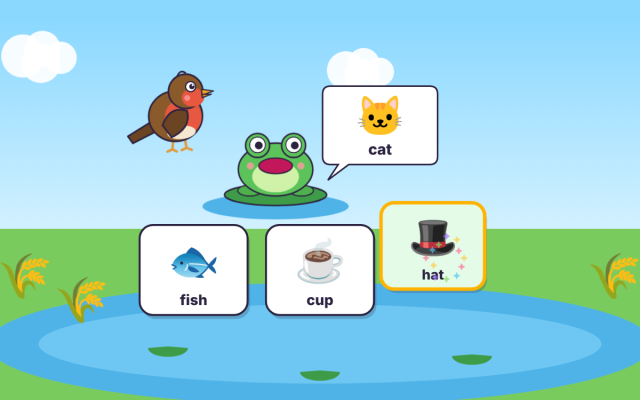
Nursery Rhymes and Rhyming Words: Sing with Ruby the Robin
Learn nursery rhymes and rhyming words: hear which words rhyme, feed rhymes to Freddie the frog and learn Twi…Understanding the world and creative play
Through play and outings children talk about the seasons, plants and animals, people who help us, and how life was different in the past, often through stories. They explore their local area and learn about festivals and celebrations, for example. Art, music, dance and role play sit in "expressive arts and design".
This year's topics, subject by subject
The roadmaps below show the order in which topics usually build up through Reception, subject by subject. Schools teach in different orders, so treat them as a guide to what's coming rather than a timetable.
Maths 13 topics, 5 coming soon
- Counting objects, actions and sounds (Reception)
- Subitising to 5 (Reception)
- Numbers and how many (Reception)
- Repeating patterns (Reception) coming soon
- More, fewer or the same? (Reception) coming soon
- One more, one less (Reception) coming soon
- Shapes: turn, fit and build (Reception)
- Where is it? Position words (Reception) coming soon
- Making numbers to 10 (Reception)
- Longer, heavier, holds more (Reception) coming soon
- Number bonds to 5 and 10 (Reception)
- Counting to 20 and beyond (Reception)
- Doubles, odds, evens and sharing (Reception)
English 24 topics, 18 coming soon
- Good listening (Reception) coming soon
- Rhymes, songs and poems (Reception)
- Letter sounds and blending (Reception)
- Pencil grip, scissors and small tools (Reception) coming soon
- Forming letters (Reception)
- Two letters, one sound (Reception)
- Tricky words (Reception)
- Spelling by sounds (Reception) coming soon
- Must-know spellings (Reception) coming soon
- Reading simple sentences (Reception) coming soon
- New words every day (Reception) coming soon
- Must-know vocabulary (Reception) coming soon
- Talking in full sentences (Reception) coming soon
- Story time: listen and join in (Reception) coming soon
- Retelling stories you know (Reception) coming soon
- Role play and making up stories (Reception) coming soon
- Finding out from information books (Reception) coming soon
- Explaining why (Reception) coming soon
- Writing a sentence (Reception) coming soon
- Writing great sentences (Reception)
- Thinking like a writer (Reception) coming soon
- Putting ideas in order (Reception) coming soon
- Writing stories (Reception) coming soon
- Making your writing amazing (Reception) coming soon
Science 2 topics, 2 coming soon
- Plants and animals around us (Reception) coming soon
- Seasons, melting and freezing (Reception) coming soon
History 1 topic, 1 coming soon
- Then and now: old and new things (Reception) coming soon
Earth & Geography 3 topics, 3 coming soon
- My school, my street and simple maps (Reception) coming soon
- Seaside, jungle and icy lands (Reception) coming soon
- Life in other countries (Reception) coming soon
Schools teach topics in different orders, so use this as a guide. Open the roadmaps, pick the school year, and follow the steps.
How you can help at home
- Share a book every day, even for five minutes. Talk about the pictures and ask what might happen next.
- Practise independence: coats, shoes, opening a lunch box, washing hands.
- Count real things together: stairs, grapes, red cars. Ask "how many altogether?"
- Ask the teacher which phonics programme the school uses and how they say the sounds, so you say them the same way. Our guide to phonics at home explains more.
- Play simple turn-taking games such as snap or a board game with a dice.
 TapLearn