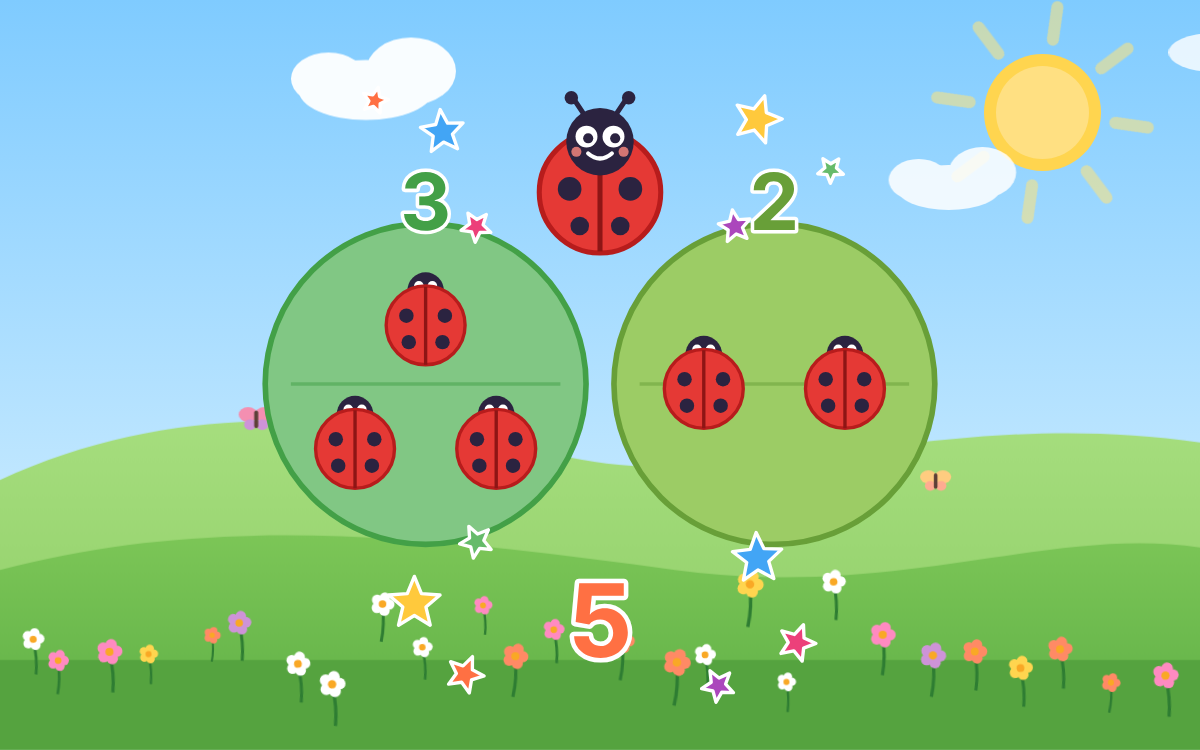
What you'll learn
- Say how many in a group of up to 5 without counting
- Recognise the dice patterns for 1 to 5, like 4 as a square
- Show numbers to 5 on fingers and know a whole hand is 5
- Read up to 5 counters on a tens frame at a glance
- Spot small groups inside 4 and 5, such as 3 and 2
- Count to check, knowing the last number said tells how many
Chapter by chapter
- Subitising 1, 2 and 3: seeing how many without counting Free to try
Reception maths · 1 Reception maths · 2
- Dot patterns and dice: subitising up to 5
Reception maths · 1 Reception maths · 2
- Finger patterns: subitising fingers up to 5
Reception maths · 1 Reception maths · 2
- Tens frames: subitising up to 5 counters
Reception maths · 1
- Small groups inside 4 and 5: subitise, then count to check
Reception maths · 1 Reception maths · 2
- Flash challenge: subitise up to 5 (10 questions)
What the chapters cover in the national curriculum in England:
- Reception maths: Subitise (recognise quantities without counting) up to 5
- Reception maths: Subitise
About this adventure
Subitising to 5 is an interactive maths game that teaches Reception children aged 4–5 to see how many things there are, up to 5, without counting them one by one. Subitising means knowing how many at a glance, and it is an Early Learning Goal in the EYFS.
Dotty the ladybird shows a small group for a moment, then a leaf covers it. Children tap the number they saw, then tap each item to count and check. Along the way they learn the dot patterns on a dice, show numbers on a hand, read counters on a tens frame and spot smaller groups hiding inside bigger ones.
Every instruction is spoken aloud, so children don't need to read. A short counting warm-up comes first for anyone who needs it, and a 10-question flash challenge at the end mixes everything together.
Questions and answers
What is subitising?
Subitising is knowing how many things there are just by looking, without counting them one by one. The word comes from a Latin word meaning 'suddenly'. Most people can subitise small groups of up to about four or five things.
Why is subitising important for young children?
Subitising helps children understand what numbers really mean. When they can see 5 as 3 and 2, they are building the number sense that later supports adding, subtracting and number bonds.
How can I help my child practise subitising at home?
Show a small group of objects, such as spoons or grapes, for a second, then hide it and ask how many. Afterwards, count them together to check. Dice games, showing numbers on fingers and an egg box used as a tens frame all help too.
What age is this subitising game for?
This game is for children aged 4 to 5 in Reception, the final year of the Early Years Foundation Stage. It matches the Reception goal of subitising up to 5, and all instructions are read aloud for children who are not yet reading.
What does the subitising game include and how long does it take?
The game has five short chapters, an optional counting warm-up and a 10-question flash challenge. Playing everything takes about 30 minutes, and children can choose any chapter and play one at a time.
More to explore
See all
Odd and Even Numbers: Pair Up Puffins with Pip
Learn to spot odd and even numbers using pairs, the 2 times table and the ones digit, by pairing puffins in b…
Counting to 20 and Beyond: Hop the Lily Pond with Pip
Learn counting to 20 and beyond, past 10 and on to 30, by tapping lily pads as Pip the frog hops along and ch…
Roman Numerals to 1,000: A Roma Town Quest with Octavia
Learn to read Roman numerals to 1,000 and recognise years like MMXXVI by splitting numerals into chunks and s…
Negative Numbers: Counting Below Zero with Pip the Penguin
Learn what negative numbers are, read temperatures below zero and count through zero, helping Pip the penguin…
Factors, Multiples and Primes: A Number Isle Adventure
Learn to find common factors, common multiples and prime numbers by planting flower beds, timing lighthouse f…
Numbers to 20: Count, Read and Compare with Dotty
Learn to read, write and compare numbers to 20 by counting apples, filling ten frames, hopping a frog along a…
Place Value to 10 Million: A Space Mission with Digi
Learn place value to 10 million: read, write, compare and order big numbers by building millions on a chart a…
 TapLearn