Number Bonds to 5 and 10: Dot the Ladybird's Garden
Learn number bonds to 5 and 10, take-away facts and doubles by growing flowers, sending bunnies home and filling a ten-frame bus with Dot.
- Ages 4–6
- About 40 min
- Easy start
- Calculation
Learn number bonds to 5 and 10, take-away facts and doubles by growing flowers, sending bunnies home and filling a ten-frame bus with Dot.
Reception maths · 1 Reception maths · 2
Reception maths · 1 Reception maths · 2
Reception maths · 1 Reception maths · 2
Reception maths · 1 Reception maths · 2
Reception maths · 1
What the chapters cover in the national curriculum in England:
Number Bonds to 5 and 10 is an interactive maths game that teaches children aged 4 to 6 to recall number bonds up to 5, take-away facts, double facts and some bonds to 10 without counting. It follows the Reception (EYFS) maths goals for England.
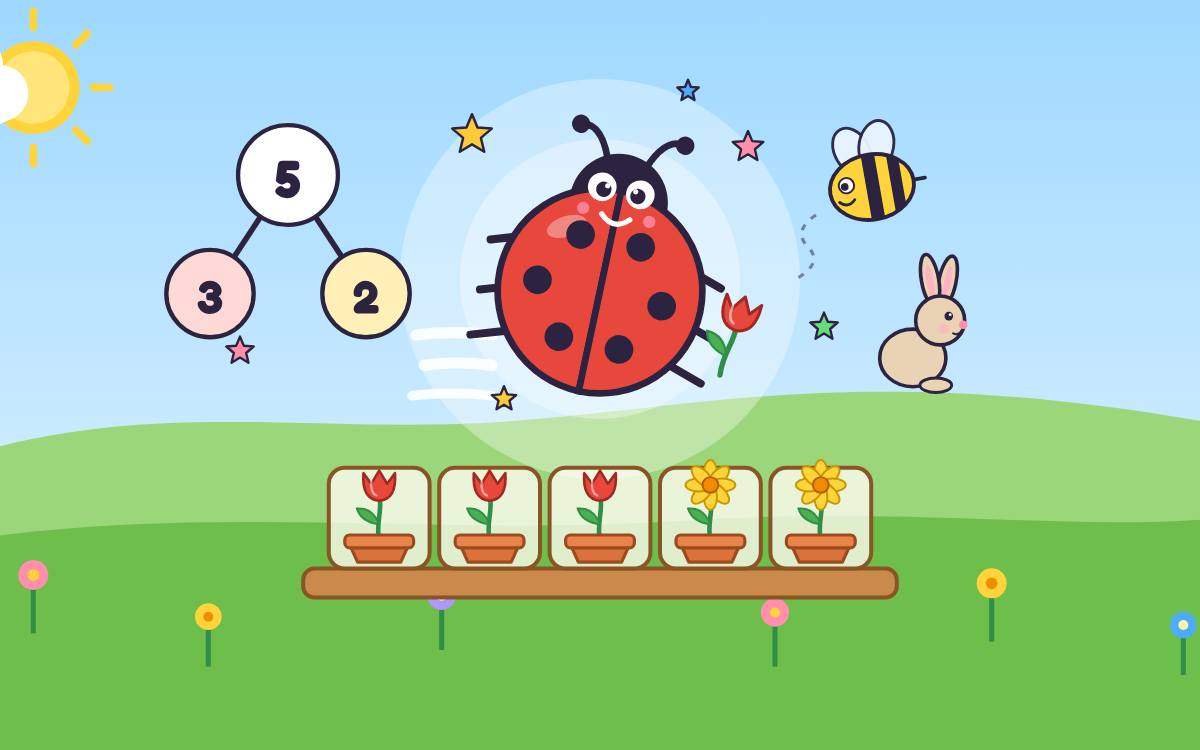
Dot the ladybird talks children through each step. They change flowers on a five frame to find every pair that makes 5, send bunnies into a burrow to see what is left, copy spots onto a ladybird's wing to make doubles, and fill empty seats on a bus shaped like a ten frame.
A part-whole model (a whole number at the top, two parts below) appears throughout, so children see how two parts make a whole. In practice rounds the missing part hides behind a bush or curtain, which nudges children to remember the fact instead of counting.
A number bond is a pair of numbers that make a whole number, like 3 and 2 making 5. Children often show it as a part-whole model, with the whole at the top and the two parts underneath.
The number bonds to 10 are 0 and 10, 1 and 9, 2 and 8, 3 and 7, 4 and 6, and 5 and 5, plus the same pairs swapped round. Reception children are expected to know some of these by heart.
Each number bond also gives take-away facts. If a child knows 3 and 2 make 5, they also know that 5 take away 2 is 3 and 5 take away 3 is 2, without needing to count back.
In England, children are expected to recall number bonds up to 5, including take-away facts and some bonds to 10, by the end of Reception, when they are about 5. This game suits ages 4 to 6.
The game has five short chapters, an optional warm-up and a ten-question star challenge, taking about 40 minutes in all. Children can choose any chapter from the garden map and play one at a time.

 TapLearn
Getting it ready…
Great work on chapter 1! To open the next chapters, ask a grown-up to take a look.
To play this game, ask a grown-up to take a look. There are lots of free games you can play right now too!
Create a free family account and your child can play every chapter of every game for 7 days, with no card needed. Their progress is kept. After that, the free plan is free for ever, and membership is £6.99 a month if you'd like to keep every chapter.
That's all the learning time for today. Great work! Flip will be ready to play again tomorrow.