Sentence endings worksheet for Year 1: Sensible endings
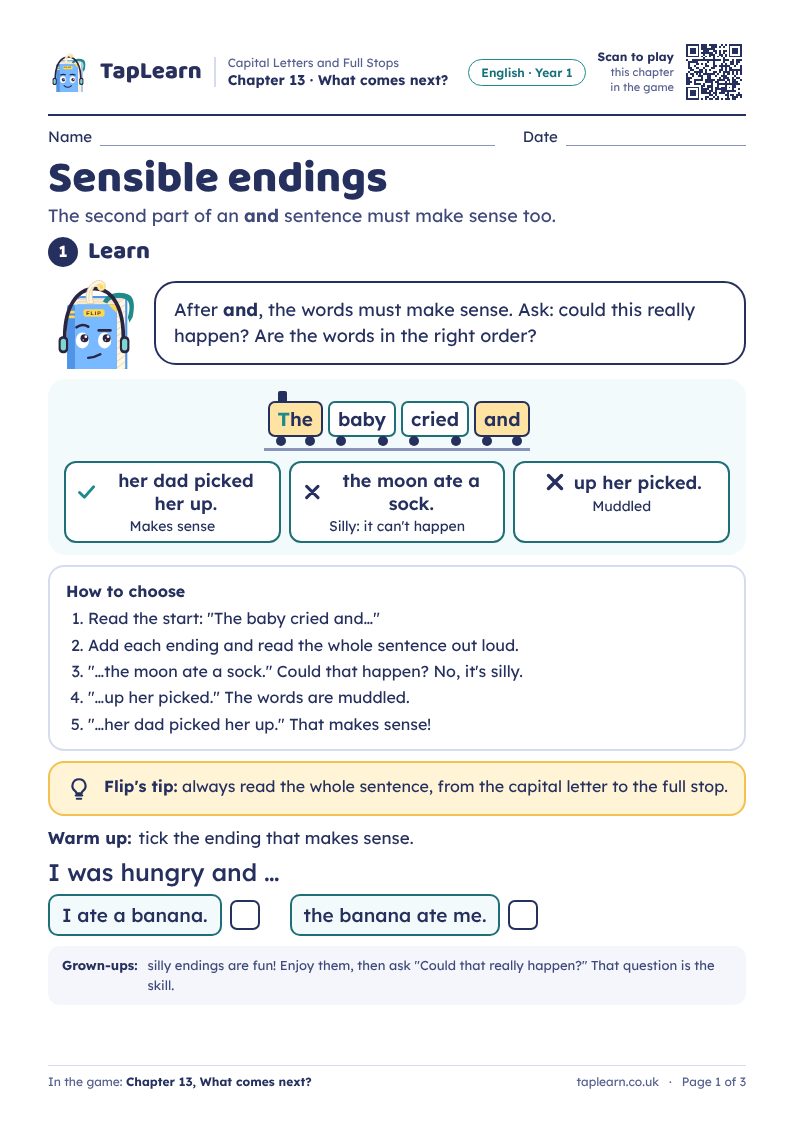
Sensible Endings is a printable sentence endings worksheet for Year 1 (ages 5 to 6) that teaches children to choose and write sensible endings for sentences with and, and to spot endings that are silly or muddled. It covers the Year 1 English statements on how words can combine to make sentences and joining clauses using and.
Free to print, no account needed.
Print it on A4, in colour or black and white. Do it after the chapter, or before it to see what your child already knows.
What's on the worksheet
Your child chooses and writes sensible endings for sentences with and, spotting endings that are silly or muddled. Includes a finish-my-sentence talk game and an answers sheet.
- Page 1 · Learn
- Three endings for The baby cried and… show a sensible one, a silly one and a muddled one, with steps for choosing and a warm-up.
- Page 2 · Try it together
- Finish my sentence: the grown-up says a start like "I went outside and…" and your child finishes it sensibly, sometimes slipping in a silly ending for the grown-up to spot.
- Page 3 · Practise
- Ring the ending that makes sense, finish three and sentences, tick sensible and cross silly sentences, write your own and sentence, and a challenge.
- Answers sheet
- Every answer, mix-ups like calling a sad sentence silly, and story starts and silly swap games.
3 A4 pages and an answers sheet · about 20 minutes
Using it at home
- Enjoy the silly endings, then ask "Could that really happen?" That question is the skill on this sheet.
- If your child's ending is muddled, say it back exactly as they said it and let them fix it.
- Try more starts on a walk, like "We saw a dog and…", and take turns to finish them.
Watch out for
- Choosing the muddled ending because it has the right words, like bath a gave.
- Read it aloud as part of the whole sentence.
- Calling something silly because it is sad or surprising, like the cup broke.
- Explain that silly means it couldn't really happen.
- Forgetting the full stop after writing an ending.
- The whole joined sentence still needs one full stop at the end.
Questions from the worksheet
- Draw a ring round the ending that makes sense: The dog was muddy and … the bath ate it. / we gave it a bath. / bath a gave.
- Finish each sentence. Make it make sense: It was cold and
- Silly or sensible? The car ate a cake and it smiled.
- Now write a whole sentence of your own with and.
- Leo says The cup fell and it broke. is a silly sentence. Is he right? Why?
The answers are on the answers sheet, for grown-ups.
National curriculum in England
This worksheet practises these statements from the Year 1 english programme of study:
- Develop their understanding of the concepts set out in English appendix 2 by: leaving spaces between words
- Develop their understanding of the concepts set out in English appendix 2 by: joining words and joining clauses using 'and'
- Develop their understanding of the concepts set out in English appendix 2 by: learning the grammar for year 1 in English appendix 2
- Sentence: how words can combine to make sentences; joining words and joining clauses using and
In the classroom
- Play finish my sentence round the class, with children giving a thumbs down when an ending is silly or muddled.
- Use silly swap as a starter: say a sensible sentence, change one word to make it silly, and ask the class to fix it.
Questions and answers
What is a sensible sentence ending?
A sensible ending could really happen and has its words in the right order, such as The dog was muddy and we gave it a bath.
What is the difference between a silly and a muddled sentence?
A silly sentence has words in order but couldn't really happen, like the moon ate a sock. A muddled sentence has its words in the wrong order.
Is a sad sentence a silly sentence?
No. The cup fell and it broke is sad but it could really happen, so it makes sense.
More worksheets from Capital Letters and Full Stops: A Sentence Train Adventure
- Chapter 1: What is a sentence worksheet: What is a sentence? Free
- Chapter 2: Building sentences worksheet Free
- Chapter 3: Sentences that make sense worksheet: Sense or muddle? Free
- Chapter 4: Capital letters worksheet Free
- Chapter 5: Matching capital letters worksheet: Letter partners Free
- Chapter 6: When to use capital letters worksheet: Capital letter jobs Free
- Chapter 7: Correcting capital letters worksheet: Capital fix-up Free
- Chapter 8: Full stops worksheet Free
- Chapter 9: Where full stops go worksheet Free
- Chapter 10: Capital letters and full stops worksheet: Sentence check Free
- Chapter 11: Joining words with and worksheet: Joining with and Free
- Chapter 12: Joining clauses with and worksheet: Join two ideas Free
 TapLearn