Capital letters and full stops worksheet for Year 1: Sentence check
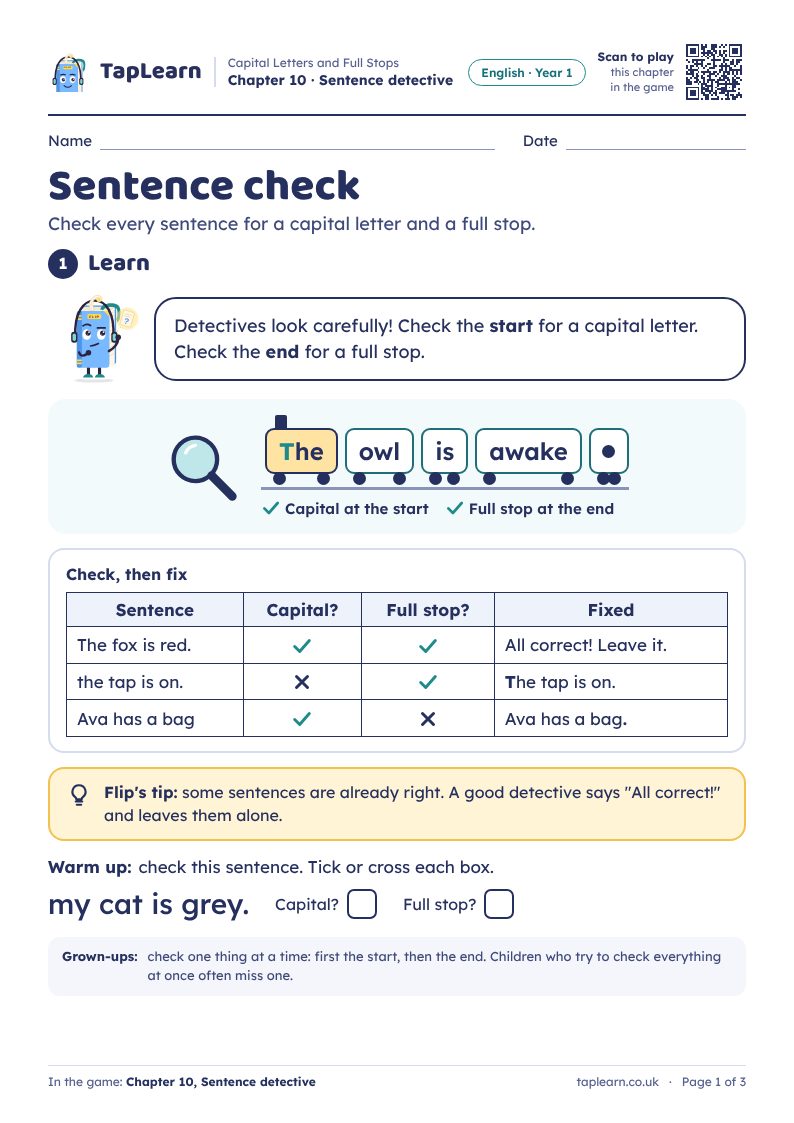
Sentence Check is a printable capital letters and full stops worksheet for Year 1 (ages 5 to 6) that teaches children to check each sentence for a capital letter at the start and a full stop at the end. Children fix the mistakes, leave correct sentences alone and find four mistakes in a short story.
Free to print, no account needed.
Print it on A4, in colour or black and white. Do it after the chapter, or before it to see what your child already knows.
What's on the worksheet
Your child checks sentences for a capital letter at the start and a full stop at the end, fixes the mistakes and leaves correct sentences alone. Includes a detective cards game and an answers sheet.
- Page 1 · Learn
- A check-then-fix table shows one correct sentence, one missing a capital and one missing a full stop, with Flip's 'All correct!' tip and a warm-up.
- Page 2 · Try it together
- Detective cards: the grown-up writes 6 sentences with some mistakes, and your child checks each one with a cardboard spyglass, sorts them into correct and needs fixing, then fixes them.
- Page 3 · Practise
- Tick or cross five sentences for capitals and full stops, rewrite the ones with mistakes, find and fix 4 mistakes in Ava's story, and a challenge about a correct sentence.
- Answers sheet
- Every answer with all four story fixes, the mix-ups to watch for, and check-my-writing and spot-it-in-a-book games.
3 A4 pages and an answers sheet · about 20 minutes
Using it at home
- Check one thing at a time: first the start, then the end. Children who check everything at once often miss one.
- Include the 'all correct' cards in detective cards: they show your child that not every sentence needs changing.
- Write a shopping list sentence and ask your child to check the start and the end.
Watch out for
- Missing the capital at the start, or on a name like Pip.
- Check the start first, every time, then look for names.
- Missing a full stop where one sentence runs into the next, like fish she.
- Read the story aloud and listen for where each idea ends.
- Changing a sentence that is already right.
- Praise "All correct!" as much as a good fix.
Questions from the worksheet
- Be a detective. Tick or cross each box for a capital and a full stop: we can see a boat.
- Tick or cross each box: The duck swims
- Find and fix 4 mistakes in Ava's story: my cat is called pip. She likes fish she sleeps on my bed.
- Leo says We play in the garden. needs fixing. Does it? How do you know?
The answers are on the answers sheet, for grown-ups.
National curriculum in England
This worksheet practises these statements from the Year 1 english programme of study:
- Develop their understanding of the concepts set out in English appendix 2 by: leaving spaces between words
- Develop their understanding of the concepts set out in English appendix 2 by: joining words and joining clauses using 'and'
- Develop their understanding of the concepts set out in English appendix 2 by: learning the grammar for year 1 in English appendix 2
- Sentence: how words can combine to make sentences; joining words and joining clauses using and
In the classroom
- Run detective cards as a group sort, with sentences on cards and two hoops for all correct and needs fixing.
- Use Ava's story as a shared write: children spot the mistakes one at a time on the board.
Questions and answers
What should Year 1 children check in a sentence?
They check for a capital letter at the start and a full stop at the end, and that the words make sense. Names and I need capitals too.
Should every sentence be corrected?
No. Some sentences are already right, and a good checker says "All correct!" and leaves them alone.
How can children check their own writing?
Point to the start of each sentence for a capital letter, then the end for a full stop. Checking one thing at a time works best.
More worksheets from Capital Letters and Full Stops: A Sentence Train Adventure
- Chapter 1: What is a sentence worksheet: What is a sentence? Free
- Chapter 2: Building sentences worksheet Free
- Chapter 3: Sentences that make sense worksheet: Sense or muddle? Free
- Chapter 4: Capital letters worksheet Free
- Chapter 5: Matching capital letters worksheet: Letter partners Free
- Chapter 6: When to use capital letters worksheet: Capital letter jobs Free
- Chapter 7: Correcting capital letters worksheet: Capital fix-up Free
- Chapter 8: Full stops worksheet Free
- Chapter 9: Where full stops go worksheet Free
- Chapter 11: Joining words with and worksheet: Joining with and Free
- Chapter 12: Joining clauses with and worksheet: Join two ideas Free
- Chapter 13: Sentence endings worksheet: Sensible endings Free
 TapLearn