Full stops worksheet for Year 1
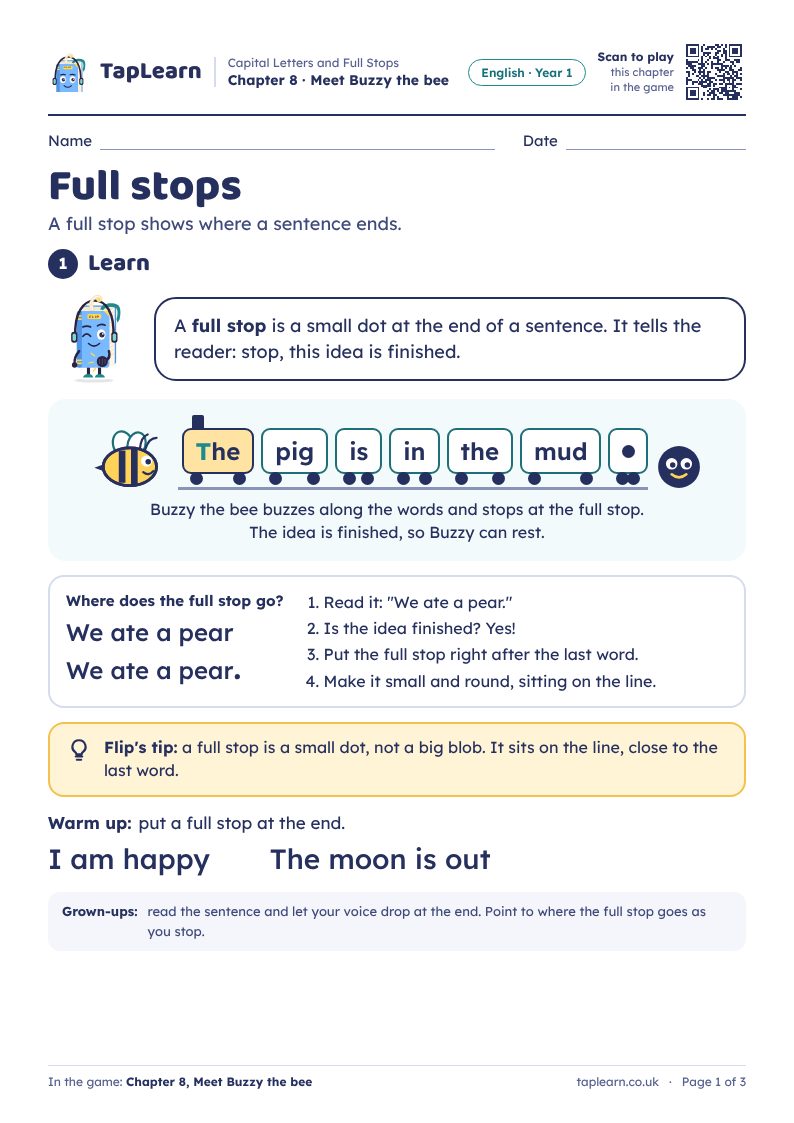
Full Stops is a printable full stops worksheet for Year 1 (ages 5 to 6) that teaches children that a full stop is a small dot that ends a sentence when the idea is finished. Children add full stops, tick sentences that have one, copy a sentence and write their own.
Free to print, no account needed.
Print it on A4, in colour or black and white. Do it after the chapter, or before it to see what your child already knows.
What's on the worksheet
Your child learns that a full stop ends a sentence when an idea is finished, adds full stops to sentences and spots ones that are missing. Includes a stop-and-go walking game and an answers sheet.
- Page 1 · Learn
- Buzzy the bee buzzes along a sentence and stops at the full stop, with steps for placing a full stop after We ate a pear and a warm-up adding full stops.
- Page 2 · Try it together
- Stop and go walk: take one step for each word as a grown-up reads a sentence, freeze at the full stop, and count the steps to find how many words.
- Page 3 · Practise
- Add full stops to four sentences, tick or cross sentences with and without full stops, copy a sentence, write your own about a bee, and a challenge.
- Answers sheet
- Every answer, the most common full stop slips, and full stop spotter and freeze games.
3 A4 pages and an answers sheet · about 20 minutes
Using it at home
- Read a sentence aloud and let your voice drop at the end, pointing to where the full stop goes as you stop.
- Say "full stop!" as you both freeze in the stop and go walk. It links the dot with the end of the idea.
- After your child writes a sentence, ask "Has your sentence got a full stop?"
Watch out for
- Forgetting the full stop at the end.
- This is the most common slip. After writing, ask "Has your sentence got a full stop?"
- Putting full stops after every word or in the middle of an idea.
- Read it aloud and stop at each dot: does it sound finished?
- A big blob or a full stop floating in the air.
- Show that a full stop is a small dot, on the line, close to the last word.
Questions from the worksheet
- Put a full stop at the end of each sentence: I have a red bike
- Tick the sentences that have a full stop. Put a cross if the full stop is missing: My hat is blue
- Copy this sentence. Remember the full stop! The bee is on the flower.
- Write your own sentence about a bee.
- Tom wrote: The cat. is black. Is the full stop in the right place? Write it the right way.
The answers are on the answers sheet, for grown-ups.
National curriculum in England
This worksheet practises these statements from the Year 1 english programme of study:
- Develop their understanding of the concepts set out in English appendix 2 by: leaving spaces between words
- Develop their understanding of the concepts set out in English appendix 2 by: joining words and joining clauses using 'and'
- Develop their understanding of the concepts set out in English appendix 2 by: learning the grammar for year 1 in English appendix 2
- Sentence: how words can combine to make sentences; joining words and joining clauses using and
In the classroom
- Play the freeze game as a starter: read sentences aloud and the class claps once when each one is finished.
- Use the stop and go walk with the whole class in a line, freezing together at each full stop.
Questions and answers
What is a full stop?
A full stop is a small dot at the end of a sentence. It tells the reader to stop because the idea is finished.
Where does a full stop go?
A full stop goes right after the last word of a sentence, sitting on the line, when the idea is finished.
Why can't a full stop go after 'The cat'?
The cat is not a finished idea, because it doesn't tell us anything about the cat yet. The full stop goes at the end: The cat is black.
More worksheets from Capital Letters and Full Stops: A Sentence Train Adventure
- Chapter 1: What is a sentence worksheet: What is a sentence? Free
- Chapter 2: Building sentences worksheet Free
- Chapter 3: Sentences that make sense worksheet: Sense or muddle? Free
- Chapter 4: Capital letters worksheet Free
- Chapter 5: Matching capital letters worksheet: Letter partners Free
- Chapter 6: When to use capital letters worksheet: Capital letter jobs Free
- Chapter 7: Correcting capital letters worksheet: Capital fix-up Free
- Chapter 9: Where full stops go worksheet Free
- Chapter 10: Capital letters and full stops worksheet: Sentence check Free
- Chapter 11: Joining words with and worksheet: Joining with and Free
- Chapter 12: Joining clauses with and worksheet: Join two ideas Free
- Chapter 13: Sentence endings worksheet: Sensible endings Free
 TapLearn