Where full stops go worksheet for Year 1
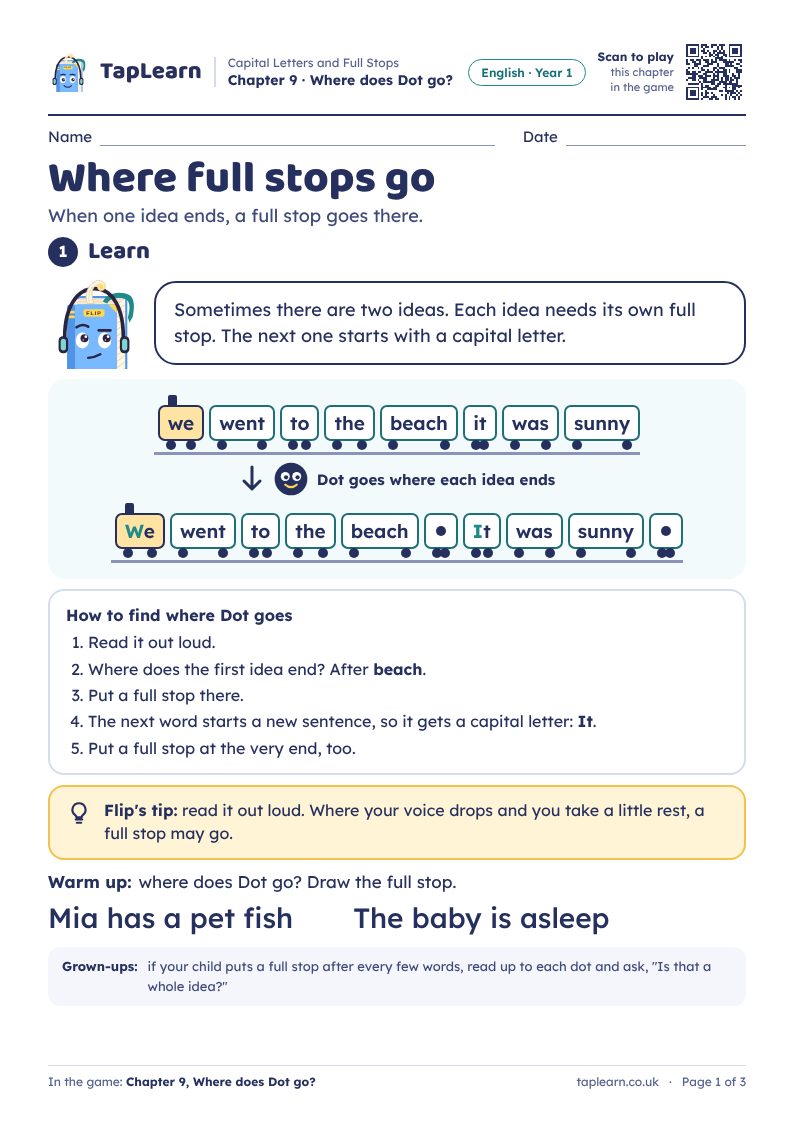
Where Full Stops Go is a printable where full stops go worksheet for Year 1 (ages 5 to 6) that teaches children to find where one idea ends, put a full stop there and start the next sentence with a capital letter. Children split lines into two sentences, count sentences by their full stops and write two of their own.
Free to print, no account needed.
Print it on A4, in colour or black and white. Do it after the chapter, or before it to see what your child already knows.
What's on the worksheet
Your child finds where one idea ends, puts a full stop there and starts the next sentence with a capital letter. Includes a two-idea talk activity with a toy or picture book and an answers sheet.
- Page 1 · Learn
- Dot shows where each idea ends in we went to the beach it was sunny, with five steps for placing full stops and capitals and a warm-up.
- Page 2 · Try it together
- Two-idea talk: your child says two sentences about a toy or picture, the grown-up writes them as one long line, and your child adds the full stops and the capital in colour.
- Page 3 · Practise
- Put two full stops into lines like I have a dog he is big and ring the capital, count the sentences in short passages, write two sentences about food, and a challenge.
- Answers sheet
- Every answer, mix-ups like one full stop at the end of two ideas, and two-things and count-the-sentences games.
3 A4 pages and an answers sheet · about 20 minutes
Using it at home
- Read the line aloud with your child and listen for where your voice drops and takes a little rest.
- The second sentence often starts with he, she, it or they. Point out that it needs a capital because it starts a new sentence.
- If your child puts a full stop after every few words, read up to each dot and ask "Is that a whole idea?"
Watch out for
- Putting only one full stop at the very end of two ideas.
- Ask "How many ideas are there?" Each idea needs its own full stop.
- Forgetting the capital after the full stop, as in We had a picnic. it was fun.
- A new sentence always starts with a capital letter.
- Putting a full stop at the end of each line of writing.
- Full stops go where the idea ends, not where the line ends.
Questions from the worksheet
- Each line has two sentences. Put in the two full stops. Then ring the letter that needs to be a capital: We had a picnic it was fun
- How many sentences? Count the full stops: The sun came out. We went to the park. Ben ran fast.
- Write two sentences about your favourite food. Start each one with a capital letter and end it with a full stop.
- Mia wrote: I like apples. and pears. Is the full stop in the right place? Write it the right way.
The answers are on the answers sheet, for grown-ups.
National curriculum in England
This worksheet practises these statements from the Year 1 english programme of study:
- Develop their understanding of the concepts set out in English appendix 2 by: leaving spaces between words
- Develop their understanding of the concepts set out in English appendix 2 by: joining words and joining clauses using 'and'
- Develop their understanding of the concepts set out in English appendix 2 by: learning the grammar for year 1 in English appendix 2
- Sentence: how words can combine to make sentences; joining words and joining clauses using and
In the classroom
- Write a run-on line on the board and have children show with a clap where each full stop should go.
- Use Practise C in pairs: one child reads a passage aloud and the other counts the sentences by the full stops.
Questions and answers
How do children know where to put a full stop?
They read the writing aloud and find where one idea ends. A full stop goes there, and the next sentence starts with a capital letter.
Why does each idea need its own full stop?
Each sentence tells one idea. Two ideas written as sentences need two full stops, such as I have a dog. He is big.
What comes after a full stop?
After a full stop, the next sentence starts with a capital letter, even if it is a small word like he or it.
More worksheets from Capital Letters and Full Stops: A Sentence Train Adventure
- Chapter 1: What is a sentence worksheet: What is a sentence? Free
- Chapter 2: Building sentences worksheet Free
- Chapter 3: Sentences that make sense worksheet: Sense or muddle? Free
- Chapter 4: Capital letters worksheet Free
- Chapter 5: Matching capital letters worksheet: Letter partners Free
- Chapter 6: When to use capital letters worksheet: Capital letter jobs Free
- Chapter 7: Correcting capital letters worksheet: Capital fix-up Free
- Chapter 8: Full stops worksheet Free
- Chapter 10: Capital letters and full stops worksheet: Sentence check Free
- Chapter 11: Joining words with and worksheet: Joining with and Free
- Chapter 12: Joining clauses with and worksheet: Join two ideas Free
- Chapter 13: Sentence endings worksheet: Sensible endings Free
 TapLearn