When to use capital letters worksheet for Year 1: Capital letter jobs
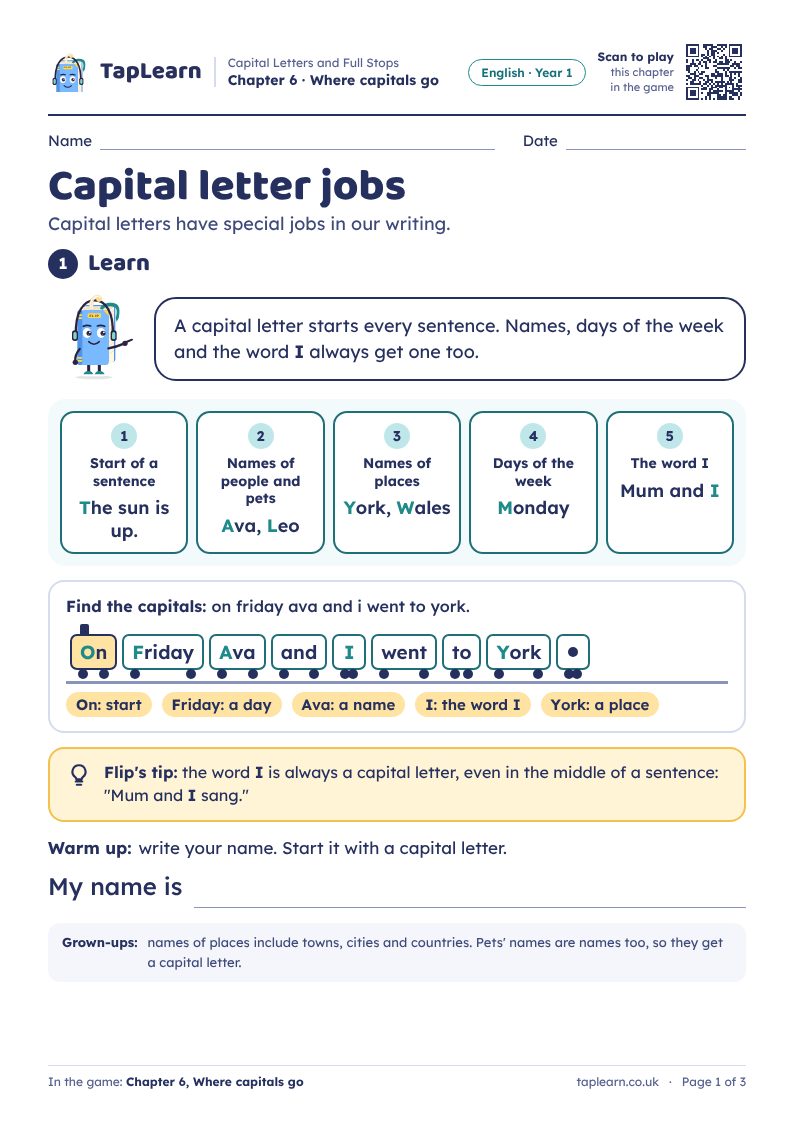
Capital Letter Jobs is a printable when to use capital letters worksheet for Year 1 (ages 5 to 6) that teaches children to use capitals at the start of a sentence, for names of people, pets and places, for days of the week and for the word I. Children ring words that need capitals, fix sentences and write the days of the week.
Free to print, no account needed.
Print it on A4, in colour or black and white. Do it after the chapter, or before it to see what your child already knows.
What's on the worksheet
Your child learns the five jobs of capital letters: starting a sentence, names of people and pets, names of places, days of the week and the word I. Includes a capital collectors activity about your own family and an answers sheet.
- Page 1 · Learn
- The five jobs of capital letters with examples, a worked sentence about Friday, Ava and York with every capital explained, and a warm-up writing your own name.
- Page 2 · Try it together
- Capital collectors: write the names of the people and pets in your home, places you know and today's day in a table, each with a capital letter.
- Page 3 · Practise
- Ring words that always need a capital, write names with capitals, ring letters that should be capitals, write a sentence about a day, fill in the days of the week, and a challenge.
- Answers sheet
- Every answer, mix-ups like capitals sprinkled everywhere, and capital-or-not and days-in-order games.
3 A4 pages and an answers sheet · about 20 minutes
Using it at home
- In capital collectors, write a word for your child to copy if they ask, but let them write the capital letter themselves.
- Pets' names are names too, so they get a capital letter. Towns, cities and countries all count as places.
- Say the days of the week together, starting from today, while you get ready in the morning.
Watch out for
- Forgetting the capital for a name in the middle of a sentence, like tess or york.
- Ask "Is that somebody's name, or the name of a place?"
- Writing a small i for the word I.
- When it means me, I is always a capital letter, even in the middle of a sentence.
- Capitals sprinkled everywhere, like The or Park mid-sentence.
- Only sentence starts, names, places, days and I get one.
Questions from the worksheet
- Draw a ring round the words that always need a capital letter: ava, cat, monday, york, cup, leo, tuesday, bed, i, park
- Write each word with its capital letter: sam, wales, sunday, zoe
- Draw a ring round each letter that should be a capital letter: jack and i went to york.
- Fill in the missing days of the week. Each one starts with a capital letter.
- Leo wrote: I like The park. He says the needs a capital letter. Is he right?
The answers are on the answers sheet, for grown-ups.
National curriculum in England
This worksheet practises these statements from the Year 1 english programme of study:
- Develop their understanding of the concepts set out in English appendix 2 by: leaving spaces between words
- Develop their understanding of the concepts set out in English appendix 2 by: joining words and joining clauses using 'and'
- Develop their understanding of the concepts set out in English appendix 2 by: learning the grammar for year 1 in English appendix 2
- Sentence: how words can combine to make sentences; joining words and joining clauses using and
In the classroom
- Play capital or not as a starter: call out words like Monday, spoon and Leo, and children stand tall for words that need a capital.
- Make a class capital letters display with five columns for the five jobs and add examples from children's writing.
Questions and answers
When do you use capital letters in Year 1?
Year 1 children use capital letters at the start of a sentence, for names of people and pets, for names of places, for days of the week and for the word I.
Do days of the week need capital letters?
Yes. Days of the week are names, so they always start with a capital letter, like Monday and Friday.
Why is I always a capital letter?
When I means me, it is always written as a capital letter, wherever it comes in the sentence.
More worksheets from Capital Letters and Full Stops: A Sentence Train Adventure
- Chapter 1: What is a sentence worksheet: What is a sentence? Free
- Chapter 2: Building sentences worksheet Free
- Chapter 3: Sentences that make sense worksheet: Sense or muddle? Free
- Chapter 4: Capital letters worksheet Free
- Chapter 5: Matching capital letters worksheet: Letter partners Free
- Chapter 7: Correcting capital letters worksheet: Capital fix-up Free
- Chapter 8: Full stops worksheet Free
- Chapter 9: Where full stops go worksheet Free
- Chapter 10: Capital letters and full stops worksheet: Sentence check Free
- Chapter 11: Joining words with and worksheet: Joining with and Free
- Chapter 12: Joining clauses with and worksheet: Join two ideas Free
- Chapter 13: Sentence endings worksheet: Sensible endings Free
 TapLearn