Matching capital letters worksheet for Year 1: Letter partners
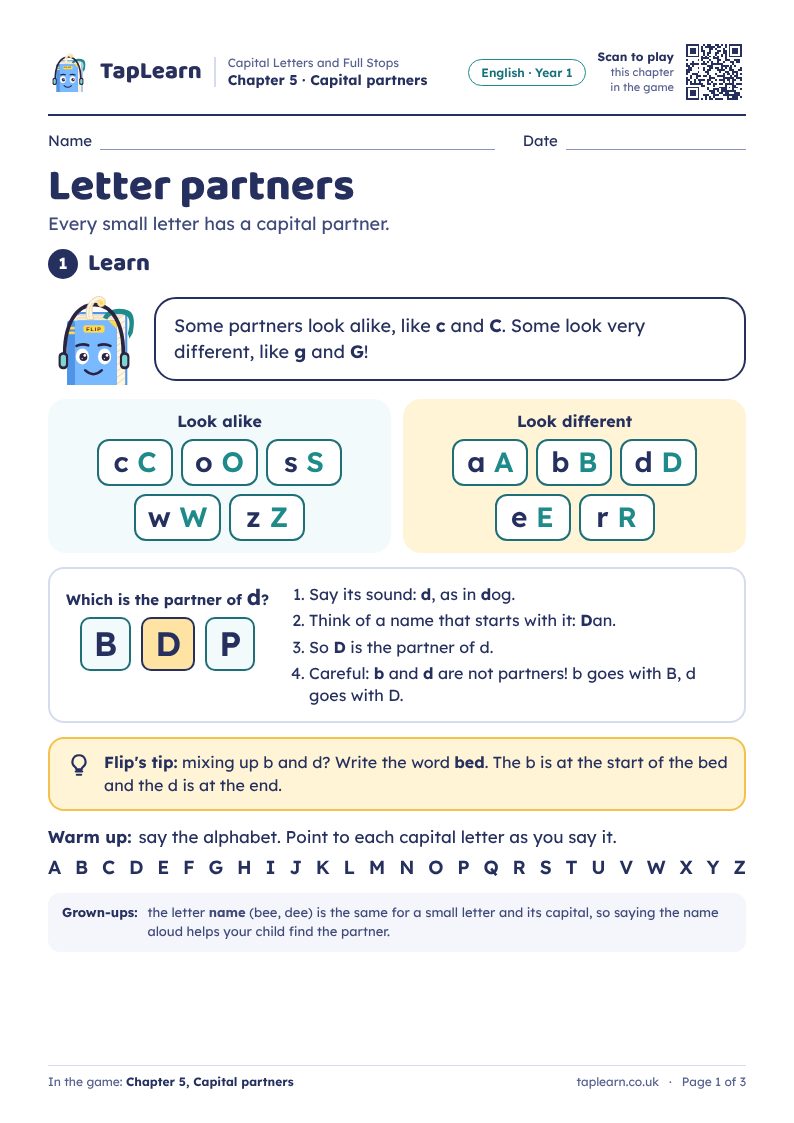
Letter Partners is a printable matching capital letters worksheet for Year 1 (ages 5 to 6) that teaches children to match each small letter to its capital, including tricky ones like b, d, g, q and r. Children join partners, write capitals and small letters, and fill gaps in an alphabet train.
Free to print, no account needed.
Print it on A4, in colour or black and white. Do it after the chapter, or before it to see what your child already knows.
What's on the worksheet
Your child matches each small letter to its capital partner, including letters that look different like g and G, and learns to tell b and d apart. Includes a partner pairs memory game to make and play, and an answers sheet.
- Page 1 · Learn
- Letter partners that look alike and look different, a worked example finding the partner of d, Flip's bed tip for b and d, and an alphabet warm-up.
- Page 2 · Try it together
- Partner pairs: write 8 small letters and their capitals on paper, lay them face down and take turns turning over two to find matching partners.
- Page 3 · Practise
- Join small letters to capitals, ring the right capital, write capital and small partners, fill missing capitals in the alphabet, and a b-and-d challenge.
- Answers sheet
- Every answer, help for mixing up b, d, p and q, and name-the-partner and bath letter games.
3 A4 pages and an answers sheet · about 20 minutes
Using it at home
- Say the letter name aloud: it's the same for a small letter and its capital, so it helps your child find the partner.
- In partner pairs, b, d and q are the tricky ones. If your child pairs b with D, hold up both and say "bee… dee".
- Show Flip's bed trick by writing the word bed: the b is at the start and the d is at the end.
Watch out for
- Mixing up b, d, p and q.
- They are the same shape turned round. Use the bed picture and say the letter names aloud.
- Choosing a capital that looks a bit similar, like M for n.
- Ask "What is this letter called?" then find the capital with the same name.
- Writing a bigger small letter instead of the capital.
- Show the capital in the alphabet strip on page 1 and compare the two.
Questions from the worksheet
- Draw a line from each small letter to its capital partner: a b d e g r
- Draw a ring round the capital partner of q: O G Q
- Now go the other way. Write the small partner: B G D R Q A
- Some capitals have fallen off the alphabet train! Write the missing capital letters: AB_DE_GH
- Mia says b and d are partners because they look nearly the same. Is she right? What are their real partners?
The answers are on the answers sheet, for grown-ups.
National curriculum in England
This worksheet practises these statements from the Year 1 english programme of study:
- Develop their understanding of the concepts set out in English appendix 2 by: leaving spaces between words
- Develop their understanding of the concepts set out in English appendix 2 by: joining words and joining clauses using 'and'
- Develop their understanding of the concepts set out in English appendix 2 by: learning the grammar for year 1 in English appendix 2
- Sentence: how words can combine to make sentences; joining words and joining clauses using and
In the classroom
- Play partner pairs in small groups using letter cards, then share which pairs were hardest to find.
- Use Practise E as a starter: say the alphabet together and children write the missing capitals on mini-whiteboards.
Questions and answers
What are letter partners?
Letter partners are a small letter and its capital letter, such as a and A. They have the same letter name.
How can children tell b and d apart?
Write the word bed: the b is at the start and the d is at the end. Saying the letter names helps too.
Which capital letters look different from their small letters?
Letters such as a, b, d, e, g, q and r look quite different from their capitals, so children need to learn those partners.
More worksheets from Capital Letters and Full Stops: A Sentence Train Adventure
- Chapter 1: What is a sentence worksheet: What is a sentence? Free
- Chapter 2: Building sentences worksheet Free
- Chapter 3: Sentences that make sense worksheet: Sense or muddle? Free
- Chapter 4: Capital letters worksheet Free
- Chapter 6: When to use capital letters worksheet: Capital letter jobs Free
- Chapter 7: Correcting capital letters worksheet: Capital fix-up Free
- Chapter 8: Full stops worksheet Free
- Chapter 9: Where full stops go worksheet Free
- Chapter 10: Capital letters and full stops worksheet: Sentence check Free
- Chapter 11: Joining words with and worksheet: Joining with and Free
- Chapter 12: Joining clauses with and worksheet: Join two ideas Free
- Chapter 13: Sentence endings worksheet: Sensible endings Free
 TapLearn