Building sentences worksheet for Year 1
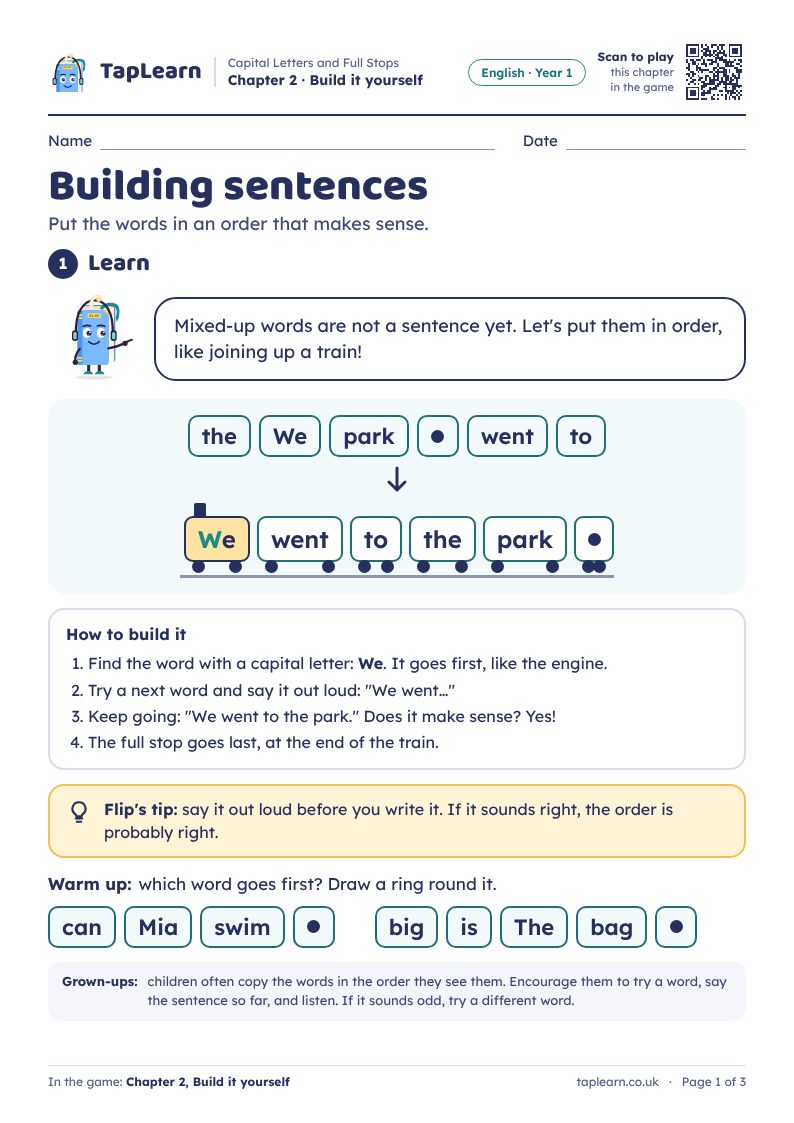
Building Sentences is a printable building sentences worksheet for Year 1 (ages 5 to 6) that teaches children to put mixed-up words in an order that makes sense, starting with the capital-letter word. It covers the Year 1 English statement on how words can combine to make sentences.
Free to print, no account needed.
Print it on A4, in colour or black and white. Do it after the chapter, or before it to see what your child already knows.
What's on the worksheet
Your child puts mixed-up words in order to build sentences, starting with the word that has a capital letter and saying it aloud to check. Includes a sentence track activity with word cards and an answers sheet.
- Page 1 · Learn
- Mixed-up words become We went to the park, with four steps for building a sentence, a tip on saying it aloud, and a warm-up finding which word goes first.
- Page 2 · Try it together
- Sentence track: build My dog likes to dig from word cards along a scarf or ruler, then turn your child's own spoken sentence into cards and build it.
- Page 3 · Practise
- Put words in order, number words to show the right order, make your own sentences from a word bank, and a challenge about a muddled train with a capital and full stop.
- Answers sheet
- Every answer, what to check in your child's own sentences, the mix-ups to watch for, and add-a-word and muddle-and-fix games.
3 A4 pages and an answers sheet · about 20 minutes
Using it at home
- Encourage your child to try a word, say the sentence so far aloud, and listen. If it sounds odd, try another word.
- Keep your child's own sentence short, 3 to 5 words, and write its first word with a capital letter.
- If a sentence comes out muddled, read it back exactly as written and let your child hear the problem.
Watch out for
- Copying the cards in the order they are printed.
- Ask your child to find the capital-letter word first, then build from there.
- Leaving out the full stop when writing the sentence out.
- Point to the full-stop card or button: it goes on the end.
- Every word is there but the order is wrong, like "Ella a kite has".
- Read it back exactly as written and let them hear it.
Questions from the worksheet
- Put the words in order. Write the sentence: has kite a Ella
- Number the words 1, 2, 3… to show the right order: park play the We in
- Make your own sentences with these words: I, can, see, a, big, dog, cat, bus.
- Sam made this train: park the to went We. It has a capital letter and a full stop. Is it a sentence? Write it in the right order.
The answers are on the answers sheet, for grown-ups.
National curriculum in England
This worksheet practises these statements from the Year 1 english programme of study:
- Develop their understanding of the concepts set out in English appendix 2 by: leaving spaces between words
- Develop their understanding of the concepts set out in English appendix 2 by: joining words and joining clauses using 'and'
- Develop their understanding of the concepts set out in English appendix 2 by: learning the grammar for year 1 in English appendix 2
- Sentence: how words can combine to make sentences; joining words and joining clauses using and
In the classroom
- Play add a word round the class: start with "I see" and each child adds one word until the sentence is finished.
- Use Practise B with large word cards: children stand in a line holding the words and the class reorders them.
Questions and answers
How do children learn to build sentences in Year 1?
They put words in an order that makes sense, starting with the word that has a capital letter, and say the sentence aloud to check it. The full stop goes at the end.
Is it a sentence if it has a capital letter and a full stop?
Not always. The words must also be in an order that makes sense: park the to went We has both marks but isn't a sentence.
Why should children say a sentence out loud before writing it?
Saying it aloud lets them hear whether the words are in the right order. If it sounds right, the order is probably right.
More worksheets from Capital Letters and Full Stops: A Sentence Train Adventure
- Chapter 1: What is a sentence worksheet: What is a sentence? Free
- Chapter 3: Sentences that make sense worksheet: Sense or muddle? Free
- Chapter 4: Capital letters worksheet Free
- Chapter 5: Matching capital letters worksheet: Letter partners Free
- Chapter 6: When to use capital letters worksheet: Capital letter jobs Free
- Chapter 7: Correcting capital letters worksheet: Capital fix-up Free
- Chapter 8: Full stops worksheet Free
- Chapter 9: Where full stops go worksheet Free
- Chapter 10: Capital letters and full stops worksheet: Sentence check Free
- Chapter 11: Joining words with and worksheet: Joining with and Free
- Chapter 12: Joining clauses with and worksheet: Join two ideas Free
- Chapter 13: Sentence endings worksheet: Sensible endings Free
 TapLearn