Sentences that make sense worksheet for Year 1: Sense or muddle?
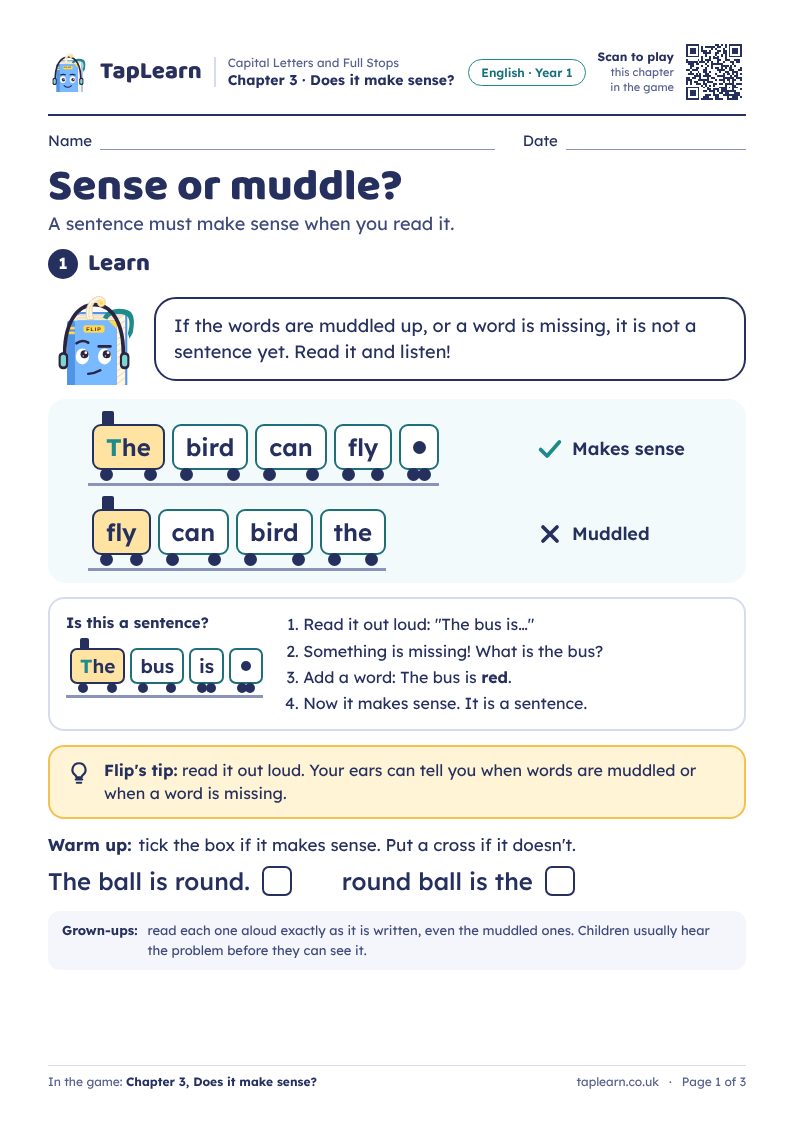
Sense or Muddle? is a printable sentences that make sense worksheet for Year 1 (ages 5 to 6) that teaches children to tell whether a group of words makes sense and to fix muddled or unfinished sentences. It covers the Year 1 English statement on how words can combine to make sentences.
Free to print, no account needed.
Print it on A4, in colour or black and white. Do it after the chapter, or before it to see what your child already knows.
What's on the worksheet
Your child decides whether a group of words makes sense, spots muddled or unfinished sentences, chooses sensible endings and fixes muddles. Includes a toy talk activity and an answers sheet.
- Page 1 · Learn
- The bird can fly compared with a muddled version, a worked example finishing The bus is…, and a tick-or-cross warm-up.
- Page 2 · Try it together
- Toy talk: your child makes a toy do something and says a sentence about it, then shows thumbs up or down for the grown-up's sensible and muddled sentences and fixes the muddles.
- Page 3 · Practise
- Tick or cross sentences, ring the ending that makes sense, fix two muddled sentences, and a challenge about whether The bin. is a sentence.
- Answers sheet
- Every answer, the mix-ups to watch for such as thinking a full stop makes a sentence, and silly-or-sensible and finish-it games.
3 A4 pages and an answers sheet · about 20 minutes
Using it at home
- Read each sentence aloud exactly as it is written, even the muddled ones. Children usually hear the problem before they see it.
- In toy talk, try leaving a word out too, like "The bear can", and ask "Is that finished? What could the bear do?"
- At tea time, say a silly sentence like "The plate ate my peas" and let your child judge it.
Watch out for
- Ticking a muddle because it has the right words.
- All the words can be there and it still doesn't make sense. Read it aloud.
- Choosing "the." or "is." as an ending because it is short.
- Read the whole thing, like "I sleep in is.", and ask whether it makes sense.
- Thinking a full stop makes a sentence.
- A full stop ends a sentence, but the words still have to make sense.
Questions from the worksheet
- Tick if it makes sense. Put a cross if it is muddled: is hot tea the
- Draw a ring round the ending that makes sense. I sleep in … bed my. / my bed. / is.
- Fix the muddle. Write the sentence: milk likes cat The
- Ava wrote: The bin. Is it a sentence? Add some words so it makes sense.
The answers are on the answers sheet, for grown-ups.
National curriculum in England
This worksheet practises these statements from the Year 1 english programme of study:
- Develop their understanding of the concepts set out in English appendix 2 by: leaving spaces between words
- Develop their understanding of the concepts set out in English appendix 2 by: joining words and joining clauses using 'and'
- Develop their understanding of the concepts set out in English appendix 2 by: learning the grammar for year 1 in English appendix 2
- Sentence: how words can combine to make sentences; joining words and joining clauses using and
In the classroom
- Play thumbs up, thumbs down as a starter with sensible, muddled and unfinished sentences read aloud.
- Give pairs muddled sentence strips to cut up and reorder, then read them to another pair.
Questions and answers
How can children tell if a sentence makes sense?
Read it out loud and listen. If the words are muddled or a word is missing, it doesn't make sense yet.
Why is 'The bin.' not a sentence?
It doesn't tell us a whole idea about the bin. Adding words, such as The bin is full., finishes the idea.
Does a full stop make something a sentence?
No. A full stop ends a sentence, but the words must still be in an order that makes sense and tell a whole idea.
More worksheets from Capital Letters and Full Stops: A Sentence Train Adventure
- Chapter 1: What is a sentence worksheet: What is a sentence? Free
- Chapter 2: Building sentences worksheet Free
- Chapter 4: Capital letters worksheet Free
- Chapter 5: Matching capital letters worksheet: Letter partners Free
- Chapter 6: When to use capital letters worksheet: Capital letter jobs Free
- Chapter 7: Correcting capital letters worksheet: Capital fix-up Free
- Chapter 8: Full stops worksheet Free
- Chapter 9: Where full stops go worksheet Free
- Chapter 10: Capital letters and full stops worksheet: Sentence check Free
- Chapter 11: Joining words with and worksheet: Joining with and Free
- Chapter 12: Joining clauses with and worksheet: Join two ideas Free
- Chapter 13: Sentence endings worksheet: Sensible endings Free
 TapLearn