What is a sentence worksheet for Year 1: What is a sentence?
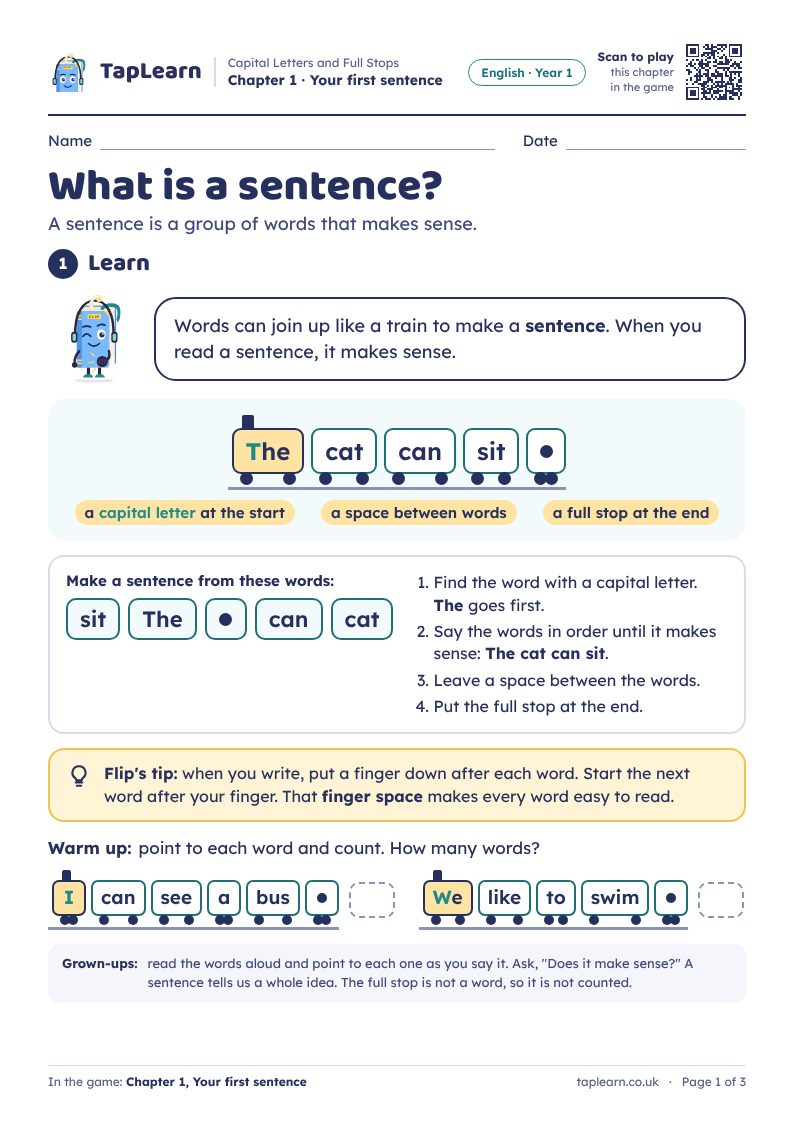
What Is a Sentence? is a printable what is a sentence worksheet for Year 1 (ages 5 to 6) that teaches children that a sentence is a group of words that makes sense, with the words in order and spaces between them. It covers the Year 1 English statements on leaving spaces between words and how words can combine to make sentences.
Free to print, no account needed.
Print it on A4, in colour or black and white. Do it after the chapter, or before it to see what your child already knows.
What's on the worksheet
Your child learns that a sentence is a group of words that makes sense, puts words in order, counts them and leaves finger spaces. Includes a paper train activity to build a sentence together and an answers sheet.
- Page 1 · Learn
- A sentence train shows a capital letter, spaces between words and a full stop, with steps to build The cat can sit from muddled words and a word-counting warm-up.
- Page 2 · Try it together
- Paper train: lay word cards in an order that makes sense, put a finger between each word and a button for the full stop, then swap one word to make a new sentence.
- Page 3 · Practise
- Count the words in sentences, split squashed words like Thecatisbig, put words in order, and a challenge about a sentence written with no spaces.
- Answers sheet
- Every answer, why the full stop isn't counted as a word, the mix-ups to watch for, and clap-a-sentence and fix-my-muddle games.
3 A4 pages and an answers sheet · about 20 minutes
Using it at home
- Read the words aloud and point to each one as you say it, then ask "Does it make sense?"
- In the paper train, let your child try orders that don't work and read them aloud together. Hearing the muddle helps.
- When your child writes, let them rest a finger after each word before starting the next one.
Watch out for
- Counting the full stop as a word.
- Explain that the full stop is a mark that ends the sentence, not a word.
- Running words together when writing.
- Let your child rest a finger, or a lolly stick, after each word to make the space.
- Muddled word order, like "The sat dog".
- Read exactly what they wrote, aloud, and ask "Does that sound right?"
Questions from the worksheet
- Count the words in each sentence: I can see the moon.
- Oh no, the words are squashed! Draw a line between each word: Thecatisbig.
- Put the words in order. Write the sentence: dog sat The
- Leo wrote this: Isawabigdog. What did he forget? Write it the right way.
The answers are on the answers sheet, for grown-ups.
National curriculum in England
This worksheet practises these statements from the Year 1 english programme of study:
- Develop their understanding of the concepts set out in English appendix 2 by: leaving spaces between words
- Develop their understanding of the concepts set out in English appendix 2 by: joining words and joining clauses using 'and'
- Develop their understanding of the concepts set out in English appendix 2 by: learning the grammar for year 1 in English appendix 2
- Sentence: how words can combine to make sentences; joining words and joining clauses using and
In the classroom
- Clap a sentence as a starter: say a short sentence and the class claps once for each word, then counts the claps.
- Give groups word cards to build a human sentence train at the front, with one child holding the full stop.
Questions and answers
What is a sentence in Year 1?
A sentence is a group of words that makes sense and tells a whole idea. It starts with a capital letter, has spaces between words and ends with a full stop.
What are finger spaces?
Finger spaces are the gaps children leave between words by putting a finger down after each word. They make writing easy to read.
Is the full stop a word?
No. A full stop is a punctuation mark that ends the sentence, so it isn't counted when you count the words.
More worksheets from Capital Letters and Full Stops: A Sentence Train Adventure
- Chapter 2: Building sentences worksheet Free
- Chapter 3: Sentences that make sense worksheet: Sense or muddle? Free
- Chapter 4: Capital letters worksheet Free
- Chapter 5: Matching capital letters worksheet: Letter partners Free
- Chapter 6: When to use capital letters worksheet: Capital letter jobs Free
- Chapter 7: Correcting capital letters worksheet: Capital fix-up Free
- Chapter 8: Full stops worksheet Free
- Chapter 9: Where full stops go worksheet Free
- Chapter 10: Capital letters and full stops worksheet: Sentence check Free
- Chapter 11: Joining words with and worksheet: Joining with and Free
- Chapter 12: Joining clauses with and worksheet: Join two ideas Free
- Chapter 13: Sentence endings worksheet: Sensible endings Free
 TapLearn