What you'll learn
- Write decimals as fractions out of 10, 100 or 1,000
- Know that 10 thousandths make one hundredth
- Say what each digit is worth, like the 4 in 2.347
- Compare and order decimals using the signs <, > and =
- Round decimals like 6.48 to the nearest whole number
- Round decimals like 3.47 to one decimal place
Chapter by chapter
- Writing decimals as fractions: tenths and hundredths Free to try
Year 5 maths · 1
- Thousandths: what 0.001 means, and reading and writing three decimal places
Year 5 maths · 2 Year 5 maths · 1 Year 5 maths · 3
- Comparing and ordering decimals with up to three decimal places
Year 5 maths · 3
- Rounding decimals with two decimal places to the nearest whole number
Year 5 maths · 4
- Rounding decimals with two decimal places to one decimal place
Year 5 maths · 4
- Solving problems with decimals up to three decimal places
Year 5 maths · 5 Year 5 maths · 3
- Golden Acorn Challenge (10 questions)
See every Maths chapter in the chapter library
What the chapters cover in the national curriculum in England:
- Year 5 maths: Read and write decimal numbers as fractions
- Year 5 maths: Recognise and use thousandths and relate them to tenths, hundredths and decimal equivalents
- Year 5 maths: Read, write, order and compare numbers with up to 3 decimal places
- Year 5 maths: Round decimals with 2 decimal places to the nearest whole number and to 1 decimal place
- Year 5 maths: Solve problems involving number up to 3 decimal places
About this adventure
Milli's Decimal Zoom is an interactive Year 5 decimals game for children aged 9–10 that teaches decimals as fractions, thousandths, comparing and ordering decimals, and rounding. It follows the national curriculum in England for KS2 maths.
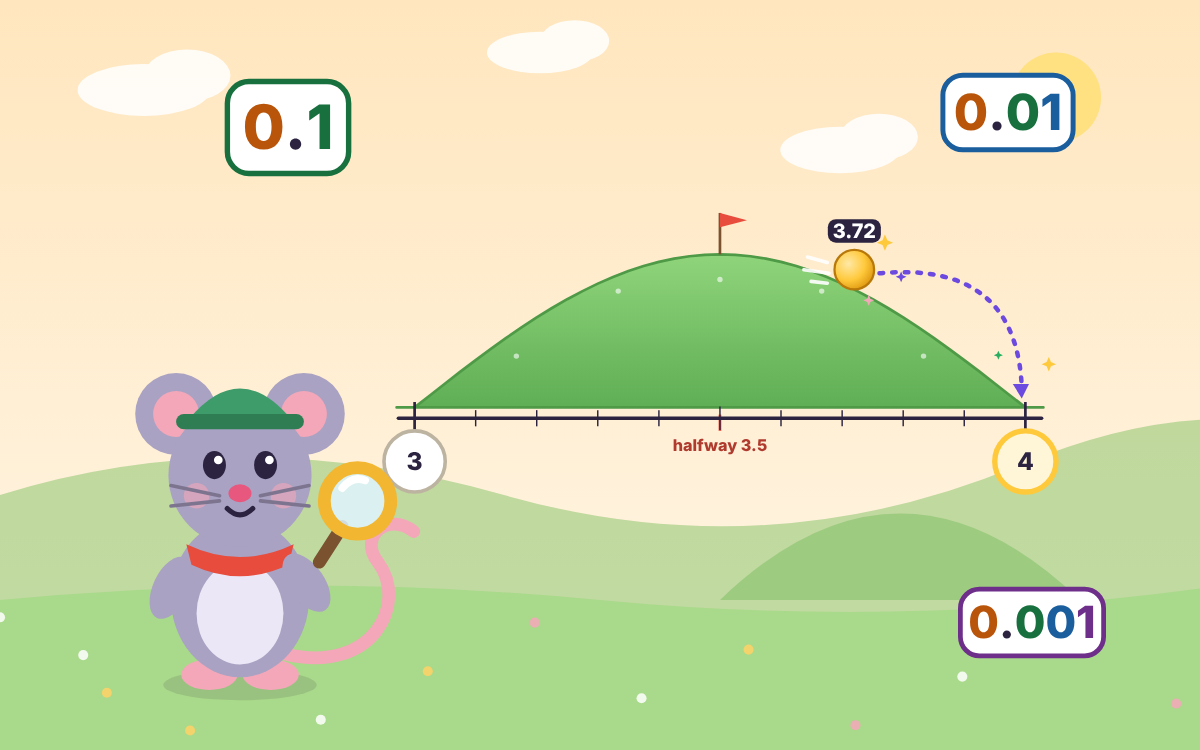
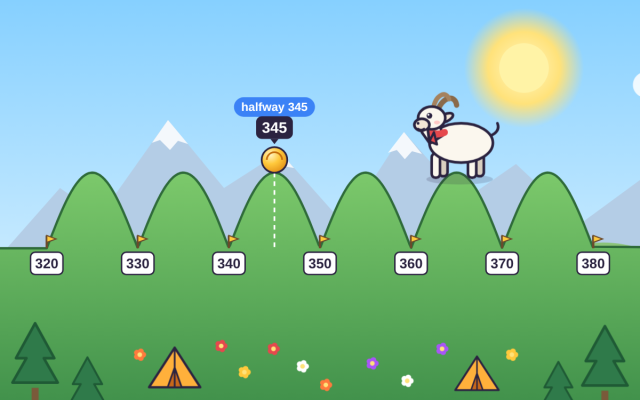
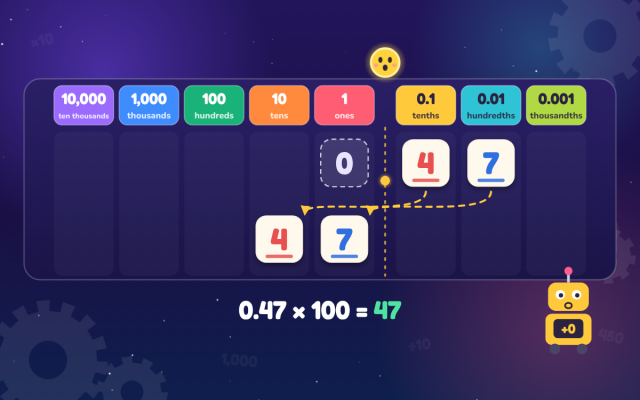
Players shade hundred squares to see that 0.71 means 71 hundredths, zoom into a number line until each tiny step is one thousandth (0.001), and build numbers with place value counters. They line up decimal points to check why 0.5 is greater than 0.45, roll a ball down a rounding hill to find the nearer whole number or tenth, and solve race-time and parcel problems.
Milli reads every instruction aloud. Wrong answers get a hint about the exact mistake, such as thinking a longer decimal is always larger. Two optional warm-ups refresh tenths, hundredths and basic rounding, and a 10-question challenge checks everything at the end.
Questions and answers
How do you write a decimal as a fraction?
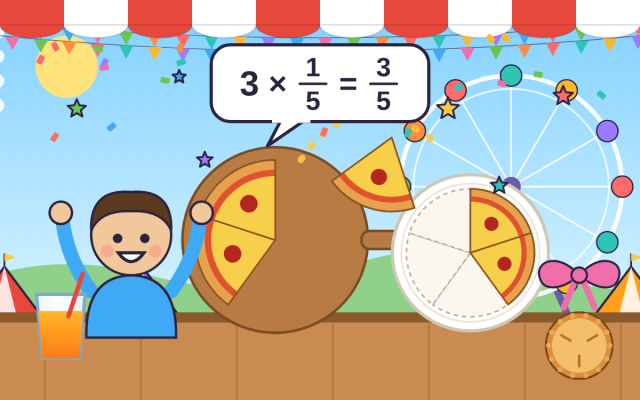
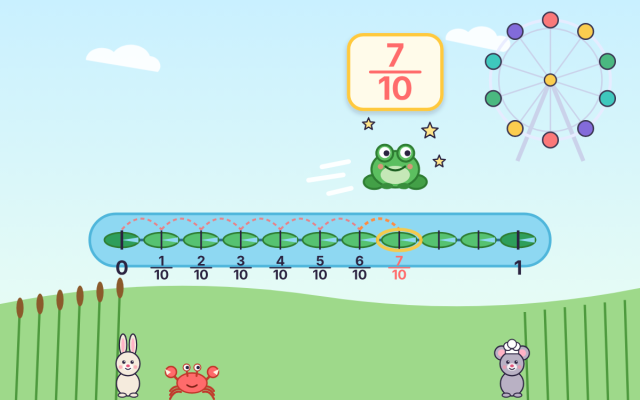
Look at the place of the last digit: tenths give a bottom number of 10, hundredths give 100 and thousandths give 1,000. So 0.7 = 7/10, 0.71 = 71/100 and 0.347 = 347/1000.
What is a thousandth in maths?
A thousandth is one part of a whole split into 1,000 equal parts, written 0.001. Ten thousandths make one hundredth, and 100 thousandths make one tenth. A millimetre is one thousandth of a metre.
Which is bigger, 0.5 or 0.45?
0.5 is bigger than 0.45. Line up the decimal points and write 0.5 as 0.50, then compare from the left: 5 tenths is more than 4 tenths. A decimal with more digits is not always larger.
How do you round a decimal to one decimal place?
Look at the hundredths digit: if it is 5 or more, round the tenths up; if it is 4 or less, keep the tenths the same. So 3.47 rounds to 3.5, 7.23 rounds to 7.2 and 4.97 rounds to 5.0.
What age is this decimals game for, and how long does it take?
It is made for children aged 9–10 in Year 5, though older children can use it to revise. Playing all six chapters and the 10-question final challenge takes about 50 minutes, and each chapter can be played on its own.

 TapLearn