What the chapters cover in the national curriculum in England:
Year 5 maths: Multiply proper fractions and mixed numbers by whole numbers, supported by materials and diagrams
About this adventure
Fraction Fair is an interactive maths game that teaches children aged 9–11 multiplying fractions by whole numbers, including proper fractions and mixed numbers, as set out in the Year 5 national curriculum for England.
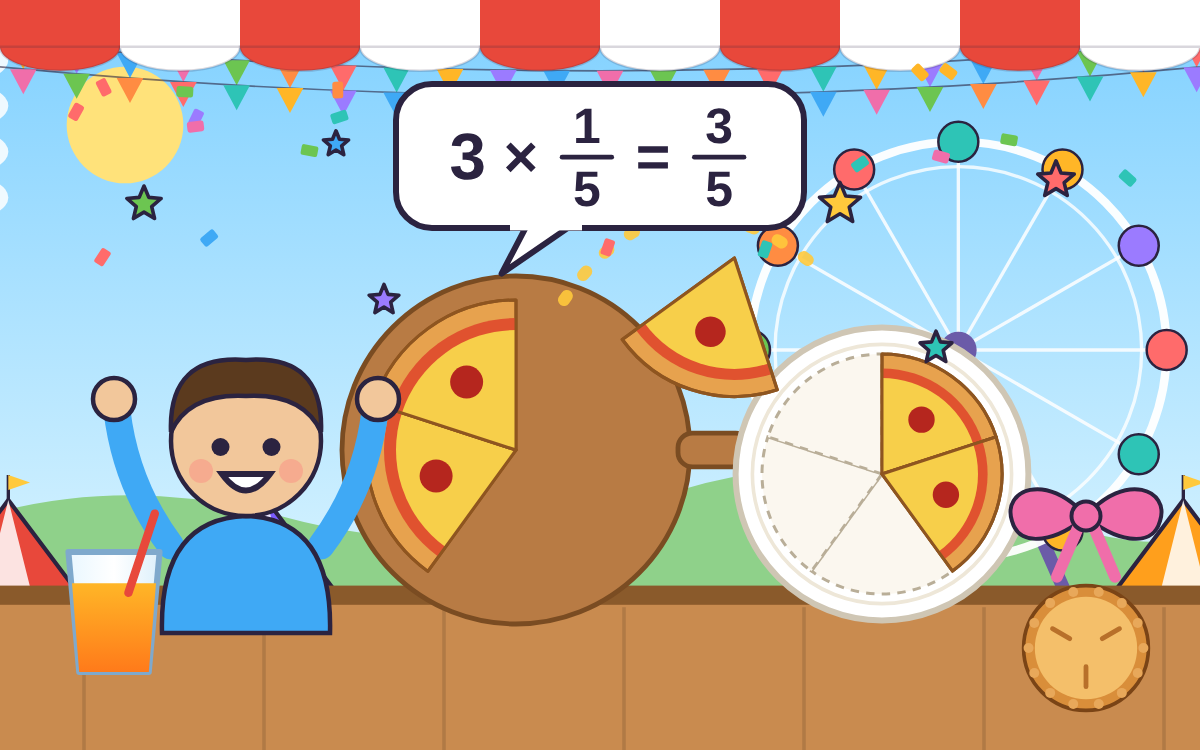
At each fairground stall, children build the idea with objects before they use the quick method. They see that 3 × 1/5 means three lots of one fifth, so the numerator (the top number) is multiplied while the denominator (the bottom number) stays the same, because the pieces do not change size. When an answer is more than 1, they group pieces into wholes to write an improper fraction as a mixed number.
A narrator reads every step aloud. Children type answers on a fraction keypad and get a hint that matches their mistake. Two optional warm-ups refresh fraction words and mixed numbers, and a 10-question challenge checks everything at the end.
Questions and answers
How do you multiply a fraction by a whole number?
Multiply the numerator by the whole number and keep the denominator the same. For example, 3 × 2/7 = 6/7, because three lots of two sevenths make six sevenths. If the answer is more than 1, you can then write it as a mixed number.
Why doesn't the denominator change when you multiply a fraction by a whole number?
The denominator stays the same because it names the size of the pieces, and multiplying by a whole number only changes how many pieces you have. Three lots of one fifth are three fifths, just as three lots of one apple are three apples.
How do you multiply a mixed number by a whole number?
Split the mixed number into its whole part and its fraction, multiply each part, then add them together. For 4 × 2 1/3, work out 4 × 2 = 8 and 4 × 1/3 = 4/3 = 1 1/3, which gives 9 1/3.
What age or school year is multiplying fractions by whole numbers for?
Multiplying proper fractions and mixed numbers by whole numbers is taught in Year 5 in England, when children are 9 or 10. This game suits that age and also works as revision for Year 6 pupils before they multiply two fractions together.
What is in the Fraction Fair game and how long does it take?
Fraction Fair has five themed chapters, two optional warm-ups and a final 10-question challenge, and takes about 45 minutes to play through. Children can play the chapters in any order and come back to one at a time.
Can we count your visit? We'd like to use one cookie, only on this site, to see how families find and use TapLearn, so we can make it better. No adverts, and nothing is shared. How we measure
Create a free family account and your child can play every chapter of every game for 7 days, with no card needed. Their progress is kept. After that, the free plan is free for ever, and membership is £6.99 (about $9.35) a month if you'd like to keep every chapter.

 TapLearn