Time and Timetables: Tock's Time Station Adventure
Learn time and timetables: convert hours, minutes, days and weeks, count on to solve time problems, then read and complete train and bus timetables.
Online game, chapter 1 free · Year 5 (KS2) · ages 9–10 · national curriculum in England · no adverts · plays on a phone, tablet or computer · no sign-up to start.
An online maths game for Year 5 (KS2). It covers the national curriculum in England, Year 5 maths: “Solve problems involving converting between units of time”, and 1 more statement listed under the chapters.
5 short chapters, about 35 minutes in all. Children can stop after any chapter.
Start playing for free. Plays in the browser on phones, tablets and computers: no app, no adverts.
Free for teachers: every chapter on the whiteboard with a free teacher account.
Last updated · Checked against the national curriculum in England by the TapLearn team
What you'll learn
How seconds, minutes, hours, days, weeks, months and years link together
Multiply to convert bigger units to smaller, divide to go back
Why 150 minutes is 2 hours 30 minutes, not 1 hour 50
Count on to the next o'clock to find durations and end times
Read timetables across the row and down the column, spotting dashes
Fill in missing times in tables by spotting the gap pattern
Chapter by chapter
Time units and how they linkStart playing for free
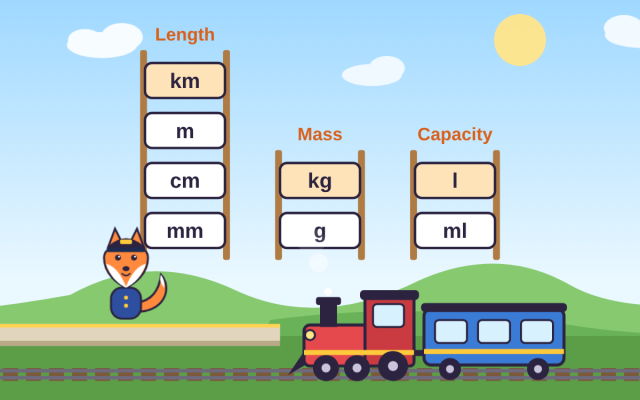
Learn that 60 seconds make a minute, 60 minutes an hour, 24 hours a day and 7 days a week, plus leap years, fortnights, decades and centuries, by running a clock and building a time ladder.
Year 5 maths · 1
Converting seconds, minutes, hours, days and weeks
Convert between units of time by multiplying for bigger to smaller and dividing for smaller to bigger, keeping leftover minutes, using hour bars and a conversion machine (bar models).
Year 5 maths · 1
Solving time problems by counting on
Compare amounts of time by changing them into the same unit, then work out end times and durations by counting on to the next o'clock along a time number line.
Year 5 maths · 1
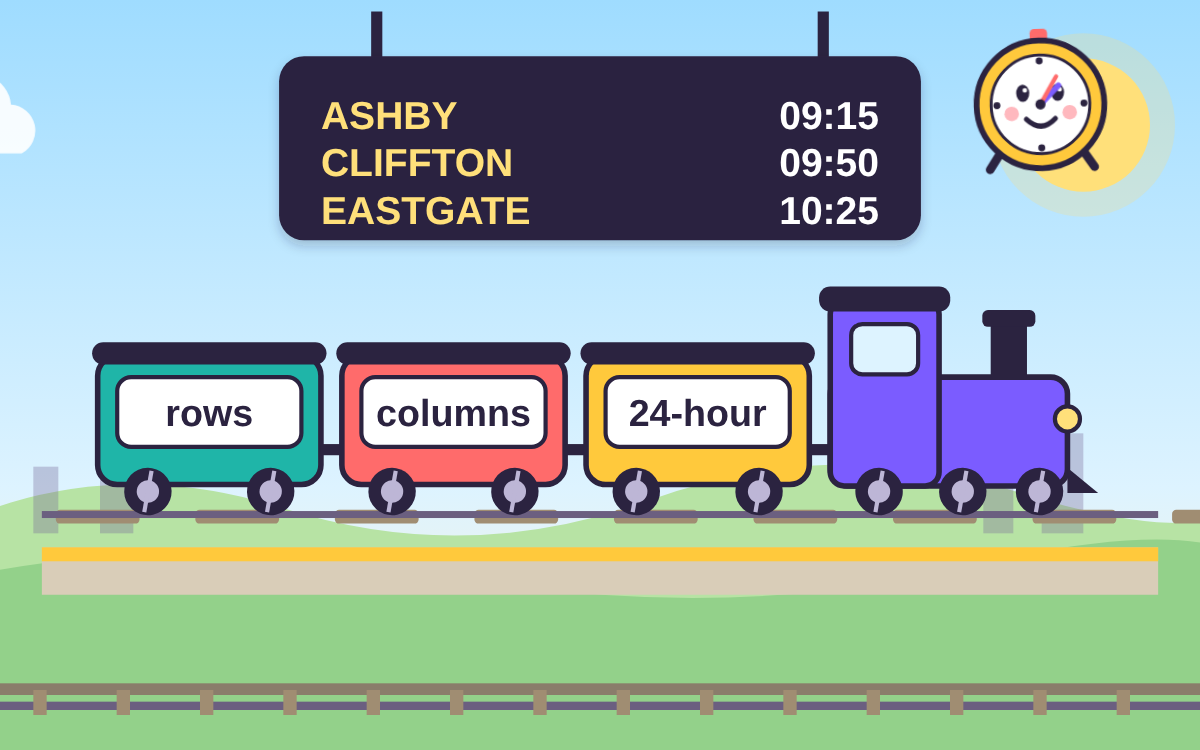
Reading bus and train timetables
Read 24-hour times in a train timetable where a station row meets a train column, spot dashes for stops a train skips, and find journey lengths and the right train to catch.
Year 5 maths · 2
Completing tables and timetables
Complete missing times in a bus timetable by spotting the gaps between stops, fill in start times, lengths and end times in a cinema table, and answer questions from the finished table.
What the chapters cover in the national curriculum in England:
Year 5 maths: Solve problems involving converting between units of time
Year 5 maths: Complete, read and interpret information in tables, including timetables
About this adventure
Time and Timetables is an interactive maths game that teaches children aged 9–10 to convert between units of time, solve time problems and read and complete timetables, following the Year 5 national curriculum in England.
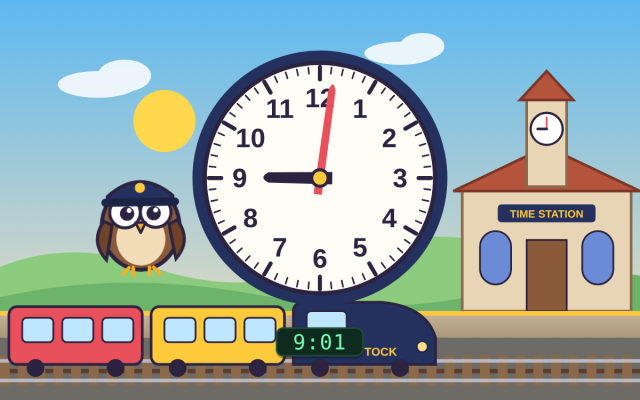
Guided by Tock the station clock, players run a clock to see 60 seconds make a minute, build a time ladder, open hour bars into minutes and cut 150 minutes into whole hours with minutes left over. They balance amounts like 5 weeks and 30 days on scales, then jump along a time number line to the next o'clock so they never write impossible times like 8:65.
On the Riverside Line, children find times where a station row meets a train column, learn that a dash means the train doesn't stop, work out journey lengths and pick the right train to catch. They finish by filling gaps in bus and cinema tables using 24-hour times.
Questions and answers
How do you convert minutes into hours and minutes?
Divide by 60, because there are 60 minutes in an hour. The whole number of 60s gives the hours and the remainder gives the minutes, so 150 minutes is 2 hours with 30 minutes left over: 2 hours 30 minutes.
Why is 1.5 hours not 1 hour 50 minutes?
Time is counted in 60s, not 100s, so half an hour is 30 minutes. That makes 1.5 hours equal to 1 hour 30 minutes, or 90 minutes. Mixing up time with decimals is one of the most common mistakes children make.
How do you read a train timetable?
Find your station in the rows down the side, then follow that row across to the column for your train. The time where they meet is when the train is there. A dash means the train goes straight through without stopping.
What age is this time and timetables game for?
It is written for children aged 9 to 10 in Year 5, matching the national curriculum in England for converting units of time and reading timetables. Older children who need a refresher on time can use it too.
What does the game include and how long does it take?
It has five chapters with animated intros, two optional warm-ups on quarter hours and the 24-hour clock, and a 10-question Station Master challenge. Playing everything takes about 35 minutes, and each chapter can be played on its own.
We count visits to make TapLearn better.We use one cookie, only on this site, to see how families find and use it. No adverts, and nothing is shared.One cookie, only on this site. No adverts.How we measure

 TapLearn