Properties of Shapes for Year 6: Draw, Sort, Fold and Measure
Learn the properties of shapes for Year 6: draw shapes with a ruler and protractor, sort quadrilaterals, fold nets into 3D shapes and name circle parts.
Online game, chapter 1 free · Year 6 (KS2) · ages 10–11 · national curriculum in England · no adverts · plays on a phone, tablet or computer · no sign-up to start.
An online maths game for Year 6 (KS2). It covers the national curriculum in England, Year 6 maths: “Draw 2-D shapes using given dimensions and angles”, and 3 more statements listed under the chapters.
4 short chapters, about 40 minutes in all. Children can stop after any chapter.
Start playing for free. Plays in the browser on phones, tablets and computers: no app, no adverts.
Free for teachers: every chapter on the whiteboard with a free teacher account.
Last updated · Checked against the national curriculum in England by the TapLearn team
What you'll learn
Draw lines and angles accurately with a ruler and protractor
Construct a triangle and parallelogram from given lengths and angles
Why a square is also a rectangle, a rhombus and a parallelogram
Classify shapes using Carroll diagrams, Venn diagrams and diagonals
Count faces, edges and vertices and match 3D shapes to nets
Name the radius, diameter and circumference, and that d = 2 × r
Chapter by chapter
Drawing shapes from given lengths and anglesStart playing for free
Learn to draw lines, angles and 2D shapes accurately from given lengths and angles by using an on-screen ruler and protractor to construct a triangle and a parallelogram, reading the scale that starts at zero.
Year 6 maths · 1
Sorting triangles and quadrilaterals by their properties
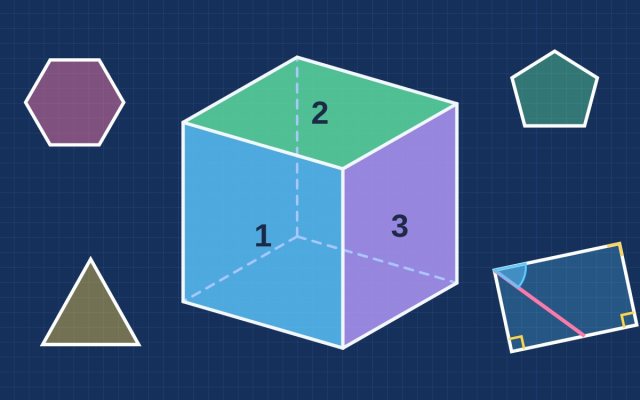
Compare and classify triangles and quadrilaterals by their sides, angles, parallel lines and diagonals, sorting them in Carroll and Venn diagrams and morphing a quadrilateral to see why a square is also a rectangle and a rhombus.
Year 6 maths · 2
Describing 3D shapes and building them from nets
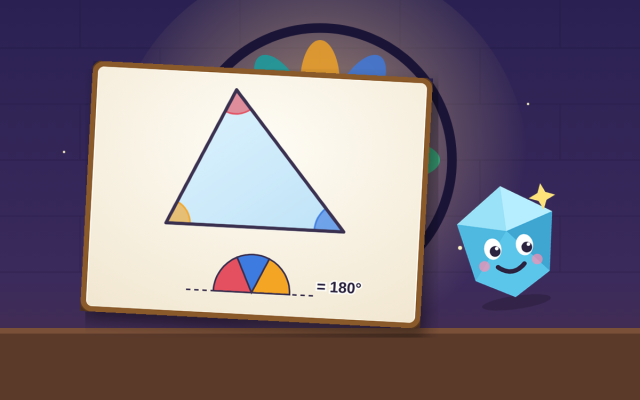
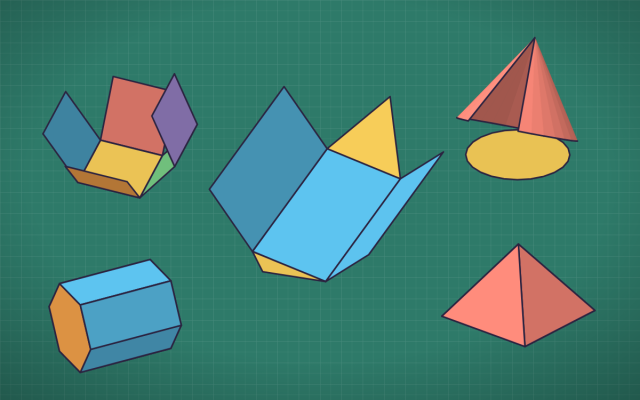
Recognise and describe 3D shapes by counting faces, edges and vertices on spinning models, tell prisms from pyramids, and build shapes from nets by fixing a prism net and testing which nets fold into a cube.
Year 6 maths · 3
Naming parts of a circle: radius, diameter and circumference
Draw a circle with compasses, then name the centre, radius, diameter and circumference, discover that the diameter is twice the radius and use doubling and halving to solve circle problems.
Year 6 maths · 4
Final check: everything in the Shape Studio (10 questions)
What the chapters cover in the national curriculum in England:
Year 6 maths: Draw 2-D shapes using given dimensions and angles
Year 6 maths: Compare and classify geometric shapes based on their properties and sizes and find unknown angles in any triangles, quadrilaterals, and regular polygons
Year 6 maths: Recognise, describe and build simple 3-D shapes, including making nets
Year 6 maths: Illustrate and name parts of circles, including radius, diameter and circumference and know that the diameter is twice the radius
About this adventure
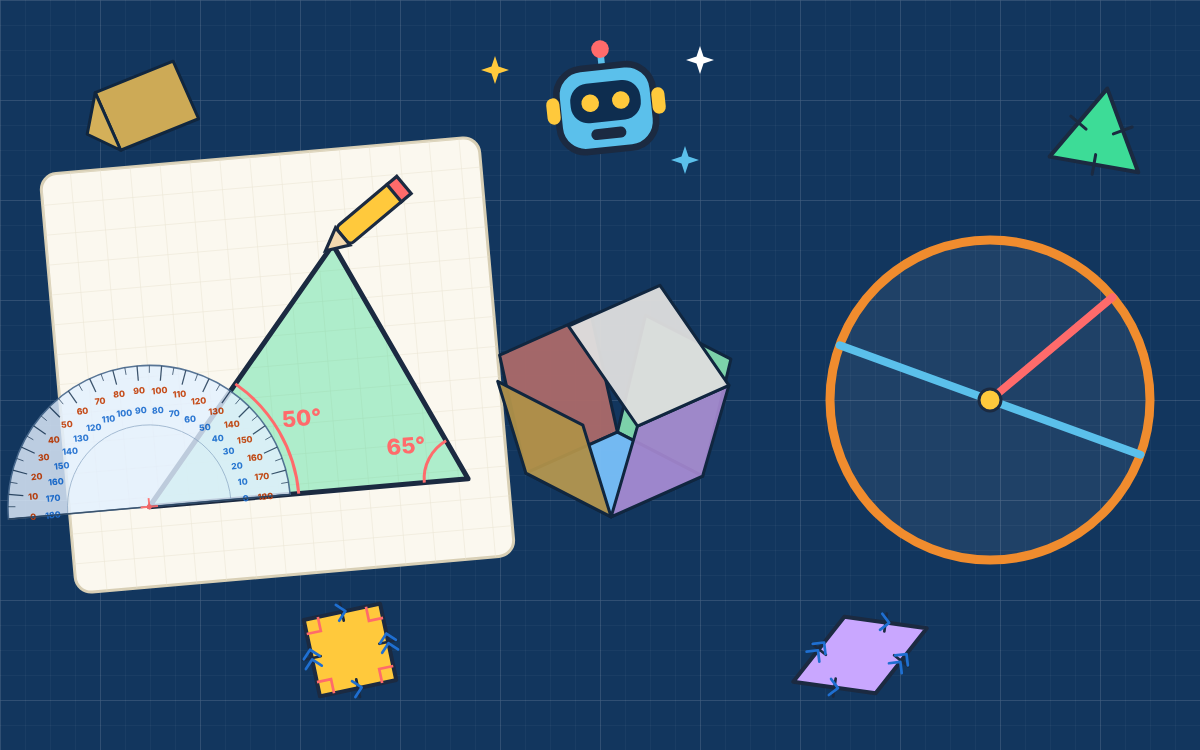
Shape Studio is an interactive properties of shapes game for children aged 10–11 that covers the Year 6 geometry curriculum: drawing 2D shapes accurately, classifying triangles and quadrilaterals, building 3D shapes from nets and naming the parts of a circle.
Guided by Ada, a robot architect, players drag a pencil along a ruler and swing a protractor arm to construct a triangle and a parallelogram from given lengths and angles, learning to read the scale that starts at zero. They sort shapes in Carroll and Venn diagrams, morph a quadrilateral through the family tree to see why a square is also a rectangle and a rhombus, and test diagonals.
In the workshop they spin solids to count faces, edges and vertices, tell prisms from pyramids and watch nets fold up. At the Round Tower they draw a circle with compasses and discover that the diameter is twice the radius.
Questions and answers
What are the properties of a shape?
The properties of a shape are the features that describe it, such as the number of sides, the lengths of the sides, the sizes of the angles, parallel or perpendicular sides and lines of symmetry. For 3D shapes they include faces, edges and vertices.
Is a square a rectangle?
Yes, a square is a special kind of rectangle. A rectangle needs four right angles and two pairs of parallel sides, and a square has all of these plus four equal sides. A square is also a rhombus and a parallelogram.
How do you use a protractor to draw an angle?
Put the centre cross of the protractor exactly on the corner point, with the baseline along your line. Find the zero that sits on your line, count up on that same scale to the angle you need, mark a dot, then join it to the corner with a ruler.
What age is this properties of shapes game for?
It is written for Year 6 children aged 10 to 11 and follows the national curriculum in England for geometry. Year 5 children who already measure angles can also enjoy it, and older children can use it for revision.
What does the Shape Studio game include and how long does it take?
It has four chapters on drawing shapes, classifying 2D shapes, 3D shapes and nets, and parts of a circle, plus a 10-question final check. Playing everything takes about 40 minutes, and each chapter can be played on its own.
We count visits to make TapLearn better.We use one cookie, only on this site, to see how families find and use it. No adverts, and nothing is shared.One cookie, only on this site. No adverts.How we measure

 TapLearn