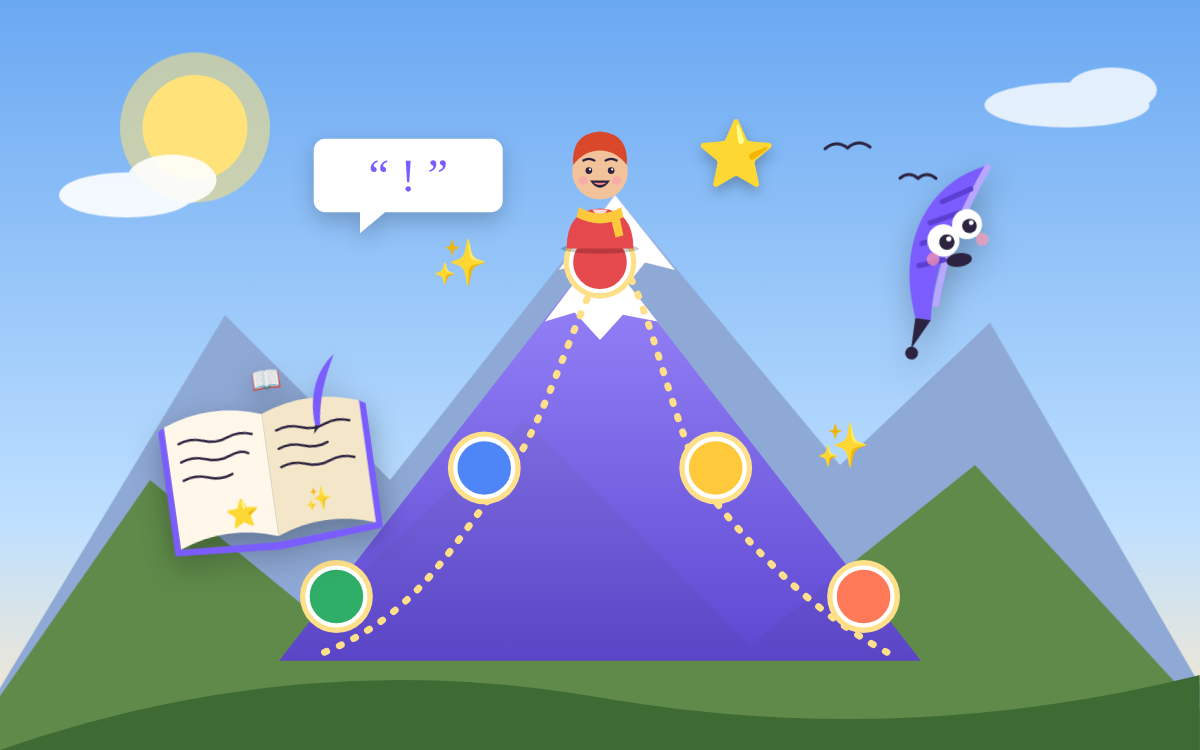
What you'll learn
- The five parts of a story mountain, from opening to ending
- How to describe a setting using the senses and expanded noun phrases
- How to show a character’s feelings through actions instead of telling
- How to plan a problem and a resolution that really solves it
- How to join ideas with conjunctions and use commas after fronted adverbials
- How to punctuate speech with inverted commas and choose a fitting speech verb
Chapter by chapter
- Learn from a story like yours: its parts, best words and sentences Free to try
Years 3–4 english · 1
- Describe a setting with your senses and carefully chosen words
Years 3–4 english · 2 Years 3–4 english · 3
- Create a character and show their feelings
Years 3–4 english · 2 Years 3–4 english · 3
- Plan a plot on a story mountain with a problem and a resolution
Years 3–4 english · 2 Years 3–4 english · 1
- Say sentences aloud first: joining ideas and punctuating speech
Years 3–4 english · 3
- Write your own story with a setting, a character and a plot
Years 3–4 english · 2 Years 3–4 english · 3 Years 3–4 english · 4
- Story Writer Challenge (10 questions)
See every English chapter in the chapter library
What the chapters cover in the national curriculum in England:
- Years 3–4 english: Plan their writing by: discussing writing similar to that which they are planning to write in order to understand and learn from its structure, vocabulary and grammar
- Years 3–4 english: Draft and write by: in narratives, creating settings, characters and plot
- Years 3–4 english: Draft and write by: composing and rehearsing sentences orally (including dialogue), progressively building a varied and rich vocabulary and an increasing range of sentence structures (English appendix 2)
- Years 3–4 english: Read their own writing aloud to a group or the whole class, using appropriate intonation and controlling the tone and volume so that the meaning is clear
About this adventure
How to Write a Story is an interactive game that teaches children aged 7–9 how to plan, say aloud and write their own story with a setting, characters and a plot. It follows the Years 3 and 4 national curriculum for writing in England.
Guided by Inky, a talking quill, children read a short model story and map it onto a story mountain: opening, build-up, problem, resolution and ending. They explore a setting with their senses, build expanded noun phrases such as “the crumbling tower with a rusty lock”, and create a character whose feelings they show through actions rather than naming them.
Children also say sentences out loud before writing, join ideas with conjunctions like because and when, and put inverted commas (speech marks) around spoken words. Finally they write a five-page story, choosing a suggested sentence or typing their own, and turn the pages of their finished book.
Questions and answers
How do you write a story, in simple words?
To write a story, you choose a character, a setting and a problem, then tell it in order: an opening, a build-up, the problem, a resolution that fixes it and an ending. Saying each sentence aloud before writing it helps it sound right.
What is a story mountain?
A story mountain is a plan that shows a story’s shape in five parts: opening, build-up, problem, resolution and ending. The problem sits at the top, where something goes wrong, and the story comes back down as the problem gets solved.
What does ‘show, don’t tell’ mean in writing?
‘Show, don’t tell’ means letting readers work out a feeling from what a character does or says, instead of naming it. For example, “Leo’s knees shook” shows that Leo is scared, while “Leo was scared” only tells the reader.
What age is this story writing game for?
The game is designed for children aged 7 to 9, in Years 3 and 4 of primary school in England. It follows the national curriculum for writing at that stage, so it also suits slightly older children who want a refresher.
What does the story writing game include and how long does it take?
The game has six chapters, an optional warm-up on story basics and a 10-question challenge, and takes about an hour to play in full. Each chapter can also be played on its own in a shorter session.
More to explore
See all
Cohesive Devices: Build Bridges Between Paragraphs
Learn how cohesive devices link paragraphs, from repeated words and adverbials to ellipsis, by building bridg…
Writing Paragraphs: Ride the Paragraph Express with Cleo
Learn how writing paragraphs works: group sentences by idea, spot when to start a new one, order them and lin…
Writing Sentences: All Aboard the Sentence Express
Learn the skills of writing sentences that are clear and correct by building word trains, fixing capitals and…
Improve Your Writing: A Story Workshop with Scribble
Learn how to improve your writing with wow words, varied sentence starts, vivid detail and careful checking,…
The Writing Process: Think Like a Writer with Quill
Learn the writing process step by step: gather ideas, think about your reader, plan the order, write correctl…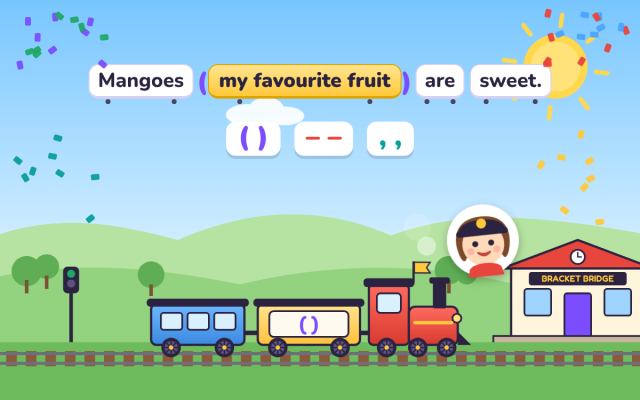
Parenthesis: Brackets, Dashes and Commas on a Word Train
Learn how to use parenthesis with brackets, dashes and commas, then add extra information to sentences by cou…
Letter Formation: Trace and Write with Squiggle the Snail
Learn letter formation: where each letter starts and which way to go. Trace, then write lower-case and capita…
 TapLearn