Cohesive Devices: Build Bridges Between Paragraphs
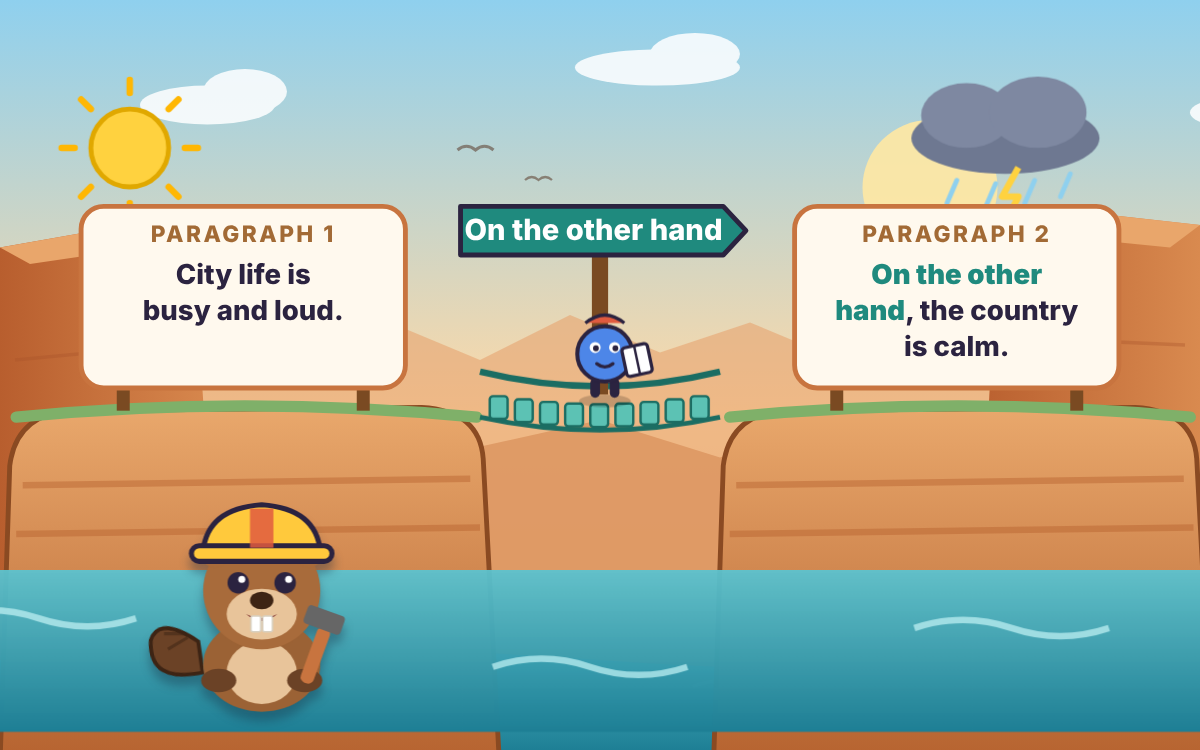
Learn how cohesive devices link paragraphs, from repeated words and adverbials to ellipsis, by building bridges across Cohesion Canyon.
- Ages 9–11
- About 40 min
- Some thinking
- Grammar & Punctuation
Learn how cohesive devices link paragraphs, from repeated words and adverbials to ellipsis, by building bridges across Cohesion Canyon.
Years 5–6 english · 1 Year 6 english · 2
Years 5–6 english · 1 Year 6 english · 2
Years 5–6 english · 1 Year 6 english · 2
Years 5–6 english · 1 Year 6 english · 2
Years 5–6 english · 1 Year 6 english · 2
Years 5–6 english · 1 Year 6 english · 2
See every English chapter in the chapter library
What the chapters cover in the national curriculum in England:
Cohesion Canyon is an interactive game that teaches children aged 9–11 the cohesive devices Year 6 writers use to link ideas across paragraphs: repetition, adverbials and ellipsis. Every paragraph is an island, and Bea the beaver helps the player build bridges between them so the reader can cross.
Children tap the words that link paragraphs and choose a clearer start when a pronoun such as "he" is confusing. They sort adverbials by meaning (contrast or consequence) and type their own. They also learn that ellipsis means leaving out words the reader can work out, as in "Others don't", and that it doesn't always need three dots.
An optional warm-up first revises the Year 5 ways of linking paragraphs, and a 10-question final challenge checks everything at the end. Every line is read aloud. After a wrong answer the game gives a hint, and after a second it shows the answer and explains it.
Cohesive devices are words and phrases that link the parts of a piece of writing so the ideas stick together. In Year 6, children link paragraphs by repeating a key word, using adverbials such as on the other hand, and using ellipsis.
Ellipsis means leaving out words that the reader can work out from earlier in the text. In "Mum likes tea, but Dad doesn't", the words "like tea" are left out. The three-dot punctuation mark is also called an ellipsis, but this kind of ellipsis needs no dots.
An adverbial at the start of a paragraph shows how it connects to the one before. On the other hand and in contrast signal a different side. As a consequence and as a result show that the new paragraph follows from the last.
The game is for children aged 9 to 11 and follows the Year 6 English curriculum in England. Year 5 children can play it too, starting with the optional warm-up on pronouns and time and place adverbials.
It has six chapters, an optional warm-up and a 10-question final challenge, and takes about 40 minutes to play through. Each chapter starts with a short animated scene and can be played on its own, in any order.
 TapLearn
Getting it ready…
Great work on chapter 1! To open the next chapters, ask a grown-up to take a look.
To play this game, ask a grown-up to take a look. There are lots of free games you can play right now too!
Create a free family account and your child can play every chapter of every game for 7 days, with no card needed. Their progress is kept. After that, the free plan is free for ever, and membership is £6.99 (about $9.35) a month if you'd like to keep every chapter.
That's all the learning time for today. Great work! Flip will be ready to play again tomorrow.