What you'll learn
- A paragraph is a group of sentences about one idea
- Each new paragraph starts on a new line, often with an indent
- Sort sentences on the same topic into one paragraph
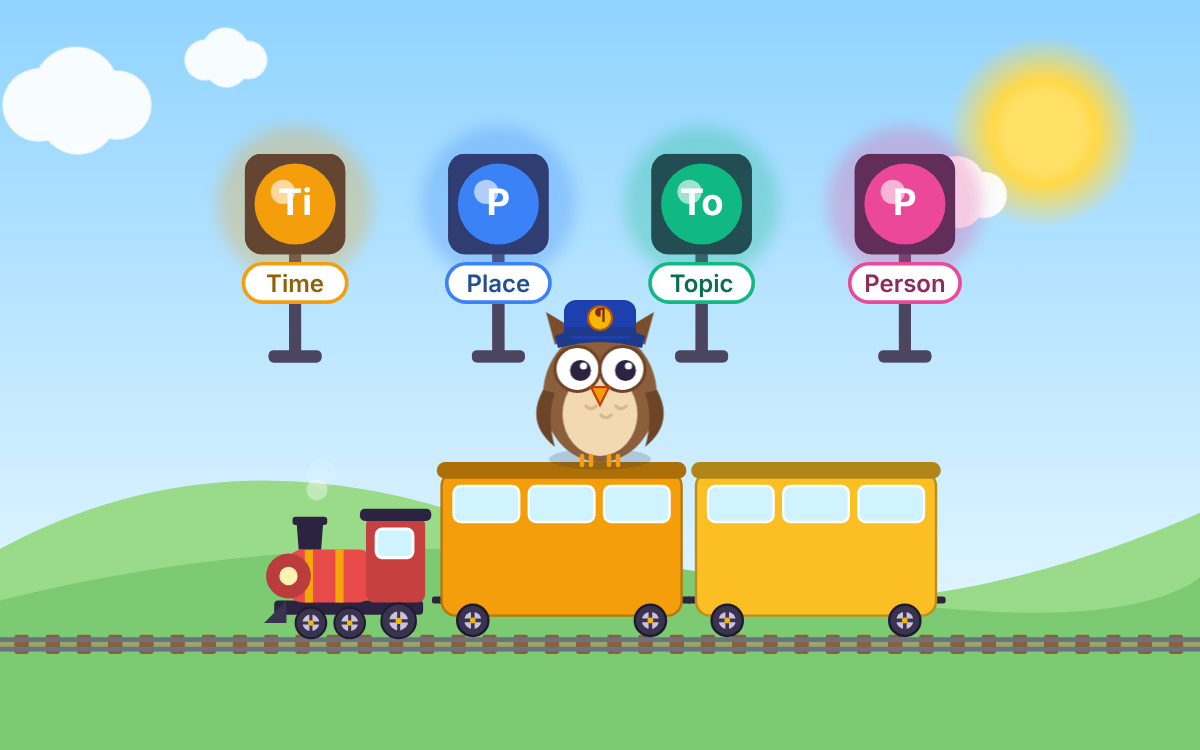
- Use TiPToP: new time, place, topic or person means new paragraph
- Order paragraphs with a beginning, middle and end using time clues
- Link paragraphs with words like first, next, after that and finally
What's inside
- Meet the Paragraph
- Sort the Sentences
- TiPToP Junction
- Line Them Up
- Link It Up
- Grand Terminus Challenge (10 questions)
About this adventure
Writing Paragraphs is an interactive game that teaches children aged 7–9 how to group sentences into paragraphs, put paragraphs in a sensible order and link them so a reader can follow. It is pitched at Year 3 English in the national curriculum.
Cleo the owl conductor guides players along a railway where every carriage is a paragraph. They split a wall of words into chunks, sort sentence luggage into carriages by topic, and use the TiPToP rule (a new Time, Place, Topic or Person) to decide when a new paragraph should begin.
Later stations ask players to line up a recount and an information report from beginning to end using time clues, then join paragraphs with linking words such as first, next, after that and finally. Every line is read aloud, and a 10-question challenge checks what they remember.
Questions and answers
What is a paragraph, in simple words?
A paragraph is a group of sentences that are all about one idea. Each new paragraph starts on a new line, often with a small gap called an indent, so the reader can see where one idea ends and the next begins.
How do children know when to start a new paragraph?
Children can use the TiPToP rule: start a new paragraph when the Time, Place, Topic or Person changes. In stories, a new speaker also gets a new line, which helps the reader follow who is talking.
What are linking words between paragraphs?
Linking words are words or phrases such as first, next, after that, finally, also and because of this. They show the reader how one paragraph connects to the next, so the writing reads in a clear order.
What age is this paragraph game for?
The game is designed for children aged 7 to 9, matching Year 3 English in England, when pupils are introduced to paragraphs. It also works as a quick refresher for Year 4 children or anyone who finds paragraphing tricky.
What does the Paragraph Express game include and how long does it take?
It includes a short sentence warm-up, five chapters with spoken guidance and hands-on sorting, ordering and linking tasks, and a 10-question final challenge. Playing everything takes about 45 minutes, and children can start from any chapter.
More to explore
See all
Writing Sentences: All Aboard the Sentence Express
Learn the skills of writing sentences that are clear and correct by building word trains, fixing capitals and…
Improve Your Writing: A Story Workshop with Scribble
Learn how to improve your writing with wow words, varied sentence starts, vivid detail and careful checking,…
The Writing Process: Think Like a Writer with Quill
Learn the writing process step by step: gather ideas, think about your reader, plan the order, write correctl…
Parenthesis: Brackets, Dashes and Commas on a Word Train
Learn how to use parenthesis with brackets, dashes and commas, then add extra information to sentences by cou…
Letter Formation: Trace and Write with Squiggle the Snail
Learn letter formation: where each letter starts and which way to go. Trace, then write lower-case and capita…
Year 1 Handwriting: Trace Letters and Digits with Poppy
Learn Year 1 handwriting: hold a pencil well, start each letter in the right place and form capitals and digi…
Joined Handwriting: Learn the Joins with Loopy the Pencil
Learn joined handwriting with diagonal and horizontal joins, which letters stay unjoined and how to write nea…
 TapLearn