Area and Perimeter for Year 5: Plan a Park with Gus the Goat
Learn to find the area and perimeter of rectangles, L-shapes and curvy shapes in cm, m, cm² and m² by planning fences, patios and a duck pond.
Online game, chapter 1 free · Year 5 (KS2) · ages 9–10 · national curriculum in England · no adverts · plays on a phone, tablet or computer · no sign-up to start.
An online maths game for Year 5 (KS2). It covers the national curriculum in England, Year 5 maths: “Measure and calculate the perimeter of composite rectilinear shapes in centimetres and metres”, and 1 more statement listed under the chapters.
5 short chapters, about 40 minutes in all. Children can stop after any chapter.
Start playing for free. Plays in the browser on phones, tablets and computers: no app, no adverts.
Free for teachers: every chapter on the whiteboard with a free teacher account.
Last updated · Checked against the national curriculum in England by the TapLearn team
What you'll learn
Find the perimeter of a rectangle with (length + width) × 2
Work out missing sides before finding a composite shape's perimeter
Calculate area with length × width in cm² and m²
Compare areas by calculating rather than trusting how shapes look
Split an L-shape into rectangles and add their areas
Estimate irregular areas by counting whole and half-or-more squares
Chapter by chapter
Perimeter of rectangles and squares in cm and mStart playing for free
Year 5 maths · 1
Perimeter of composite rectilinear shapes (L-shapes) in cm and m
Year 5 maths · 1
Area of rectangles and squares in cm² and m²
Year 5 maths · 2
Comparing and combining areas of rectangles and squares
Year 5 maths · 2
Estimating the area of irregular shapes
Year 5 maths · 2
Park Planner Challenge: area and perimeter (10 questions)
What the chapters cover in the national curriculum in England:
Year 5 maths: Measure and calculate the perimeter of composite rectilinear shapes in centimetres and metres
Year 5 maths: Calculate and compare the area of rectangles (including squares), including using standard units, square centimetres (cm²) and square metres (m²), and estimate the area of irregular shapes
About this adventure
Area and Perimeter: Plan a Park is an interactive maths game that teaches children aged 9–10 to calculate perimeter and area the Year 5 way. Perimeter is the distance all the way around a shape, and area is the flat space it covers, measured in square units.
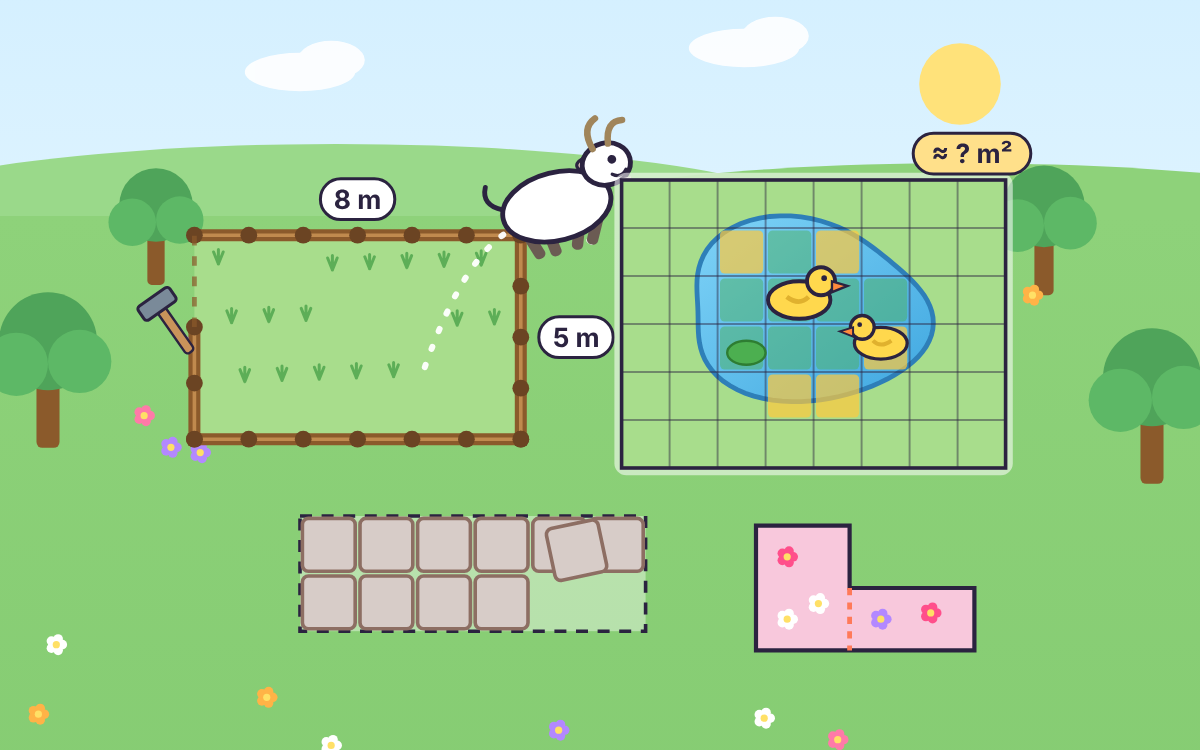
Players build a fence for Gus the goat, then use the shortcut (length + width) × 2. They work out missing sides on L-shaped gardens, lay rows of 1 m² slabs to discover that area = length × width, and drag a corner to make 12 cm² in two different ways.
Later they compare lawns that look misleading, split an L-shaped lawn into rectangles, and estimate the area of a pond on a grid by counting whole squares plus squares that are half or more covered. Spoken narration, hints that name the exact mistake and a 10-question challenge check understanding.
Questions and answers
What is the difference between area and perimeter?
Perimeter is the total distance around the edge of a shape, measured in units like cm or m. Area is the amount of flat space inside the shape, measured in square units like cm² or m².
How do you find the perimeter of an L-shape?
First work out any sides with no label, using the sides opposite them: the pieces on one side add up to the whole length on the other. Then add every outside edge, leaving out any lines inside the shape.
How do you estimate the area of an irregular shape?
Put the shape on a grid of squares and count the squares that are completely covered. Then add the squares that are half or more covered and leave out the ones that are less than half covered. The total is a close estimate.
What age is this area and perimeter game for?
It is made for children aged 9 to 10, matching Year 5 of the national curriculum in England. An optional warm-up recaps the Year 4 ideas of counting squares and edges, so children who need a refresher can start there.
What does the game include and how long does it take?
It has five chapters, an optional warm-up and a 10-question final challenge, taking about 40 minutes in total. Each chapter opens with a short animated introduction and can be played on its own, on a phone, tablet or computer.
We count visits to make TapLearn better.We use one cookie, only on this site, to see how families find and use it. No adverts, and nothing is shared.One cookie, only on this site. No adverts.How we measure

 TapLearn