Five senses poem worksheet for Year 2: Senses for ideas
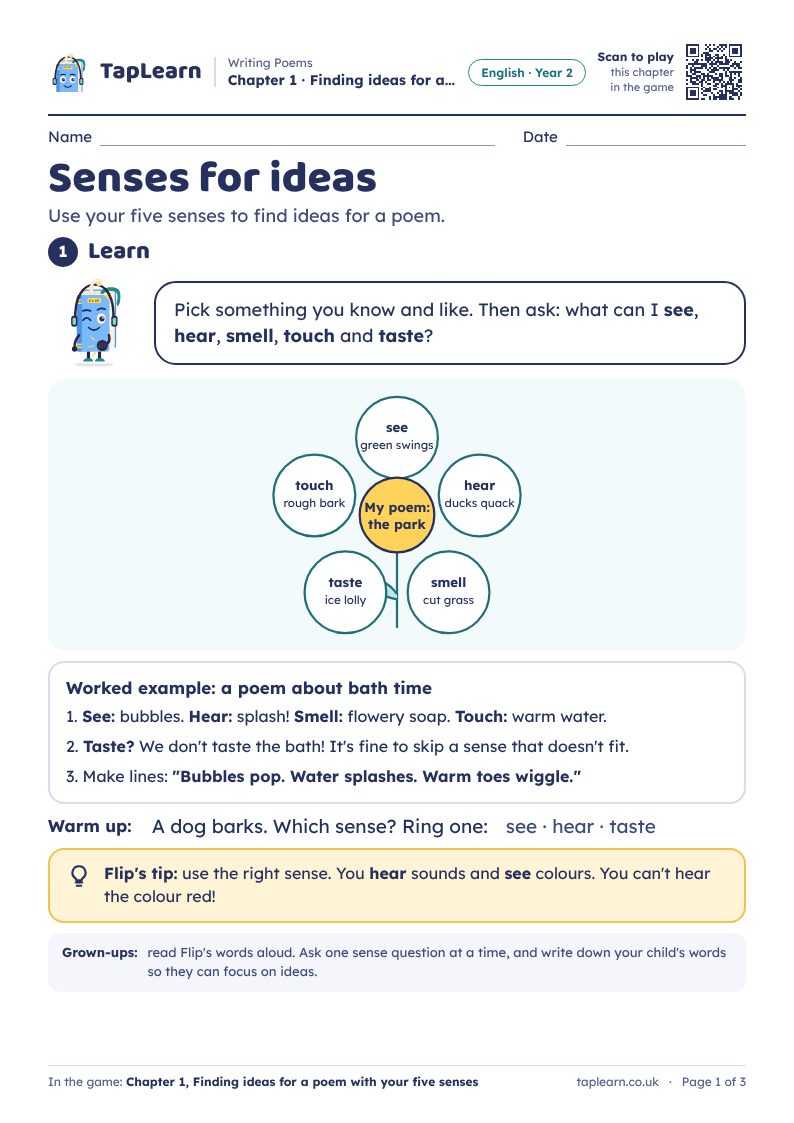
Senses for Ideas is a printable five senses poem worksheet for Year 2 (ages 6 to 7) that teaches children to pick something they know and like, then ask what they can see, hear, smell, touch and taste to find ideas. It covers the Year 2 statement on developing positive attitudes towards and stamina for writing by writing poetry.
Free to print, no account needed.
Print it on A4, in colour or black and white. Do it after the chapter, or before it to see what your child already knows.
What's on the worksheet
Your child finds ideas for a poem by asking what they can see, hear, smell, touch and taste, and keeps every idea on topic. Includes a senses hunt round the home and an answers sheet.
- Page 1 · Learn
- A senses flower for a poem about the park, a worked example finding bath time ideas, Flip's tip to use the right sense, and a which-sense warm-up.
- Page 2 · Try it together
- Senses hunt: stand still in one room or the garden, close your eyes to listen and smell, then look, touch something and taste a snack, and write an idea for each sense.
- Page 3 · Practise
- Match senses to body parts, ring which sense each thing uses, ring ideas that belong in a beach poem, make your own senses flower, and a challenge about hearing a colour.
- Answers sheet
- Every answer, mix-ups like ideas that wander off the topic, and senses-walk and guess-my-place ideas.
3 A4 pages and an answers sheet · about 20 minutes
Using it at home
- Ask one sense question at a time, and write down your child's words so they can focus on ideas.
- In the senses hunt, it's fine to write the words for your child. Read the ideas back together as a poem.
- Give three sense clues, like "I hear waves, I smell salt, I touch sand", for the other person to guess the place.
Watch out for
- Mixing up the senses, like "I can hear the blue sky".
- Point to the body part: "Do we use our ears or our eyes for that?"
- Ideas that wander off the topic.
- Ask "Would you find that at the beach?"
- Getting stuck for ideas.
- Close your eyes together and just listen: sounds are often the easiest place to start.
Questions from the worksheet
- Which sense? Ring one: a bell ringing, a red balloon, a sour lemon, a soft blanket.
- Ideas for a poem called "The Beach". Ring the ideas that belong: waves, a snowman, shells, my school bus, seagulls, sandcastles.
- Make your own senses flower. Pick a place you like. Write or draw one idea for each sense.
- Leo says, "I can hear the colour red." Is he right? Which sense do we use for colours?
The answers are on the answers sheet, for grown-ups.
National curriculum in England
This worksheet practises this statement from the Year 2 english programme of study:
- Develop positive attitudes towards and stamina for writing by: writing poetry
In the classroom
- Make a class senses flower for a shared place, like the playground.
- Play guess my place as a starter, giving three sense clues.
Questions and answers
How can children find ideas for a poem?
Pick something they know and like, then ask what they can see, hear, smell, touch and taste. Each answer is an idea for a line.
What are the five senses?
The five senses are sight, hearing, smell, touch and taste.
Does a poem need all five senses?
No. It's fine to skip a sense that doesn't fit, like taste in a poem about bath time.
More worksheets from Writing Poems: Grow Your Own Poems in the Poem Garden
- Chapter 2: Describing words and onomatopoeia worksheet: Picture words Members
- Chapter 3: List poems worksheet Members
- Chapter 4: Rhyming words worksheet: Rhymes that make sense Members
- Chapter 5: Acrostic poems worksheet Members
- Chapter 6: Reading poems aloud worksheet: Read it aloud Members
- Chapter 7: Writing a poem worksheet: My poem studio Members
 TapLearn