Writing a poem worksheet for Year 2: My poem studio
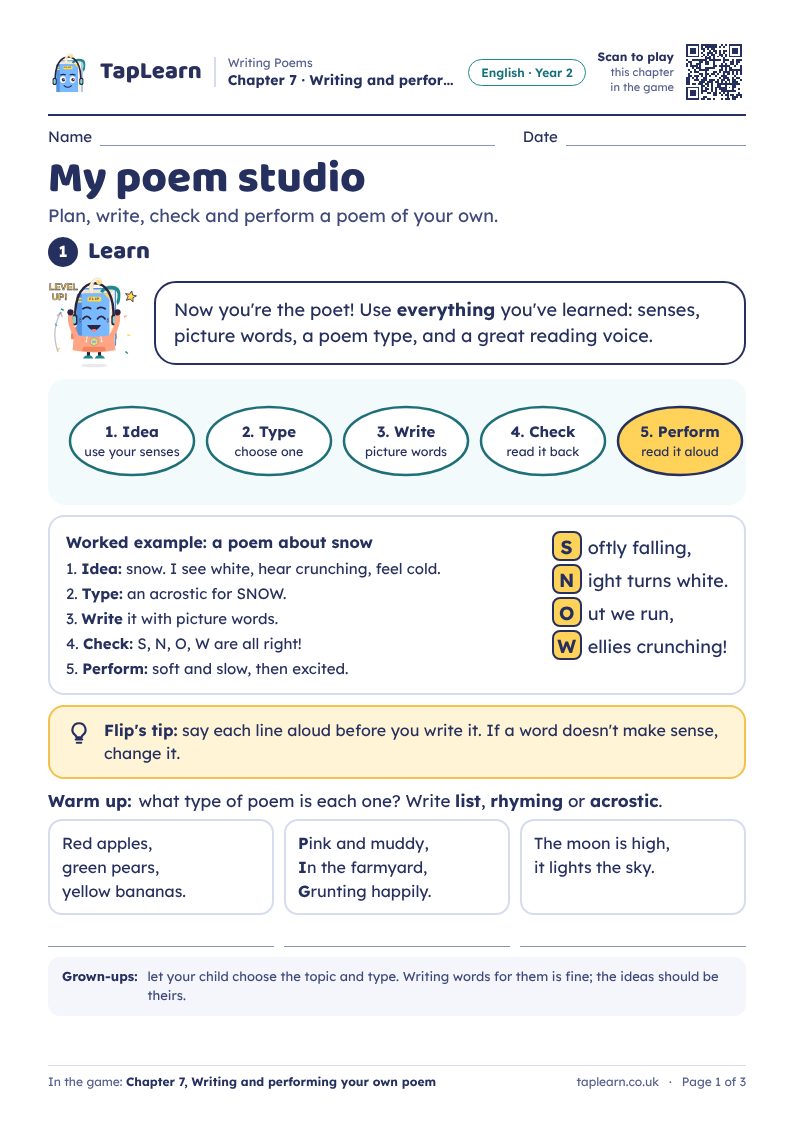
My Poem Studio is a printable writing a poem worksheet for Year 2 (ages 6 to 7) that teaches children to plan with their senses, choose a list, rhyming or acrostic poem, write with picture words, check it and perform it. It covers the Year 2 statements on writing poetry and reading aloud with appropriate intonation to make the meaning clear.
This worksheet is for members
Membership opens every chapter of every game and every worksheet, for all your children.
See the plansAlready a member? Log in to print it.
Start with the free one: Senses for ideas (chapter 1).
Print it on A4, in colour or black and white. Do it after the chapter, or before it to see what your child already knows.
What's on the worksheet
Your child plans, writes, checks and performs their own poem, choosing an idea, a poem type and picture words, then reading it aloud with expression. Includes a plan-my-poem activity and an answers sheet.
- Page 1 · Learn
- Five steps from idea to performance, a worked example writing an acrostic about snow, Flip's tip to say each line aloud first, and a name-the-poem-type warm-up.
- Page 2 · Try it together
- Plan my poem: choose something you know and like, look at it or touch it if you can, fill in your senses, then choose a poem type and three picture words.
- Page 3 · Practise
- Make a plain line better, write your poem from your plan, tick a checklist for your poem and your performance, and a challenge about a forced rhyme.
- Answers sheet
- Every answer, mix-ups like rushed reading, and poem-of-the-week and pocket-poem ideas.
3 A4 pages and an answers sheet · about 25 minutes
Using it at home
- Let your child choose the topic and type. Writing words for them is fine; the ideas should be theirs.
- If your child thinks the poem has to rhyme, remind them a list poem or an acrostic is a great choice too.
- Ask your child to perform their poem at a family meal, and everyone says one thing they liked.
Watch out for
- Using plain words like nice, big and went.
- Ask "What kind? How did it move?"
- Forced rhymes and wrong first letters.
- Read each line aloud, and point at each acrostic letter.
- Rushed or flat reading.
- Pause at full stops, and choose a voice that matches each line.
Questions from the worksheet
- Make this plain line better. Swap the plain words for picture words: The nice dog went in the big park.
- Write your poem from your plan. Say each line aloud first.
- Check your poem: every line is about my idea, I used picture words, it makes sense, rhymes or first letters are right.
- Mia's poem goes: "The cat sat on the mat. / It wore a big pink hat." But her cat was asleep! Does the second line make sense? What could she write instead?
The answers are on the answers sheet, for grown-ups.
National curriculum in England
This worksheet practises these statements from the Year 2 english programme of study:
- Develop positive attitudes towards and stamina for writing by: writing poetry
- Read aloud what they have written with appropriate intonation to make the meaning clear
In the classroom
- Run a class poetry studio where pupils plan, write and perform poems in small groups.
- Use the warm-up to recap list, rhyming and acrostic poems before writing.
Questions and answers
How do Year 2 children write a poem?
Find an idea with the senses, choose a poem type (list, rhyming or acrostic), write it with picture words, check it, then read it aloud.
Which type of poem is easiest for Year 2?
List poems and acrostics are a good start because they don't need to rhyme.
Why say each line aloud before writing?
Saying it aloud helps children hear whether a line makes sense before they write it down.
More worksheets from Writing Poems: Grow Your Own Poems in the Poem Garden
- Chapter 1: Five senses poem worksheet: Senses for ideas Free
- Chapter 2: Describing words and onomatopoeia worksheet: Picture words Members
- Chapter 3: List poems worksheet Members
- Chapter 4: Rhyming words worksheet: Rhymes that make sense Members
- Chapter 5: Acrostic poems worksheet Members
- Chapter 6: Reading poems aloud worksheet: Read it aloud Members
 TapLearn