Acrostic poems worksheet for Year 2
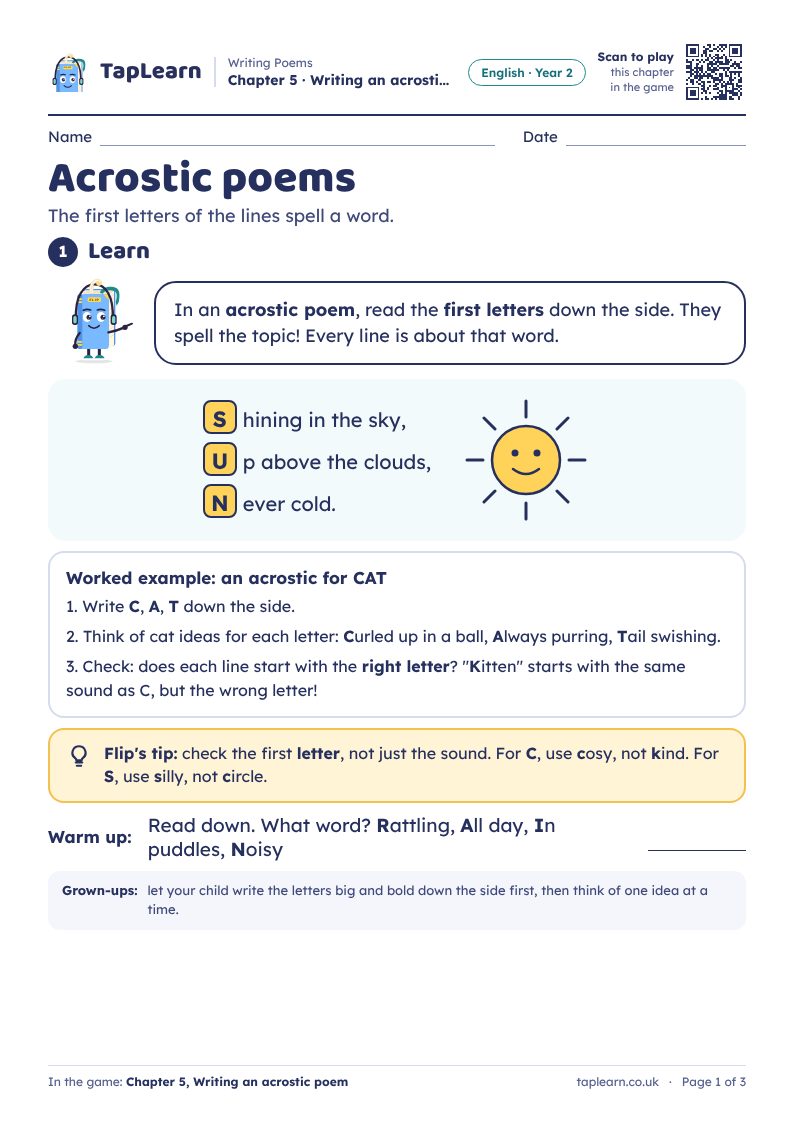
Acrostic Poems is a printable acrostic poems worksheet for Year 2 (ages 6 to 7) that teaches children that the first letters of an acrostic spell the topic, and to check each line starts with the right letter, like cosy not kind for C. It covers the Year 2 statement on developing positive attitudes towards and stamina for writing by writing poetry.
This worksheet is for members
Membership opens every chapter of every game and every worksheet, for all your children.
See the plansAlready a member? Log in to print it.
Start with the free one: Senses for ideas (chapter 1).
Print it on A4, in colour or black and white. Do it after the chapter, or before it to see what your child already knows.
What's on the worksheet
Your child writes acrostic poems where the first letters spell a word, checking each line starts with the right letter, not just the right sound. Includes a name acrostic to write together and an answers sheet.
- Page 1 · Learn
- An acrostic for SUN, a worked example writing an acrostic for CAT, Flip's tip to check the first letter and not just the sound, and a read-down warm-up.
- Page 2 · Try it together
- My name acrostic: write the letters of your first name down the side, talk about what you like and are good at, and write a line about yourself for each letter.
- Page 3 · Practise
- Ring the line that starts with the right letter, spot the wrong line in an acrostic for BEE, write an acrostic for DOG, and a challenge about Kind for CAKE.
- Answers sheet
- Every answer, mix-ups like a letter that only sounds right, and spoken and family acrostic ideas.
3 A4 pages and an answers sheet · about 20 minutes
Using it at home
- Let your child write the letters big and bold down the side first, then think of one idea at a time.
- For a longer name, carry on on the back of the sheet.
- Make a spoken acrostic for a pet's or a grandparent's name.
Watch out for
- Using a letter that only sounds right, like K for C.
- Ask your child to point at the first letter and say its name.
- Lines that aren't about the topic.
- Each line should tell us something about the word.
- Forcing a rhyme.
- Acrostics don't need to rhyme.
Questions from the worksheet
- Ring the line that starts with the right letter. For C in CAT: Cuddly and soft or Kind and soft? For S in SUN: Circle of gold or Sparkling and gold?
- Spot the mistake. This acrostic should spell BEE: Buzzing round the flowers, Every day so busy, Always making honey. Which line is wrong?
- Write an acrostic poem for DOG.
- Leo's acrostic for CAKE starts: "Kind of yummy...". He says K sounds like C, so it's fine. Is he right?
The answers are on the answers sheet, for grown-ups.
National curriculum in England
This worksheet practises this statement from the Year 2 english programme of study:
- Develop positive attitudes towards and stamina for writing by: writing poetry
In the classroom
- Write a class acrostic for a topic word, with pupils suggesting a line for each letter.
- Try spoken acrostics for short words like SUN or BUS as a starter.
Questions and answers
What is an acrostic poem?
An acrostic poem is a poem where the first letters of each line, read downwards, spell a word. Every line is about that word.
Does an acrostic poem need to rhyme?
No. Acrostic poems don't need to rhyme.
What is a common mistake in acrostic poems?
Starting a line with a letter that only sounds right, like Kind for C. The first letter must be the right letter.
More worksheets from Writing Poems: Grow Your Own Poems in the Poem Garden
- Chapter 1: Five senses poem worksheet: Senses for ideas Free
- Chapter 2: Describing words and onomatopoeia worksheet: Picture words Members
- Chapter 3: List poems worksheet Members
- Chapter 4: Rhyming words worksheet: Rhymes that make sense Members
- Chapter 6: Reading poems aloud worksheet: Read it aloud Members
- Chapter 7: Writing a poem worksheet: My poem studio Members
 TapLearn