Describing words and onomatopoeia worksheet for Year 2: Picture words
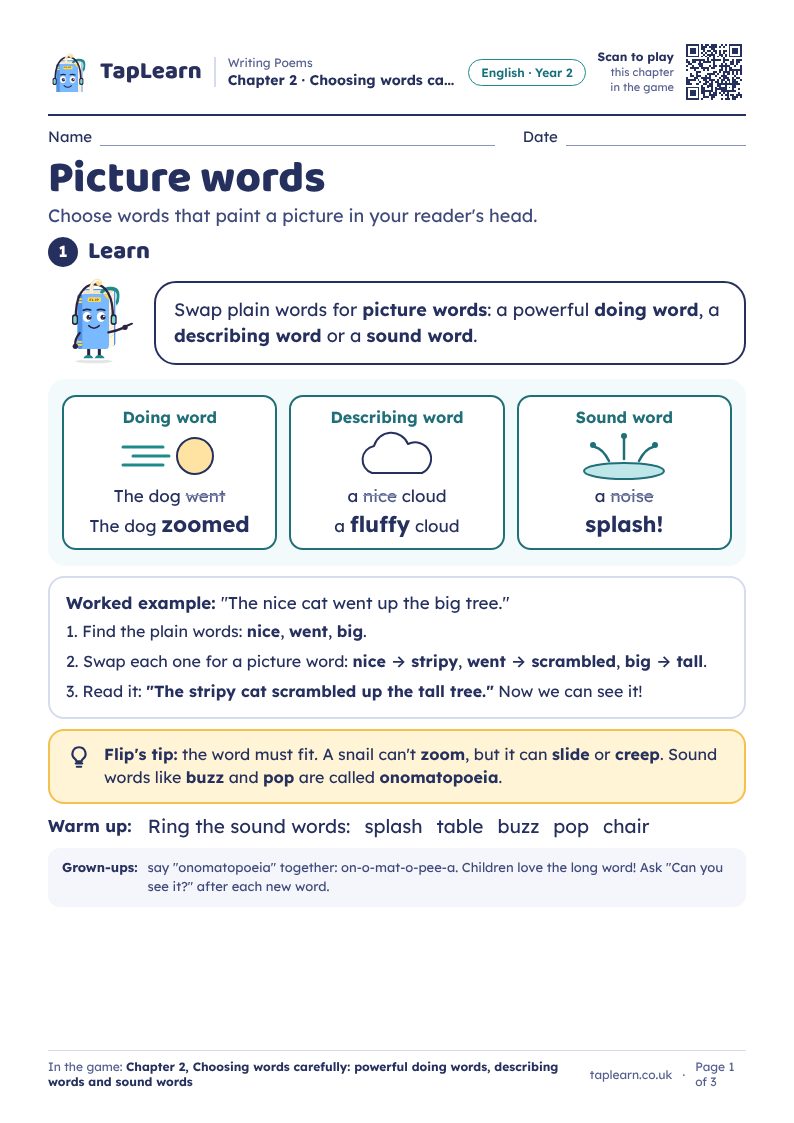
Picture Words is a printable describing words and onomatopoeia worksheet for Year 2 (ages 6 to 7) that teaches children to swap plain words like nice, big and went for picture words, and to use sound words like splash and buzz. It covers the Year 2 statement on developing positive attitudes towards and stamina for writing by writing poetry.
This worksheet is for members
Membership opens every chapter of every game and every worksheet, for all your children.
See the plansAlready a member? Log in to print it.
Start with the free one: Senses for ideas (chapter 1).
Print it on A4, in colour or black and white. Do it after the chapter, or before it to see what your child already knows.
What's on the worksheet
Your child swaps plain words for powerful doing words, describing words and sound words (onomatopoeia) that fit the line. Includes a kitchen sound band and an answers sheet.
- Page 1 · Learn
- Plain words and picture words compared, a worked example improving "The nice cat went up the big tree", Flip's tip that the word must fit, and a ring-the-sound-words warm-up.
- Page 2 · Try it together
- Kitchen sound band: tap a tub, shake rice and scrunch paper, invent a sound word for each noise, choose a doing word for what you did, and put one in a line.
- Page 3 · Practise
- Ring the picture word that fits, match pictures to sound words, tick whether a word fits, fill gaps with a describing word, doing word and sound word, and a challenge.
- Answers sheet
- Every answer, mix-ups like exciting words that don't fit, and better-word and sound-spotting ideas.
3 A4 pages and an answers sheet · about 20 minutes
Using it at home
- Say "onomatopoeia" together: on-o-mat-o-pee-a. Children love the long word!
- Ask "Can you see it?" after each new word your child chooses.
- At bath time or on a walk, name the sounds you hear with sound words.
Watch out for
- Using plain words like nice, big, went or good.
- Ask "What kind? How did it move?"
- Choosing exciting words that don't fit, like a fluffy rock.
- Ask "Can you picture that? Does it make sense?"
Questions from the worksheet
- Ring the picture word that fits: The frog (went / leapt) into the pond. I ate a (nice / crunchy) apple.
- Does the word fit? Tick or cross: The snail raced across the leaf. The lion roared. I sat on a fluffy rock.
- Fill the gaps with picture words: The ___ dog ___ across the park. ___!
- Mia wrote, "The tortoise zoomed." She says zoomed is an exciting word. Is it a good choice? Why?
The answers are on the answers sheet, for grown-ups.
National curriculum in England
This worksheet practises this statement from the Year 2 english programme of study:
- Develop positive attitudes towards and stamina for writing by: writing poetry
In the classroom
- Make a class sound word wall with words like splash, buzz, pop and tick-tock.
- Play better word as a starter: say "The car went" and pupils swap in stronger doing words.
Questions and answers
What is onomatopoeia?
Onomatopoeia is a word that sounds like the noise it describes, like splash, buzz or pop.
What are picture words in a poem?
Picture words help the reader see what is happening: a powerful doing word (zoomed), a describing word (fluffy) or a sound word (splash).
Is an exciting word always a good choice?
Only if it fits. A tortoise can't zoom, but it can plod or creep.
More worksheets from Writing Poems: Grow Your Own Poems in the Poem Garden
- Chapter 1: Five senses poem worksheet: Senses for ideas Free
- Chapter 3: List poems worksheet Members
- Chapter 4: Rhyming words worksheet: Rhymes that make sense Members
- Chapter 5: Acrostic poems worksheet Members
- Chapter 6: Reading poems aloud worksheet: Read it aloud Members
- Chapter 7: Writing a poem worksheet: My poem studio Members
 TapLearn