Rhyming words worksheet for Year 2: Rhymes that make sense
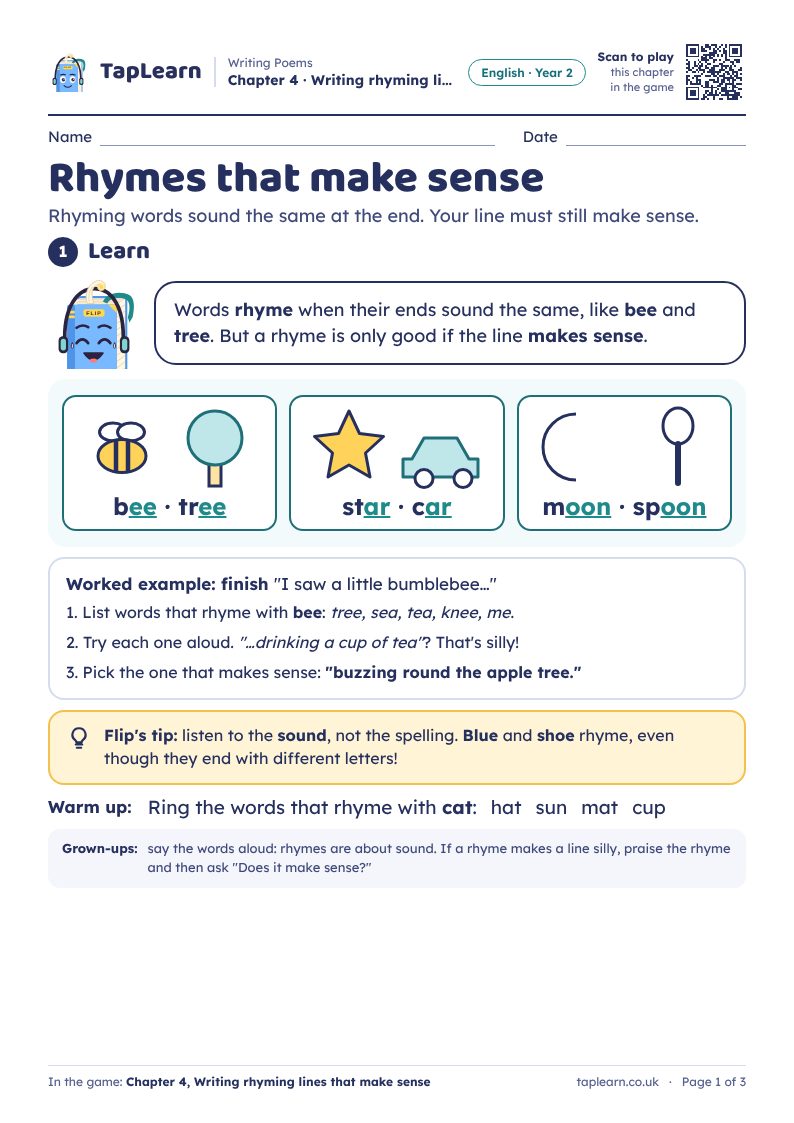
Rhymes That Make Sense is a printable rhyming words worksheet for Year 2 (ages 6 to 7) that teaches children that words rhyme when their ends sound the same, and to pick the rhyme that makes sense, not a silly one. It covers the Year 2 statement on developing positive attitudes towards and stamina for writing by writing poetry.
This worksheet is for members
Membership opens every chapter of every game and every worksheet, for all your children.
See the plansAlready a member? Log in to print it.
Start with the free one: Senses for ideas (chapter 1).
Print it on A4, in colour or black and white. Do it after the chapter, or before it to see what your child already knows.
What's on the worksheet
Your child hears and matches rhyming words, then chooses and writes rhyming lines that still make sense. Includes a rhyme hunt round the home and an answers sheet.
- Page 1 · Learn
- Rhyming pairs like bee and tree, a worked example finishing "I saw a little bumblebee", Flip's tip to listen to the sound not the spelling, and a rhymes-with-cat warm-up.
- Page 2 · Try it together
- Rhyme hunt at home: walk round a room naming things, think of a word that rhymes with each, then make two lines that rhyme and make sense.
- Page 3 · Practise
- Join rhyming words, tick the rhyming line that makes sense, finish a rhyme about the sun, and a challenge about whether a poem must always rhyme.
- Answers sheet
- Every answer, mix-ups like looking at spelling instead of sound, and rhyme-tennis and finish-my-line ideas.
3 A4 pages and an answers sheet · about 20 minutes
Using it at home
- Say the words aloud: rhymes are about sound. If a rhyme makes a line silly, praise the rhyme, then ask "Does it make sense?"
- In the rhyme hunt, try pairs like sock and clock, or bed and red.
- Play rhyme tennis: say a word and take turns batting back a rhyme until you run out.
Watch out for
- Thinking every poem has to rhyme.
- Remind your child of the list poem from Chapter 3.
- Choosing a rhyme that doesn't make sense, like puddles wearing a crown.
- Say the line aloud and ask "Could that really happen?"
- Looking at spelling instead of sound.
- Blue and shoe rhyme; bead and bread look alike but don't rhyme.
Questions from the worksheet
- Draw a line to join the rhyming words: cake, frog, red and log, bed, snake.
- Tick the line that rhymes and makes sense: The rain came down upon the town, / it made the puddles big and brown. / it made the puddles wear a crown.
- Finish the rhyme. Use a word that rhymes with sun and makes sense: I like to play out in the sun, / we...
- Ava says, "A poem must always rhyme." Is she right? How do you know?
The answers are on the answers sheet, for grown-ups.
National curriculum in England
This worksheet practises this statement from the Year 2 english programme of study:
- Develop positive attitudes towards and stamina for writing by: writing poetry
In the classroom
- Play finish my line as a starter, with pupils finishing lines with a rhyme that makes sense.
- Use Practise B for a class vote on which line makes sense and why.
Questions and answers
What are rhyming words?
Rhyming words have endings that sound the same, like bee and tree, or star and car.
Do rhyming words have to be spelt the same?
No. Rhyme is about sound. Blue and shoe rhyme even though they end with different letters.
What makes a good rhyme in a poem?
A good rhyme sounds the same at the end and still makes sense in the line.
More worksheets from Writing Poems: Grow Your Own Poems in the Poem Garden
- Chapter 1: Five senses poem worksheet: Senses for ideas Free
- Chapter 2: Describing words and onomatopoeia worksheet: Picture words Members
- Chapter 3: List poems worksheet Members
- Chapter 5: Acrostic poems worksheet Members
- Chapter 6: Reading poems aloud worksheet: Read it aloud Members
- Chapter 7: Writing a poem worksheet: My poem studio Members
 TapLearn