List poems worksheet for Year 2
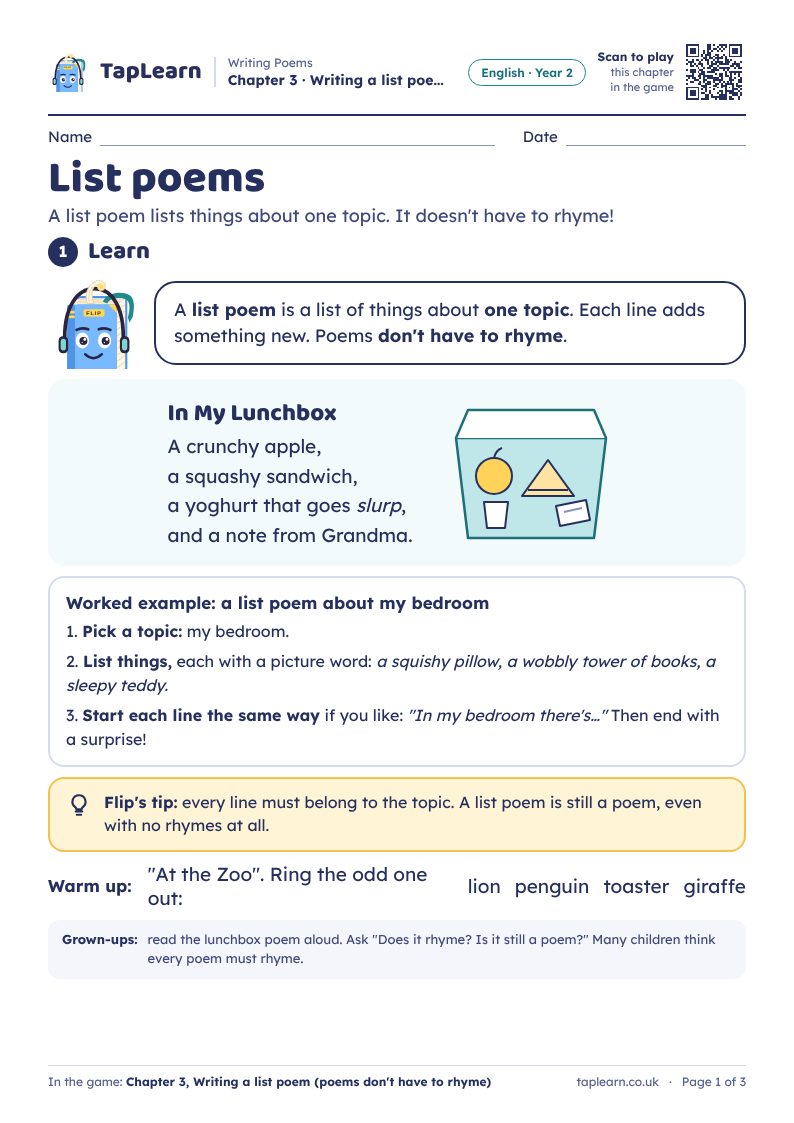
List Poems is a printable list poems worksheet for Year 2 (ages 6 to 7) that teaches children that a list poem lists things about one topic, each line adding something new, and that a poem doesn't have to rhyme. It covers the Year 2 statement on developing positive attitudes towards and stamina for writing by writing poetry.
This worksheet is for members
Membership opens every chapter of every game and every worksheet, for all your children.
See the plansAlready a member? Log in to print it.
Start with the free one: Senses for ideas (chapter 1).
Print it on A4, in colour or black and white. Do it after the chapter, or before it to see what your child already knows.
What's on the worksheet
Your child writes a list poem about one topic, with a repeating start and picture words, and learns that poems don't have to rhyme. Includes a treasure tray poem to write together and an answers sheet.
- Page 1 · Learn
- A list poem, In My Lunchbox, a worked example planning a poem about a bedroom, Flip's tip that every line must belong to the topic, and an odd-one-out warm-up.
- Page 2 · Try it together
- Treasure tray poem: collect small, safe things from one room on a tray, find a picture word for each, and write one line for each thing with the same start.
- Page 3 · Practise
- True or false about poems, add picture words to a seaside list poem, write your own list poem about a garden, kitchen or toy box, and a challenge about rhyme.
- Answers sheet
- Every answer, mix-ups like forcing a rhyme, and spoken-list-poem and shopping-poem ideas.
3 A4 pages and an answers sheet · about 20 minutes
Using it at home
- Read the lunchbox poem aloud and ask "Does it rhyme? Is it still a poem?" Many children think every poem must rhyme.
- In the treasure tray poem, let your child pick up each thing and look, touch and listen before choosing a word.
- Turn the shopping list into a list poem with picture words.
Watch out for
- Thinking every poem has to rhyme.
- Read a list poem together and ask "Does it rhyme? Is it still a poem?"
- Lines that wander off the topic.
- Ask "Is that in your bedroom (or garden, or kitchen)?"
- Forcing a rhyme.
- If your child adds a silly word just to rhyme, remind them a list poem doesn't need one.
Questions from the worksheet
- True or false? A poem must rhyme. A list poem is all about one topic. "In My Lunchbox" is a poem.
- Add a picture word to each line of this list poem: At the Seaside: a ___ shell, a ___ seagull, a ___ sandcastle.
- Write your own list poem. Choose a topic: my garden, the kitchen or my toy box.
- Sam says, "My list poem isn't finished, because nothing rhymes." Is he right?
The answers are on the answers sheet, for grown-ups.
National curriculum in England
This worksheet practises this statement from the Year 2 english programme of study:
- Develop positive attitudes towards and stamina for writing by: writing poetry
In the classroom
- Write a class list poem, with each pupil adding a line about the same topic.
- Make a spoken list poem: "On our way to school we see..."
Questions and answers
What is a list poem?
A list poem is a list of things about one topic. Each line adds something new, and lines often start the same way.
Does a poem have to rhyme?
No. A poem doesn't have to rhyme. A list poem is a poem because of its topic, its lines and its picture words.
How do you write a list poem?
Pick a topic, list things about it with a picture word for each, start each line the same way if you like, and end with a surprise.
More worksheets from Writing Poems: Grow Your Own Poems in the Poem Garden
- Chapter 1: Five senses poem worksheet: Senses for ideas Free
- Chapter 2: Describing words and onomatopoeia worksheet: Picture words Members
- Chapter 4: Rhyming words worksheet: Rhymes that make sense Members
- Chapter 5: Acrostic poems worksheet Members
- Chapter 6: Reading poems aloud worksheet: Read it aloud Members
- Chapter 7: Writing a poem worksheet: My poem studio Members
 TapLearn