Reading poems aloud worksheet for Year 2: Read it aloud
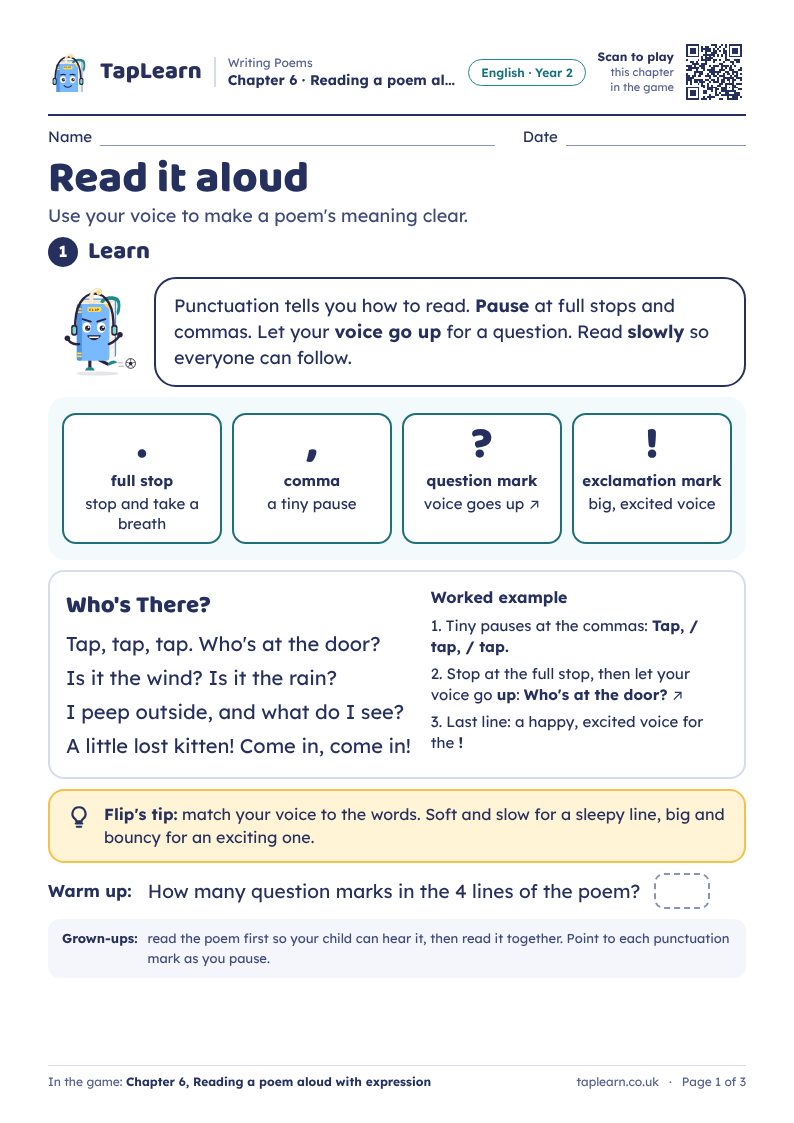
Read It Aloud is a printable reading poems aloud worksheet for Year 2 (ages 6 to 7) that teaches children to pause at full stops and commas, let their voice go up for a question and match their voice to the words. It covers the Year 2 statement on reading aloud what they have written with appropriate intonation to make the meaning clear.
This worksheet is for members
Membership opens every chapter of every game and every worksheet, for all your children.
See the plansAlready a member? Log in to print it.
Start with the free one: Senses for ideas (chapter 1).
Print it on A4, in colour or black and white. Do it after the chapter, or before it to see what your child already knows.
What's on the worksheet
Your child reads a poem aloud with expression: pausing at full stops and commas, letting their voice go up for questions and matching their voice to the words. Includes a family poem show and an answers sheet.
- Page 1 · Learn
- What each punctuation mark tells you to do, a worked example reading a poem called Who's There?, Flip's tip to match your voice to the words, and a count-the-question-marks warm-up.
- Page 2 · Try it together
- Family poem show: read a poem together with a finger on each mark, choose a voice for each line, then perform it for family or toys, who colour a star for each thing you did.
- Page 3 · Practise
- Match marks to what you do, ring how to read each line, mark pauses and question arrows on a teddy poem, and a challenge about reading too fast.
- Answers sheet
- Every answer, mix-ups like a flat voice, and same-words-new-voice and bedtime-reader ideas.
3 A4 pages and an answers sheet · about 20 minutes
Using it at home
- Read the poem first so your child can hear it, then read it together, pointing to each punctuation mark as you pause.
- After the show, name one line where your child's voice really matched the meaning.
- Say "Is it time for bed?" in a happy, a sleepy, then a surprised voice.
Watch out for
- Rushing past punctuation.
- Point at each full stop and comma together, and pause there.
- Reading in a flat voice.
- Ask "How does this line feel? Happy? Scary?" and try it that way.
- Reading too fast.
- Try reading as if to a younger child or a grandparent.
Questions from the worksheet
- Draw a line from each mark to what you do: question mark, comma, full stop.
- How should you read each line? "Shh, the baby is asleep." (shouting / whispering). "Hooray, it's my birthday!" (excited / sad).
- Read this poem. Draw a / at every full stop and comma, and an arrow after each question: The moon is out. The stars are bright. Where is my teddy? Where is my light?
- Sam read the whole poem very fast, without stopping. What would help him?
The answers are on the answers sheet, for grown-ups.
National curriculum in England
This worksheet practises this statement from the Year 2 english programme of study:
- Read aloud what they have written with appropriate intonation to make the meaning clear
In the classroom
- Read a class poem chorally, pausing together at each punctuation mark.
- Hold a poem show with star checklists for the audience.
Questions and answers
How do you read a poem with expression?
Pause at full stops and commas, let your voice go up for questions, and match your voice to the words, soft for sleepy lines and bouncy for exciting ones.
What does a comma tell you when reading aloud?
A comma tells you to make a tiny pause. A full stop means stop and take a breath.
Why should children read poems slowly?
Reading slowly and clearly helps listeners follow the words and the meaning.
More worksheets from Writing Poems: Grow Your Own Poems in the Poem Garden
- Chapter 1: Five senses poem worksheet: Senses for ideas Free
- Chapter 2: Describing words and onomatopoeia worksheet: Picture words Members
- Chapter 3: List poems worksheet Members
- Chapter 4: Rhyming words worksheet: Rhymes that make sense Members
- Chapter 5: Acrostic poems worksheet Members
- Chapter 7: Writing a poem worksheet: My poem studio Members
 TapLearn